Taming the storm of cloud complexity
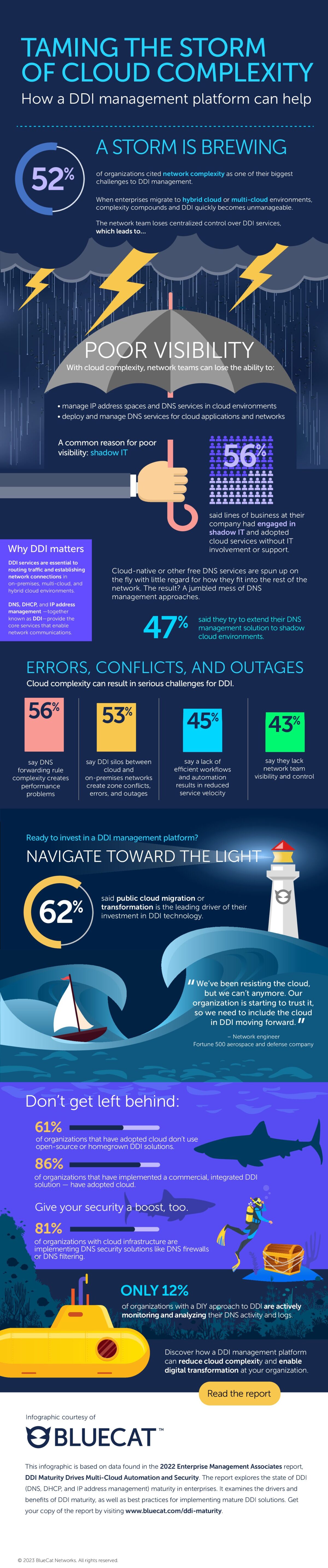
Our illuminating infographic shows how an integrated DDI platform can tame network complexity, including poor visibility, zone conflicts, and outages.



A DDI management platform can help network admins tame the storm of cloud complexity. Learn how in our infographic below.
 Key takeawaysKey takeaways are generated with AI assistance. Because automated summaries can occasionally contain errors or miss important context, always refer to the full blog post for complete information.
The article explains how a DDI (DNS, DHCP, IPAM) management platform helps network administrators manage increasing cloud complexity by centralizing and automating IP address and name services. It frames the real-world problem of sprawling hybrid and multi-cloud environments that create operational friction, visibility gaps, and configuration drift across services and teams. Key technical outcomes include streamlined provisioning, consistent policy enforcement, improved visibility across on-premises and cloud resources, and reduced risk and manual toil for network operations teams.
What problem does a DDI management platform solve for network administrators in cloud environments?
A DDI management platform addresses the operational challenge of managing DNS, DHCP, and IP address assignments across increasingly complex hybrid and multi-cloud environments. It reduces manual configuration tasks and the risk of errors that arise when resources are provisioned across different infrastructure domains. By centralizing control and automating routine operations, it improves visibility, enforces consistent policies, and lowers the administrative burden on network teams.
How does centralizing DNS, DHCP, and IPAM improve operational outcomes?
Centralizing DNS, DHCP, and IPAM provides a single source of truth for network identity and addressing, which helps prevent configuration drift and conflicting assignments. This centralized approach enables automation for provisioning and policy enforcement, accelerates service delivery, and simplifies troubleshooting by giving operators unified visibility into addressing and name resolution across environments. The result is reduced manual toil, fewer outages related to addressing mistakes, and more predictable networking behavior.
What are the main technical benefits of using a DDI platform in hybrid or multi-cloud deployments?
In hybrid or multi-cloud deployments, a DDI platform delivers consistent policy enforcement for naming and addressing, automated provisioning across clouds, and consolidated visibility into address utilization and DNS records. These capabilities help teams manage scale and complexity by preventing duplication and conflicts, speeding up deployments, and making it easier to audit and govern network identity. Ultimately, the platform reduces operational risk and improves the efficiency of network operations in cloud-first environments.