
How DNS reduces network complexity
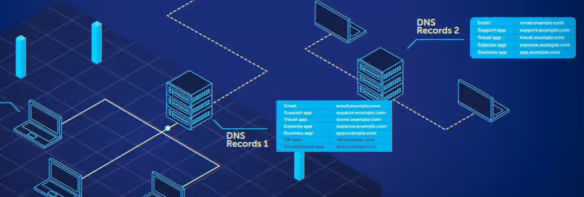
Intelligent Networking eliminates the need for complicated forwarding rules and duplicate name records by controlling resolution pathways through DNS.


 Key takeawaysKey takeaways are generated with AI assistance. Because automated summaries can occasionally contain errors or miss important context, always refer to the full blog post for complete information.
The article describes Intelligent Networking, a solution that lets network administrators control DNS resolution pathways to remove complex forwarding rules and duplicate name records. It explains that Intelligent Networking optimizes routing by resolving queries in a customer-defined sequence and supports routing traffic directly to trusted internet services for internet breakout. The result is simplified configuration, reduced reliance on costly MPLS lines, and more efficient traffic routing to preferred services.
How does Intelligent Networking reduce the need for complicated forwarding rules and duplicate name records?
Intelligent Networking reduces the need for complicated forwarding rules and duplicate name records by giving administrators control over resolution pathways so queries are handled in a customer-defined sequence. Instead of creating multiple forwarding rules or maintaining duplicate DNS entries to reach different services, the system directs queries through the chosen resolution order, simplifying DNS configurations. This centralized control of resolution eliminates workarounds that typically cause duplication and complexity while ensuring queries consistently resolve to the intended destinations.
What is meant by resolving queries in a customer-defined sequence, and why is that beneficial?
Resolving queries in a customer-defined sequence means administrators specify the order in which resolution sources or pathways are consulted when answering DNS queries. This approach ensures that preferred or trusted services are queried first, while secondary sources are only used if needed. The benefit is more predictable and optimized routing behavior, reduced configuration overhead, and the ability to prioritize direct access to trusted services, improving performance and operational clarity without relying on ad hoc forwarding rules.
How does Intelligent Networking enable internet breakout and reduce reliance on MPLS lines?
Intelligent Networking enables internet breakout by routing traffic directly to trusted internet services rather than forcing all traffic through centralized or private MPLS links. By controlling resolution pathways and directing queries to chosen external services, the solution allows sites to access internet-based resources locally when appropriate. This bypasses costly MPLS circuits for traffic that does not require transit over private links, lowering WAN costs while maintaining trust and control over which services receive direct access.
Network administrators can eliminate the need for complicated forwarding rules and duplicate name records by controlling resolution pathways. Intelligent Networking optimizes routing pathways by attempting to resolve queries in a customer-defined sequence. Intelligent Networking can also route traffic directly to trusted services supporting “internet breakout”, bypassing costly MPLS lines.


Mark is a Senior Product Marketing Manager at BlueCat Networks.
Related content

Get answers from the LiveNX data you already have with LiveAssist
Learn how LiveAssist, the AI-powered add-on for LiveNX, turns your network data into fast, guided answers, with value you can see in days.
LiveWire GEN3 device offerings
BlueCat LiveWire is a packet capture and network forensics platform that provides deep packet-level visibility across hybrid enterprise environments to help…

Get total control of your DDI infrastructure with Micetro’s unified API
Stop juggling between network tools and use Micetro’s RESTful API for complete control over your DDI infrastructure and cloud environment.

BlueCat MCP servers bring network intelligence to your AI assistant
Our MCP servers provide a standard integration layer that makes it easy to connect the AI tools you already use to BlueCat products.