
DDI Directions 2026: Turning DDI solutions into success
New Enterprise Management Associates research examines how organizations are preparing core network services for an agentic, multicloud world—and why integration, automation, API quality, and DNS security determine measurable operational results.
Enterprise Management Associates (EMA) surveyed 300 IT professionals to assess the state of their DNS, DHCP, and IP address management (IPAM), collectively known as DDI—the foundational control plane of enterprise infrastructure.
As enterprises prepare core network services for an increasingly agentic, multicloud environment, DDI is evolving beyond foundational connectivity. It now influences automation maturity, AI-readiness, DNS security posture, and overall operational resilience.
The research confirms that DDI management solutions are widely deployed and deeply embedded across modern IT environments. As organizations expand into hybrid and multicloud architectures, expectations for operational performance continue to rise. While 35% of respondents consider their DDI strategy completely successful, 58% report DDI-related service outages and 40% report DDI-related security incidents due to DDI mismanagement within the past two years—highlighting variability in operational outcomes.
Investment in DDI solutions is accelerating, driven by security risk reduction efforts, automation initiatives, AI adoption, and increasing cloud complexity. However, integration gaps, API quality concerns, and uneven DNS security governance are limiting the full operational value organizations expect from their DDI solutions.
For network, cloud, and security leaders who rely on DDI as the core components of modern infrastructure, the implication is clear: As network infrastructure becomes more distributed and automation-driven, DDI solutions must evolve to consistently deliver measurable operational results.
What the research reveals
DDI is essential to network connectivity, service delivery, and governance. EMA’s analysis shows that successful DDI strategies are strongly correlated with integration depth, API quality, automation maturity, and DNS security ownership—distinguishing high-performing DDI environments from the rest.
Only 35% of respondents report complete success with their DDI strategy. More than half experienced DDI-related downtime, and 40% experienced security incidents connected to DDI management practices.
For the 65% of organizations only partially successful or still struggling with their approaches to DDI technilift, three structural patterns emerge across the research:
- Incomplete integration between IPAM, DNS, and DHCP
- API quality limitations that constrain automation
- Low confidence in DNS security governance
As hybrid and multicloud environments expand, these maturity gaps have greater operational impact.
Key research signals

98%
say DDI plays a role in their network source of truth strategy

35%
consider their DDI strategy completely successful

58%
experienced DDI-related service outages in the past two years

40%
report DDI-related security incidents

28%
believe their DNS infrastructure is fully secure

54%
are at least somewhat likely to replace their DDI vendor in the next two years
Key findings:
The research confirms that inconsistent DDI solution performance is not a deployment issue—it is a maturity issue shaped by integration, automation capability, and governance discipline.
First, integration remains uneven. Only about one third of organizations report full IPAM-DNS integration. As enterprises expand into hybrid and multicloud environments, many struggle to unify management across on-premises and cloud-native DNS and DHCP services. Two thirds consider overlay management of third-party DNS and DHCP services very important, underscoring the need for unified visibility across environments.
Second, API quality is a defining success factor. EMA found that organizations reporting stronger API capabilities were more likely to achieve overall DDI success, integrate IPAM with DNS and DHCP services more extensively, improve visibility into DDI assets, strengthen DNS security, and experience fewer service disruptions and breaches. Where APIs are limited, automation slows and operational risk increases.
Third, DNS security confidence remains low. Only 28% of respondents believe their DNS infrastructure is fully secure, despite DNS underpinning every application, workload, and service connection. Notably, EMA found that organizations who assign clear DNS security ownership to DDI teams and work with DNS security specialists report stronger overall DNS security posture, reinforcing the importance of architectural alignment and governance clarity.
Together, these findings point to an important shift: DDI must function not only as core infrastructure, but as an integrated, automation-ready, security-aware control plane.
What the data shows
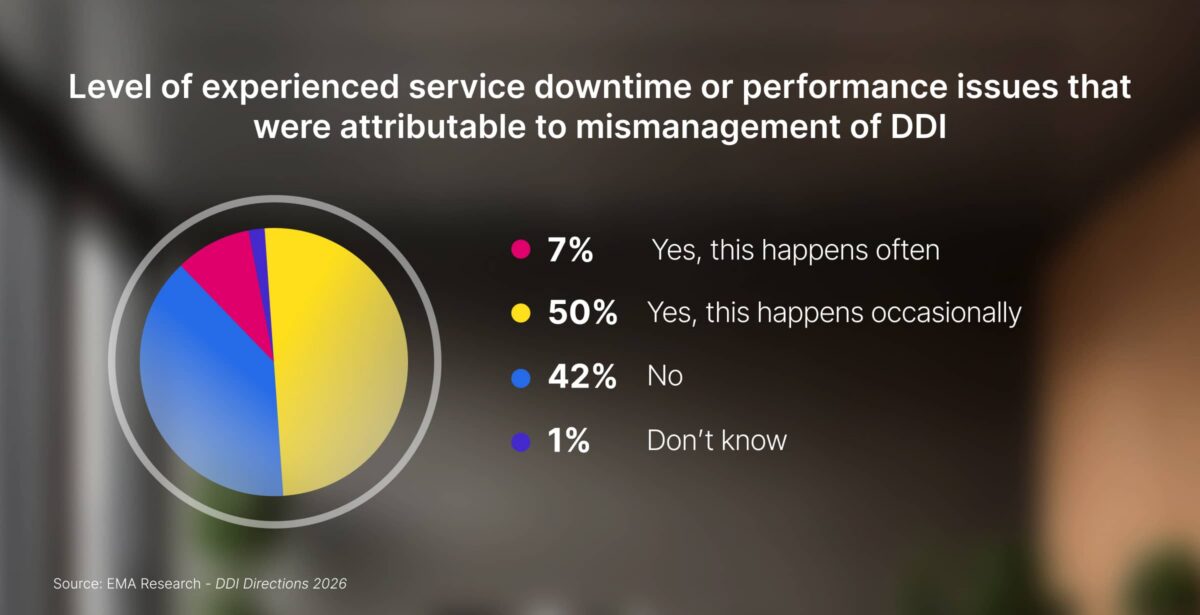
Figure 16 — DDI-related service downtime
58% experienced outages tied to DDI management practices. Deployment off DDI solutions alone does not ensure resilience—integration depth and governance consistency determine performance outcomes.
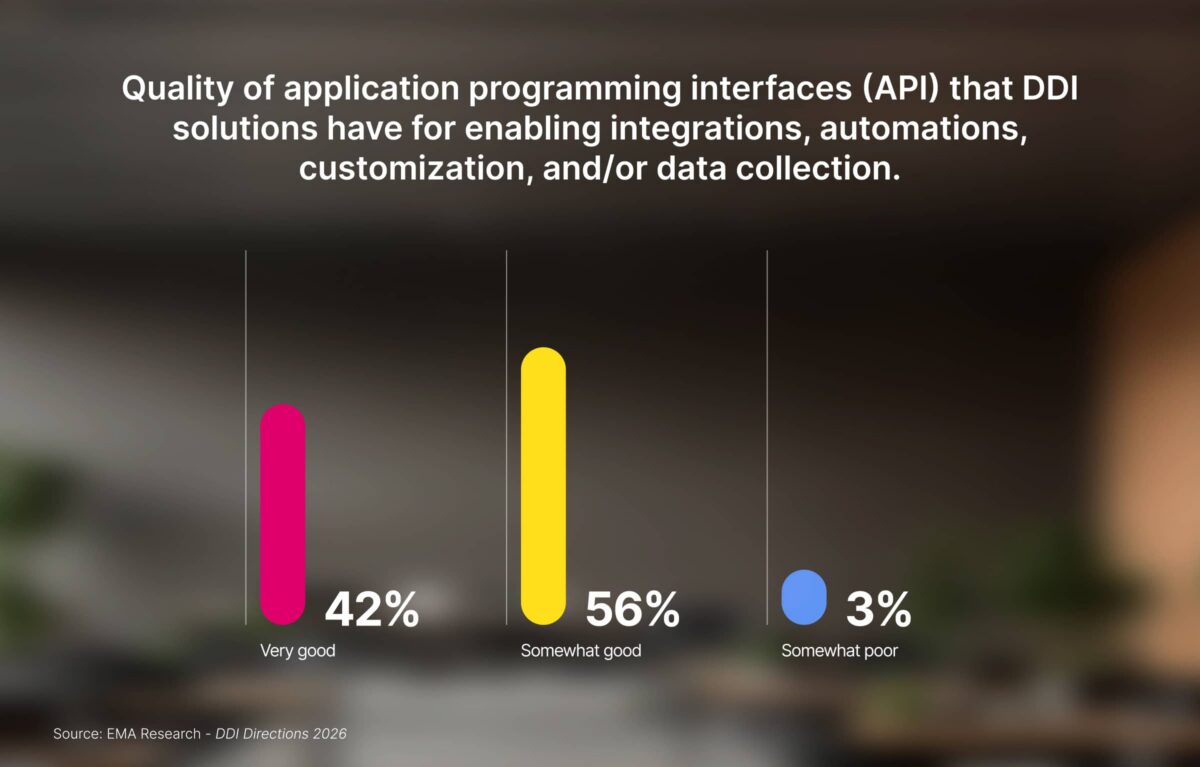
Figure 31 — API quality ratings
Only 41% rate their APIs as very good. EMA’s analysis shows that API strength correlates with higher DDI success rates, stronger DNS security posture, greater automation maturity, improved cloud influence, and fewer outages and breaches. Robust APIs are a multiplier for operational performance.
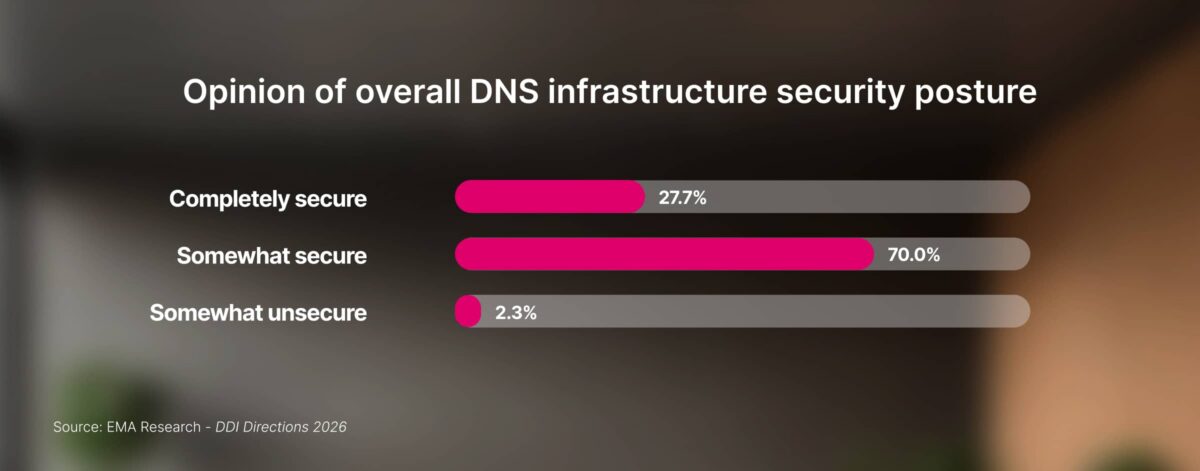
Figure 46—Confidence in DNS security
Only 28% believe DNS is fully secure. DNS governance maturity varies widely, and inconsistent visibility can increase exposure to operational and compliance risk.
What this means for network, cloud, and security leaders
DDI is no longer merely background infrastructure. It directly influences network uptime, security posture, automation velocity, and performance across hybrid and multicloud environments.
- Fragmented IPAM-DNS integration increases operational variability
- Limited API maturity constrains automation initiatives
- Inconsistent DNS visibility creates security blind spots
- Multicloud expansion amplifies governance complexity
- AI initiatives require authoritative, unified DDI data
- High-performing organizations treat API quality and integration as strategic enablers—not feature checkboxes
Organizations that modernize DDI architecture reduce operational risk, accelerate automation, and strengthen centralized control. The opportunity extends beyond incremental tuning—it lies in structural modernization that aligns DDI with multicloud governance, automation-first operations, and emerging agentic AI workflows.
Download the DDI Directions 2026 report
Understand where your DDI strategy stands
What you’ll learn from this report:
- The three structural gaps influencing DDI performance
- Why API quality and integration determine automation success
- How to reduce DDI-related outages and strengthen DNS security