AI-powered network insight
LiveNX add-on provides intelligent alerts and automated root-cause analysis for network issues
 Key takeawaysKey takeaways are generated with AI assistance. Because automated summaries can occasionally contain errors or miss important context, always refer to the full blog post for complete information.
This solution brief describes LiveAssist, an AI-powered add-on for BlueCat LiveNX that delivers real-time insights, intelligent alerts, and automated root-cause analysis to address blind spots, slow troubleshooting, and alert fatigue in complex hybrid, multicloud, edge, and remote network environments. By correlating multi-vendor telemetry via a natural language interface and using an MCP-based integration with AWS Bedrock (Anthropic’s Claude), LiveAssist enables proactive detection, guided remediation, and predictive planning while keeping full datasets within customer infrastructure and ensuring no cloud storage of customer data. Key outcomes include faster resolution and reduced downtime, improved capacity planning and security posture, democratized NetOps for less-experienced engineers, and lower operational costs through accelerated MTTR and automated workflows.
How does LiveAssist process a natural language query without exposing full network datasets to the cloud?
When a user submits a natural language query, LiveAssist sends the query and the definition of available capabilities to the LLM hosted on AWS Bedrock. The LLM acts as an orchestrator and instructs the local MCP client which specific tools to invoke. The MCP client queries LiveNX data repositories (alerts, flows, SNMP, packet data) within the customer’s secure environment and returns only the specific, encrypted query results to the LLM for analysis and summarization. No full datasets are sent to or stored in the cloud, AWS Bedrock processes results statelessly, and customer information is not retained or used to train external models.
What types of operational use cases and outcomes does LiveAssist enable for NetOps teams?
LiveAssist supports six primary use cases: morning snapshot (prioritized daily issues), proactive performance mitigation (anomaly detection and capacity planning), empowering front-line support (guided remediation for junior engineers), accelerated incident troubleshooting (correlating multi-vendor telemetry and config changes to reduce MTTR), security insights (surface anomalies and potential exfiltration for NetOps–SecOps collaboration), and on-demand compliance validation (assess device configs against frameworks like NIST/CIS). Outcomes include faster issue prioritization, prevention of outages, improved capacity planning, democratized support, reduced MTTR, stronger security posture, and faster audit preparation.
What architectural and security features differentiate LiveAssist from other observability solutions?
LiveAssist separates the MCP layer from the LLM and standardizes on OpenTelemetry for data transport, enabling modular, vendor-agnostic integration and future flexibility. It leverages agentic AI to not only summarize data but also guide workflows and recommend remediation actions, while its correlation engine synthesizes multi-source telemetry into context-rich insights. From a security standpoint, the design ensures the LLM never accesses full datasets, query results are encrypted in transit, no customer data is stored in the cloud, AWS Bedrock processes are stateless, and BlueCat’s environment is SOC 2 Type II certified, maintaining control and trust for customers.

Challenge
Complex enterprise networks that span hybrid, multicloud, edge, and remote environments overwhelm network teams with blind spots, slow troubleshooting, and alert fatigue. This puts network performance and security at risk.

Solution
LiveAssist, an AI-powered add-on for BlueCat LiveNX, delivers real-time insights, intelligent alerts, and automated root-cause analysis, simplifying network operations and speeding response times. Networking engineers can query LiveAssist’s natural language interface to receive guided root cause analysis and step-by-step remediation advice.

Benefits
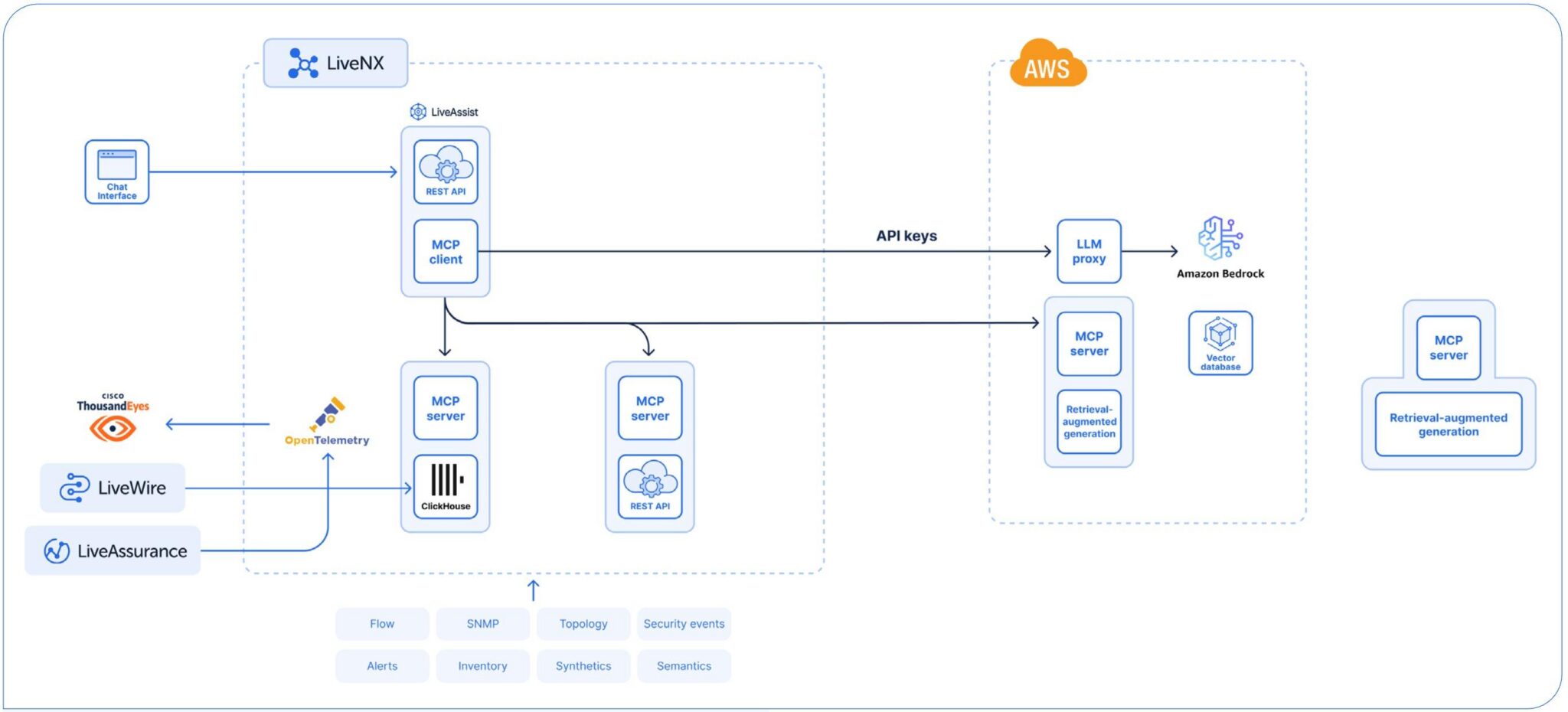
Figure 1: LiveAssist architecture
How it works
Large volumes of network data flow into LiveNX and are stored across multiple internal data repositories. When a user submits a query through LiveAssist’s natural language interface, it uses the Model Context Protocol (MCP) as the standard mechanism for accessing this data and exposing LiveNX’s capabilities to the large language model (LLM) running in AWS. LiveAssist leverages AWS Bedrock for its LLM, with Anthropic’s Claude as a foundation model.
LiveAssist combines queries made through its natural language interface with tools that have access to alerts, flow records, SNMP, and packet data in LiveNX’s data repositories. This context is passed to the LLM, which then decides which tools to invoke. Through the MCP client, the LLM calls the necessary MCP servers, which fetch, correlate, and summarize the data before returning a response.
From a data security perspective, when a user submits a request as described above, the query and the definition of available capabilities are sent to the LLM hosted on AWS Bedrock. Acting as an intelligent orchestrator, the LLM instructs the local MCP client to execute specific actions using tools exposed by the MCP server. This process ensures that the MCP client queries the data directly within the customer’s secure infrastructure. Crucially, the LLM never accesses the full network datasets; it only accesses the specific results of the query, which are encrypted in transit and returned to the LLM for analysis and summarization. No data is stored in the cloud, and AWS Bedrock processes these results statelessly, guaranteeing that customer information is never retained or used to train external models.
Additionally, the LLM isn’t limited to a single tool—it can draw from multiple sources at once to build a richer context and drill deeper into an issue. Because it understands the structure of network data (flows, security events, telemetry, etc.), it can interpret and correlate these inputs to provide clear, actionable answers to users.
Alongside MCP, we have also standardized on OpenTelemetry for data transport. This not only facilitates data movement across BlueCat’s products but also makes it straightforward to integrate with third-party tools such as Cisco ThousandEyes and Splunk.
Lastly, to ensure the highest levels of data security, BlueCat’s environment is SOC 2 Type II certified.
Six types of use cases
This section outlines six real-world scenarios that demonstrate the benefits of using LiveAssist.
Use case 1: The morning snapshot
Instead of starting the day buried in dashboards, logs, and tickets, network operations engineers can ask LiveAssist’s natural language interface, “What’s on fire this morning?” or “What needs attention?” In turn, LiveAssist delivers a clear snapshot of the most pressing issues, what’s trending, and what may escalate if left unchecked. This allows network teams to prioritize immediately, reduce wasted effort, and ensure that the highest-risk issues are addressed first.
Outcome: NetOps teams begin their day with clarity and confidence, reducing waste cycles and ensuring they address the highest-risk issues first.
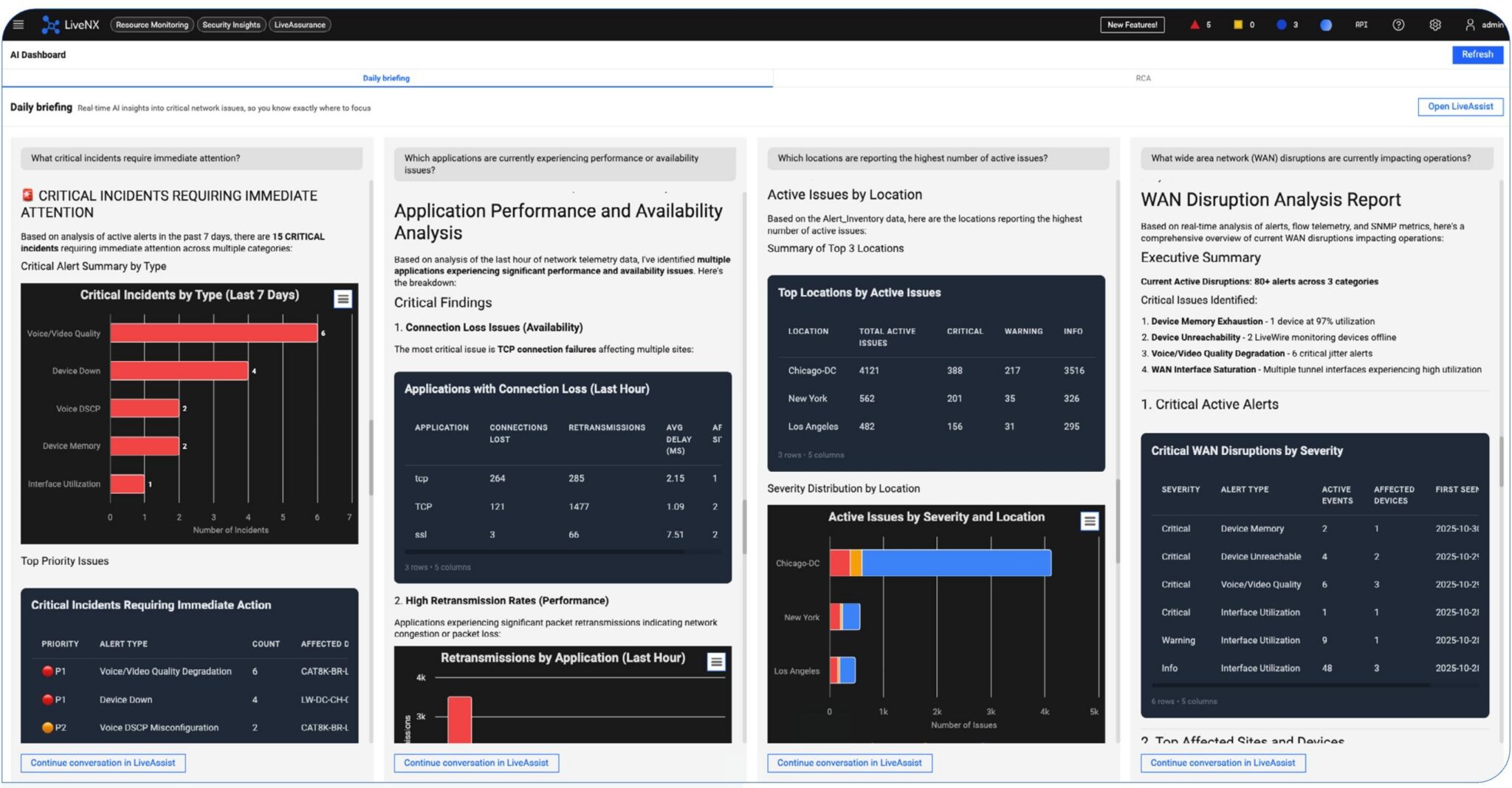
Figure 2: LiveAssist morning snapshot dashboard
Use case 2: Proactive mitigation of performance issues
Large enterprises managing complex hybrid cloud, WAN, and SD-WAN environments often experience performance degradation during peak hours. With LiveAssist, early warning signals of network saturation are automatically discovered through AI-driven anomaly detection. It not only surfaces a prioritized view of risks and guided remediation through root cause analysis, but it also provides predictive insights for capacity planning. This helps network teams forecast bandwidth demand, optimize resources, and intervene before outages impact critical applications.
Outcome: Network teams can anticipate and prevent performance bottlenecks, improve capacity planning accuracy, and maintain consistent application performance even during peak utilization.
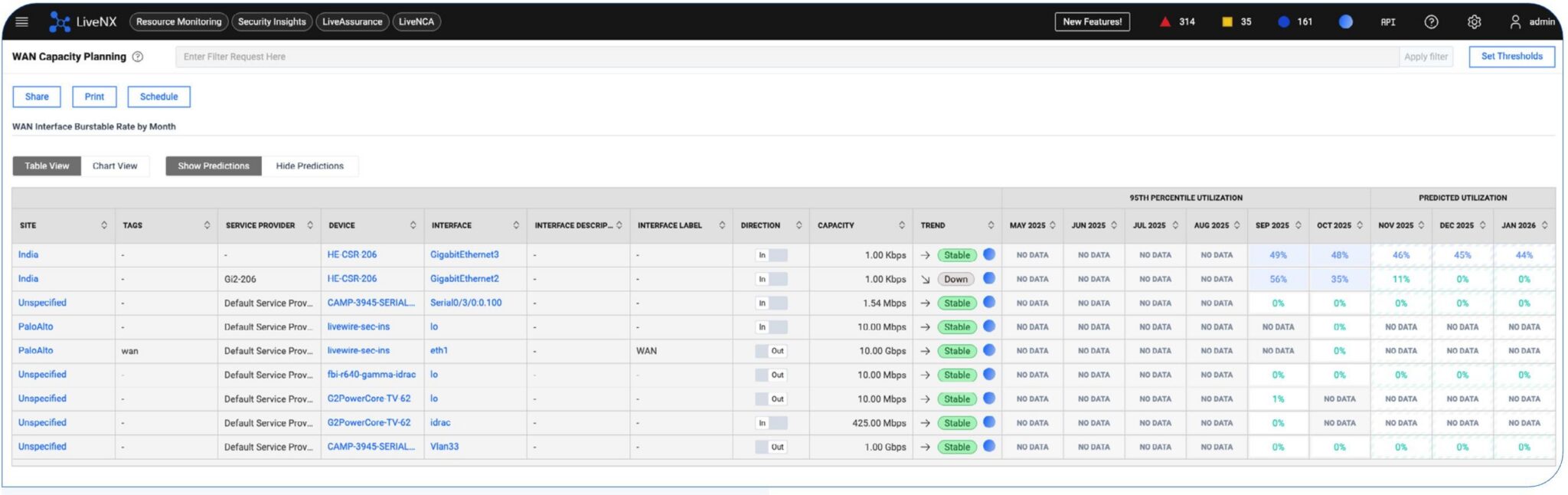
Figure 3: LiveAssist WAN capacity planning dashboard
Use case 3: Empowering front-line support engineers
Front-line support engineers and junior staff are often left to handle overwhelming volumes of alerts without the deep experience needed to troubleshoot effectively. LiveAssist enables network engineers at all experience levels to query the system in natural language and receive guided root cause analysis with step-by-step remediation advice. Human feedback helps to continuously improve the system’s accuracy.
Outcome: NetOps teams can democratize support operations, lower dependency on senior staff, and reduce alert fatigue.
Use case 4: Accelerated incident troubleshooting via root cause analysis
For organizations with complex, multi-vendor network infrastructures, identifying the root cause of performance issues can be slow and resource-intensive. Organizations experiencing intermittent application slowdowns can use LiveAssist to correlate telemetry across routers, firewalls, and cloud environments, along with recent configuration changes and trap events, to pinpoint whether the issue stems from performance degradation, a misconfiguration, or a recent change. By offering guided steps to resolution in plain language, LiveAssist empowers engineers of all skill levels.
Outcome: Troubleshooting with decreased mean time to resolution (MTTR), reduced revenue loss, and improved network team operational efficiency.
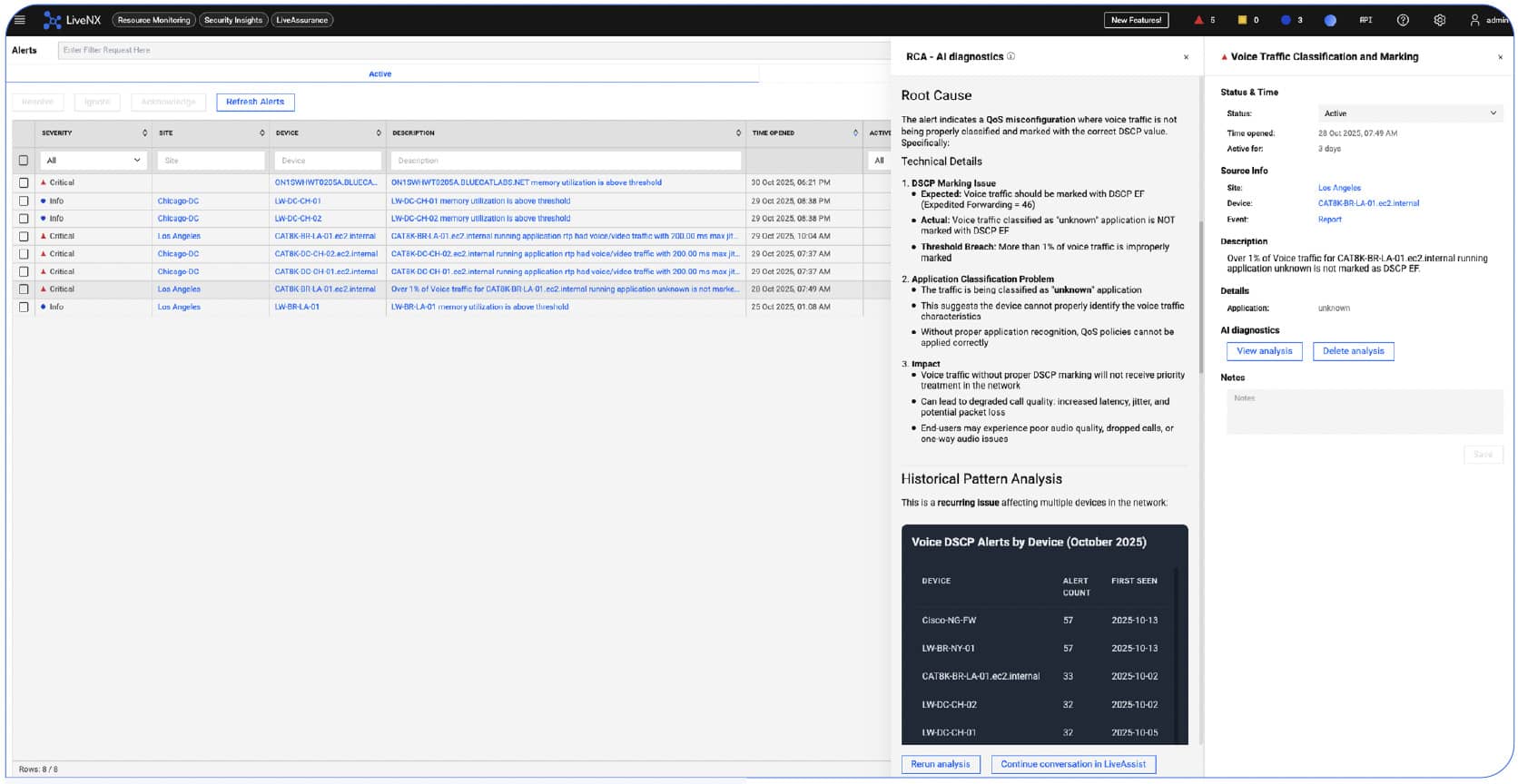
Figure 4: LiveAssist root cause analysis alerts dashboard
Use case 5: Security insights for NetOps and SecOps collaboration
Financial services firms and other security-sensitive organizations often face hidden anomalies in network traffic that evade traditional monitoring. LiveAssist surfaces these security insights directly from telemetry, highlighting unusual traffic patterns or potential data exfiltration. By presenting this information in the same LiveNX dashboard that your NetOps team already uses, LiveAssist fosters collaboration between NetOps and security operations teams.
Outcome: An enterprise network with a stronger security posture, more streamlined alignment with SecOps, and a reduced risk of breaches.
Use case 6: On-demand regulatory compliance validation
Organizations preparing for audits or validating adherence to NIST and CIS security frameworks often rely on manual configuration reviews that are time-consuming and require senior-level expertise.
With access to device configuration files, engineers can use LiveAssist to assess compliance on demand by asking questions like, “Is this device compliant with NIST?” or “Do we have login banners configured?” LiveAssist analyzes the configuration, identifies gaps against the selected framework, and provides clear remediation guidance. It’s useful for supporting compliance efforts, but it’s not a full compliance tool.
Outcome: Reduced audit preparation time, faster gap identification, and more efficient use of specialist resources.
Key differentiators
LiveAssist isn’t just another AI layer on top of a monitoring tool—it redefines how network observability is delivered. Combining deep network intelligence with agentic AI, LiveAssist empowers teams to go beyond reactive troubleshooting toward proactive, automated operations.
These three core differentiators set it apart from other network performance monitoring and observability solutions:

Agentic AI—turning insight into
action LiveAssist doesn’t just answer questions—it acts. Leveraging agentic AI, it proactively guides workflows, surfaces correlations, and recommends remediation based on real-time network context. Instead of just passively providing data, LiveAssist is an intelligent assistant that thinks and acts like an experienced network engineer. Other tools stop at alerting or summarizing data. LiveAssist understands intent and executes guided workflows—reducing MTTR, accelerating decision-making, and freeing NetOps teams from manual triage cycles.

Correlation engine—from data overload
to context-rich insights The LiveAssist correlation engine tackles one of the hardest problems in network operations: connecting symptoms to root cause. It integrates data from diverse sources—flow records, telemetry, SNMP, and alerts—and automatically identifies patterns and relationships that humans might miss. Traditional monitoring tools flood engineers with disconnected alerts. LiveAssist’s correlation engine synthesizes information into clear narratives that highlight what’s related, what’s noise, and where to act.

Open, future-ready architecture—designed for
flexibility and trust LiveAssist’s architecture separates the MCP layer from the LLM, giving customers unmatched flexibility and control over how AI is deployed. Most AI-driven observability tools are tied to a single vendor ecosystem. LiveAssist’s open, modular approach future-proofs your investments, enabling organizations to evolve their AI strategy on their own terms.
Solution benefits

Accelerated troubleshooting Reduce MTTR
and mean time to identify with automated root cause analysis and guided remediation.

Proactive operations Predict and
prevent outages with AI-driven traffic forecasting and intelligent alerting.

Enhanced security posture Surface
security insights directly from telemetry data to strengthen NetOps and SecOps collaboration.

Democratized NetOps Empower less-experienced
engineers to act confidently with natural language insights.

Ease of use Fast
deployment thanks to an easy setup and intuitive onboarding.
BlueCat’s Intelligent Network Operations (NetOps)
BlueCat’s Intelligent NetOps solutions provide the analytics and intelligence needed to enable, optimize, and secure the network to achieve business goals. With an Intelligent NetOps suite, organizations can more easily change and modernize the network as business requirements demand.