
DDI orchestration ROI: Save $120K+ annually with Micetro
Micetro users highlight how easily DDI orchestration overlays their existing DNS and DHCP infrastructure—70% citing ease of integration as a key purchase factor.

 Key takeawaysKey takeaways are generated with AI assistance. Because automated summaries can occasionally contain errors or miss important context, always refer to the full blog post for complete information.
The article presents research showing BlueCat Micetro delivers centralized DDI orchestration that overlays existing DNS and DHCP systems to reduce manual work and modernize network operations across distributed data centers, clouds, and remote locations. Organizations in the study reported an average annual ROI of $123,700 and 1,040 hours saved by automating routine DNS, DHCP, and IPAM tasks, with most users seeing tangible value within two weeks of deployment. Micetro’s vendor-agnostic architecture and rapid installation enable incremental modernization without replacing current infrastructure, improving reliability and enabling teams to focus on higher-value initiatives.
Modern IT environments are becoming increasingly distributed, spanning on-premises infrastructure, cloud platforms, and remote locations. As networks grow in scale and complexity, managing DNS, DHCP, and IP address management (IPAM) becomes more difficult—and more critical to get right.
Yet many teams still rely on fragmented tools and manual processes to manage these foundational services. This approach introduces operational inefficiencies, increases the risk of configuration errors, and limits visibility across the network environment.
This e-book explores insights gathered from Micetro users to understand how organizations are modernizing their DDI operations through Micetro’s centralized orchestration capabilities. The findings reveal how teams using Micetro have streamlined DNS, DHCP, and IPAM (together known as DDI), reduced manual work, and improved operational reliability.
Organizations participating in the study reported saving 1,040 hours of work annually, achieving $123,700 in total ROI, and realizing measurable value within weeks of deploying Micetro.
Seventy percent of them also said Micetro’s ease of integration was a key factor in their purchase decision. Micetro acts as a non-disruptive overlay on existing environments, avoiding high-risk rip-and-replace efforts.
What the data reveals
Survey findings show that organizations managing DDI manually often spend significant time on repetitive operational tasks.
Before implementing Micetro, respondents reported handling an average of 318 DNS record updates, 178 IP provisioning tasks, and 62 troubleshooting incidents each month. These tasks alone accounted for more than 4,000 minutes of manual work every month.
Fragmented tools and limited visibility also created operational challenges, including difficulty integrating with Active Directory, poor auditability, and limited integration between on-premises and cloud environments.
By introducing centralized orchestration, Micetro helps organizations automate these tasks, consolidate visibility across infrastructure, and significantly reduce operational overhead.
Key insights

$123700
average annual ROI
Organizations combining labor savings and reduced reliance on third-party vendors reported six figures in annual value from Micetro.

$1040
hours saved annually
Automating DDI processes eliminates thousands of hours of manual work each year.

95%
reported installation was easy
Micetro installs quickly and integrates with existing infrastructure without requiring major changes.

65%
realized value in less than two weeks
Organizations begin seeing operational improvements almost immediately after deployment.

80%
cited centralized management as a key benefit
Users highlighted centralized DDI visibility as a major reason for choosing Micetro.
Key findings from Micetro users
Modern networks demand greater visibility, automation, and control than traditional DDI tools were designed to provide. As environments expand across hybrid cloud, remote work, and distributed infrastructure, the operational burden on network teams continues to grow.
Survey respondents reported that prior to implementing Micetro, DNS updates, IP provisioning tasks, and troubleshooting activities consumed significant time each month. In many cases, teams were still relying on spreadsheets or fragmented tools to track and manage IP resources.
By introducing centralized DDI orchestration with a non-disruptive overlay on existing environments, Micetro enables organizations to automate routine processes, consolidate visibility, and reduce operational friction that slows network teams. These improvements translate into both measurable ROI and stronger network resilience.
Key data highlights

Figure 1 — Total Time Savings
Teams using Micetro reported saving an average of four hours per person per week managing DDI operations, which translates to 1,040 hours annually across a five-person team.

Figure 2 — Financial Impact of Micetro
Based on the median salary of a network architect, those reclaimed hours represent approximately $84,500 in labor savings annually. Organizations also saved an additional $39,200 per year by reducing reliance on third-party DDI management vendors, bringing the total ROI to $123,700 annually.
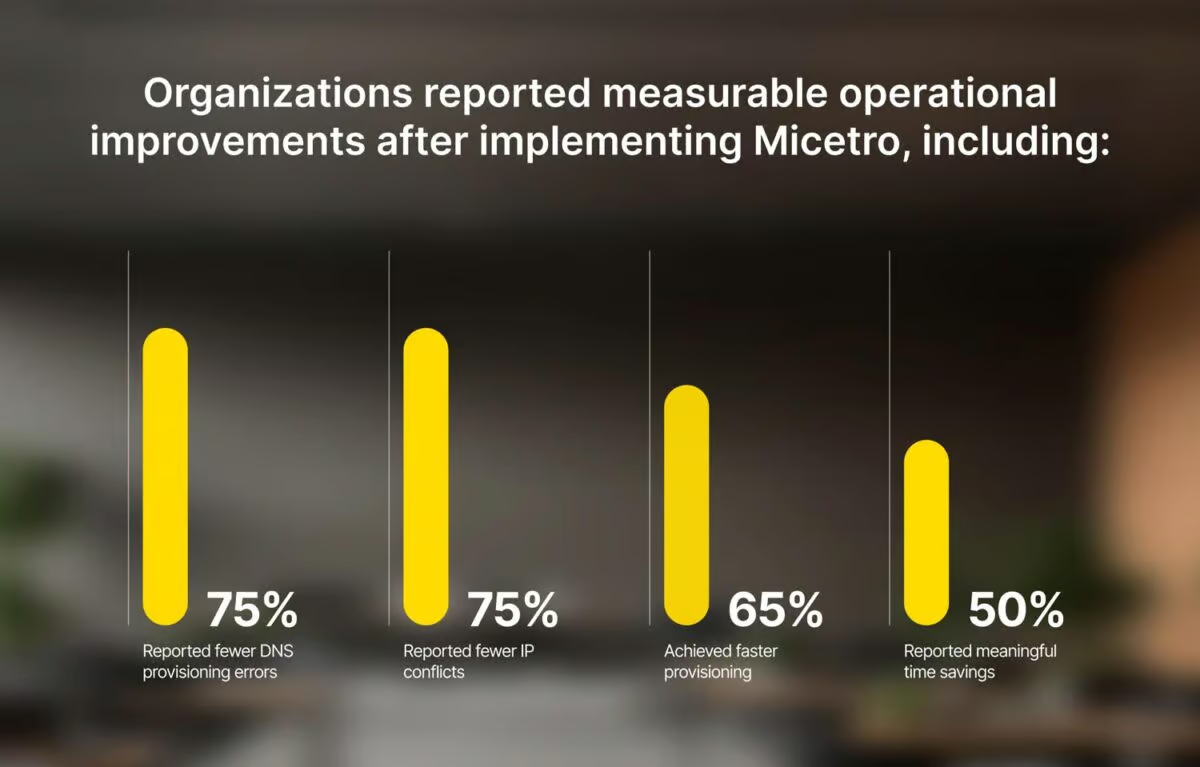
Figure 3—Operational Improvements brought by Micetro
Organizations reported measurable operational improvements after implementing Micetro, including:
- 75% reported fewer DNS provisioning errors
- 75% reported fewer IP conflicts
- 65% achieved faster provisioning
- 50% reported meaningful time savings
What this means for network and infrastructure teams
Managing DDI through fragmented tools and manual workflows creates unnecessary operational overhead and increases the risk of configuration errors and outages.
The findings from this study show how organizations are modernizing DDI management by introducing centralized orchestration that simplifies operations while working alongside existing infrastructure.
With Micetro in place, network and infrastructure teams can:
- Reduce manual DDI work by over 1,000 hours annually
- Accelerate DNS and IP provisioning across distributed environments
- Minimize IP conflicts and DNS configuration errors
- Gain centralized visibility across DNS, DHCP, and IPAM infrastructure
- Enable scalable network operations across hybrid and multi-cloud environments
By consolidating DDI management into a unified orchestration layer, Micetro allows teams to modernize network operations without ripping out and replacing their existing DNS or DHCP platforms, re-training teams, or disrupting day-to-day workflow. The result is a more efficient operational model that frees engineers to focus on strategic initiatives rather than routine infrastructure maintenance.
Download the Micetro ROI e-book
See how organizations achieve measurable ROI from DDI orchestration
What you’ll learn:
- How organizations achieve $123,700 in average annual ROI with Micetro
- Where the 1,040 hours of time savings per year comes from
- How Micetro deploys quickly and delivers value in as little as two weeks