
Spot the DNS Attack: Halloween Edition



 Key takeawaysKey takeaways are generated with AI assistance. Because automated summaries can occasionally contain errors or miss important context, always refer to the full blog post for complete information.
The article warns that Domain Name System (DNS) attacks are a growing threat that disrupt internet connectivity, invade privacy, and cause lost productivity, costing organizations an average of $1.07 million in 2019. It highlights that many organizations overlook DNS as an attack vector and therefore fail to secure it, and it frames six common DNS attack types as Halloween characters to raise awareness. The piece urges network teams to assess whether their DNS solutions provide visibility and security across hybrid cloud and virtualized environments and promotes BlueCat’s Adaptive DNS and BlueCat Edge for enhanced DNS security.
Why are DNS attacks becoming more common and what impact do they have on organizations?
DNS attacks are increasing because many organizations do not recognize DNS as a threat vector and therefore do not actively secure it, leaving gaps attackers can exploit. The impact includes interrupted internet connectivity, privacy invasion, lost productivity, and significant financial costs — the article cites an average organizational loss of $1.07 million in 2019. As networks become more complex through hybrid cloud and virtualization, inadequate DNS visibility and security amplify these operational and financial risks.
What should network teams evaluate in their current DNS solution to strengthen cybersecurity posture?
Network teams should evaluate whether their DNS solution gives sufficient visibility and security to detect and mitigate DNS-based threats across modern environments. The article recommends ensuring the solution is designed to operate effectively in hybrid cloud and virtualized infrastructures and can handle today’s compounding network complexity. Assessments should focus on capabilities that provide comprehensive threat detection, adaptive response, and enhanced security features to reduce risk and potential financial impact.
How does the article position BlueCat’s offerings in addressing DNS security challenges?
The article positions BlueCat’s Adaptive DNS and BlueCat Edge as solutions designed to help organizations defend against DNS attacks and improve their cybersecurity posture. It claims these offerings provide enhanced security capabilities and the visibility needed to stand up to DNS threats in hybrid cloud and virtualized environments. The messaging suggests BlueCat’s technologies are built to handle the complexity of modern networks and to keep organizations protected continuously.
Domain Name System (DNS) attacks are no doubt scary. They interfere with your connection to the internet, invade your privacy, and cause lost productivity. DNS attacks have seen a rise because most organizations do not realize that it is a threat vector and therefore are not actively securing it.
There are several different types of DNS attacks. Ever wondered what they would look like if they came to life?
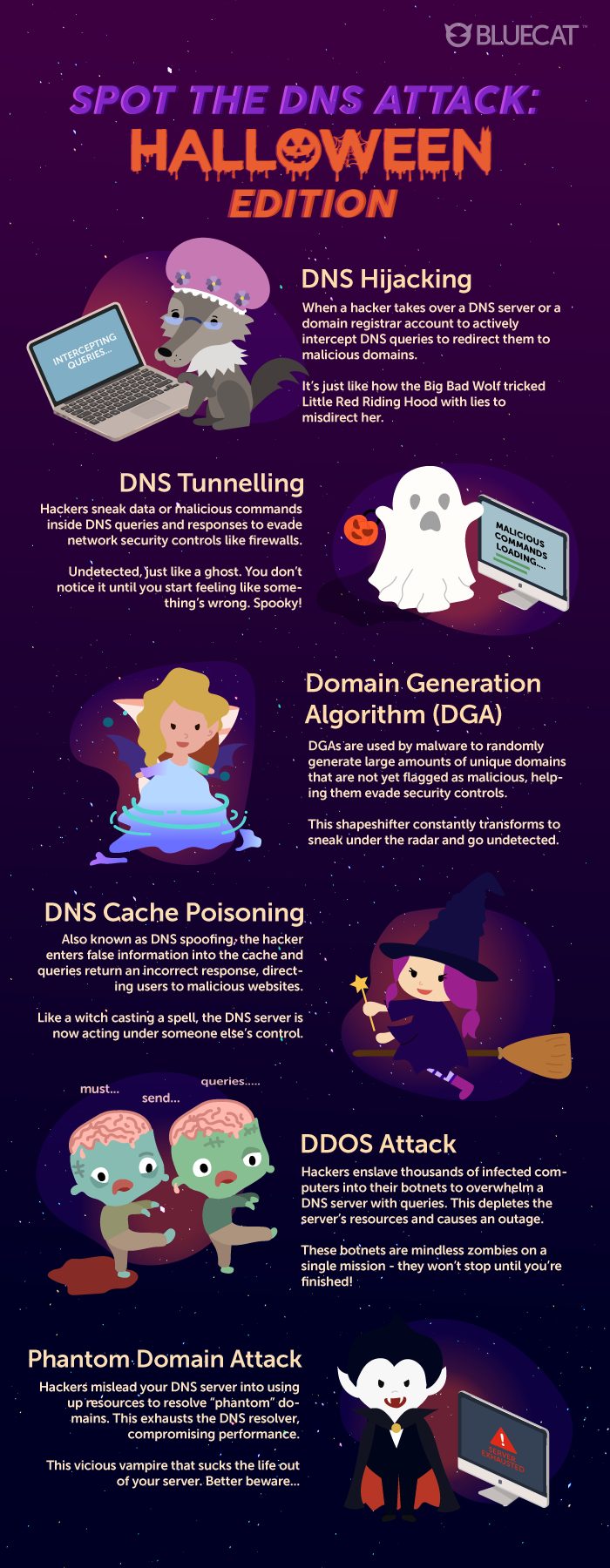
Boo! Here are 6 types of DNS attacks as Halloween characters:
As the linchpin of network communication, DNS attacks cost organizations – an average of $1.07 million as of 2019, in fact. With this number steadily on the rise, ensuring network security should be at the top your network team’s list.
So ask yourself this: Does your current DNS solution give you the visibility and security you need to strengthen your cybersecurity posture? Is it built to thrive on hybrid cloud, virtualization, and all of today’s compounding network complexity?
Our solution is.
Learn how BlueCat’s Adaptive DNS can help you stand tall in the face of these attacks, and check out BlueCat Edge’s enhanced security capabilities. It’ll keep you safe this Halloween (and every day after that).