
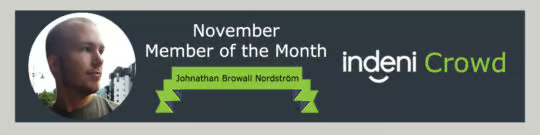
November Member of the Month: Johnathan Browall Nordström


Notice: This blog post was originally published on Indeni before its acquisition by BlueCat.
The content reflects the expertise and perspectives of the Indeni team at the time of writing. While some references may be outdated, the insights remain valuable. For the latest updates and solutions, explore the rest of our blog
 Key takeawaysKey takeaways are generated with AI assistance. Because automated summaries can occasionally contain errors or miss important context, always refer to the full blog post for complete information.
This article profiles Johnathan Browall Nordström as Indeni Crowd’s November Member of the Month, highlighting his contributions to Check Point firewall checks and community-driven troubleshooting. It describes his discovery of Indeni after seeking automation to replace repetitive ARP and firewall checks, his early development of scripts from a home lab in Stockholm, and the operational benefits of proactive monitoring that reduce unpredictable issues in mission-critical environments. The piece also emphasizes real-world collaboration through Indeni Crowd, Johnathan’s motivations for continuous learning and fixing corner cases, and provides links to his Check Point Alerts and discussions for peer feedback.
How did Johnathan first discover Indeni and what problem was he trying to solve?
Johnathan discovered Indeni after repeatedly performing manual, repetitive tasks at the office—such as checking whether ARP tables on several firewalls had reached their limits—and wanting automation to avoid those chores. He googled for a solution and found Indeni, which performed the automated checks he needed. After running a proof of concept he purchased licenses the following year and began using Indeni to proactively detect issues in mission-critical equipment to avoid unpredictable operational problems.
What contributions did Johnathan make to Indeni and the Indeni Crowd community?
Johnathan was one of the first people to build checks for Check Point firewalls from his home lab in Stockholm, effectively acting as an early Indeni Knowledge contributor before formal roles existed. He wrote scripts that delivered value to other administrators and iterated on them based on real-world input from the Indeni Crowd. He also participates in Check Point discussions, shares his Check Point Alerts for peer feedback, and enjoys bug reports because they reveal corner cases that help him improve his checks.
What personal qualities and experiences does Johnathan bring to network engineering?
Johnathan describes himself as organized, positive, and eager to learn, while acknowledging stubbornness and dislike of repetitive tasks. His proudest engineering moment was migrating a central production firewall from a legacy Cisco ASA to a new Check Point gateway with minimal issues. He advises aspiring coders from IT to pursue a concrete problem to solve in code, learning by building practical solutions rather than studying abstract examples, and credits a colleague, Patrik Jonsson, for rigorous code review and emphasis on documentation.

November represents a month of gratitude and there is one member who deserves an Indeni Crowd shout out. After completing countless challenges and tirelessly contributing to Check Point related discussions, we are happy to name Johnathan Browall Nordström as November Member of the Month.
Johnathan’s approach to network engineering aligns perfectly with Indeni’s mission. Armed with an objective of avoiding unpredictable issues while working with mission-critical equipment, Johnathan stumbled upon Indeni years ago:
After a long day at the office performing repetitive tasks, such as checking if the ARP table had reached its limits on a few firewall, it got me thinking. There has to be some automated software that could do this. I started googling around and found Indeni, which did exactly what I wanted. I did a POC and the following year purchased a few licenses.
Johnathan was so supportive of this proactive approach to Network Operations that he became one of the first individuals build checks for the CheckPoint firewalls from his home-lab in Stockholm, Sweden. In other words, Johnathan was an IKE (Indeni Knowledge Consultant) before IKEs existed. Writing scripts for Indeni opened up the opportunity to “create something that gives value to a lot of administrators just like me and to be able to do it from home and when it works for myself is a big bonus.” With the development of the Indeni Crowd, Johnathan has been enjoying the real world input that helps drive product knowledge development:
I generally love questions that question how we do things; as I always like to learn new ways of solving problems. Also, reports of bugs are something I weirdly like. It means that there was a corner case I didn’t think of and that my script now can improve.
Want to see Johnathan’s work? View his CheckPoint Alerts here and share your feedback in the Indeni Crowd CheckPoint Discussions. Don’t forget to add him to your professional network via Linkedin!
Fun Facts about Johnathan:
Do you have a collection of anything?
A long time ago I collected pins, but right now I don’t collect anything.
Best and worst quality?
The best quality is that I am organized, positive, and always wanting to learn new things
The worst quality is that I am stubborn and bad at doing repetitive tasks.
A song that always makes you happy when you hear it?
Pink Floyd – Wish You Were Here
Proudest moment as a network engineer?
Migrating the central production firewall, which was an old Cisco ASA, to a brand new Check Point gateway with very little issues.
If you could master one new skill, what would it be?
I would love to be really good at cooking. Right now it is too abstract for me to attempt more than simple dishes. However, if I was single I would probably only drink Soylent or some other liquid diet for simplicity.
Your first code ever… what was the first thing you created?
I and some friends created a text-based adventure game in Java where the player explored a cave and fought monsters. The most dreadful monster you could encounter was a “(null)” which was due to some bug and was not possible to kill. You had to hit “w” to go forward in the cave, but to prevent someone from hitting the key over and over again that key changed to “perform suicide” once you encountered a monster, so you had to be careful! It also featured us recording a intro with voice acting and special sound effects.
What advice would you give to someone who is coming from IT to start code?
Speaking for myself, the most important thing is to have something you want to do or solve in code and try start working on it as soon as possible. Once you have that goal you can try to reach it, solving issues along the way.
For me, it doesn’t work to study strange coding examples that are not applicable to situations I encounter.
What IT Heroes
My current colleague, Patrik Jonsson (also a previous member of the month), has inspired me through our 6 years working together.
His hawk-eyes do not miss a single misplaced space in code review; he also emphasizes the importance of good comments and documentation.
Related content

Get answers from the LiveNX data you already have with LiveAssist
Learn how LiveAssist, the AI-powered add-on for LiveNX, turns your network data into fast, guided answers, with value you can see in days.

Get total control of your DDI infrastructure with Micetro’s unified API
Stop juggling between network tools and use Micetro’s RESTful API for complete control over your DDI infrastructure and cloud environment.

BlueCat MCP servers bring network intelligence to your AI assistant
Our MCP servers provide a standard integration layer that makes it easy to connect the AI tools you already use to BlueCat products.
We bet on Intelligent NetOps two years ago. Infoblox now has too.
With Infoblox acquiring Kentik, BlueCat’s CEO confirms its vision for a single platform unifying DDI, network monitoring, and observability.