


Micetro
With Micetro, integrate, orchestrate, and automate your current DNS, DHCP, and IPAM network infrastructure via a single web interface.
Read moreAutomated, stakeholder-ready insight
Available as a Micetro add-on, Advanced Reporting gives teams deeper visibility into DNS, DHCP, and IPAM activity.


Leverage Micetro’s unified DNS, DHCP, and IPAM layer with 12 core and 12 derivative report sources, instead of stitching together generic logs and dashboards.
Unify reporting across Microsoft, BIND, Kea, cloud DNS, and more through Micetro’s non-disruptive orchestration layer, without replacing existing infrastructure.
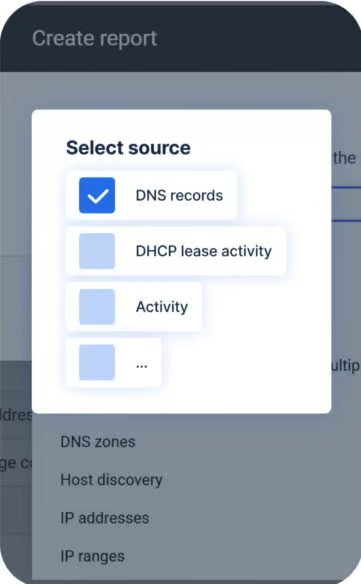
Report on DNS zones, records, DHCP leases, subnets, and individual IP addresses, enriched with custom properties and advanced filters like regex and relative time.
Export reports in CSV, JSON, XML, or SYLK and pair them with post-report actions, notifications, or scripts to feed broader network reporting and analytics workflows.

Use Micetro Advanced Reporting to turn raw DNS, DHCP, and IPAM data into focused DDI reporting. Choose from 12 core and 12 derivative report sources to analyze everything from subnet utilization and IP conflicts to DNS record changes and DHCP lease activity. Build reusable definitions that give stakeholders consistent, trustworthy views of their infrastructure.
Quickly narrow DNS, DHCP, and IPAM reporting to what matters for each team. Apply detailed filters using booleans, regex, and relative time windows such as “last 2 weeks” to focus on specific events or trends. Scope reports by domain, region, or business unit so each stakeholder group only receives relevant, actionable insight.
Replace manual, ad hoc DDI reporting with automated, policy-driven schedules. Run reports ad hoc or on recurring intervals and control storage with scavenging rules based on age or report counts. Built-in audit visibility into row counts and generation durations helps teams demonstrate governance and troubleshoot issues quickly.
Use Advanced Reporting as a bridge between DDI reporting and broader network reporting and analytics. Export results in CSV, JSON, XML, or SYLK for downstream analysis or ingestion into other tools. Configure post-report actions—such as notifications or scripts—to trigger automated workflows and reduce manual follow-up effort.
See how NetOps, security, and compliance teams turn DDI data into faster decisions and better outcomes.
Network and infrastructure teams use Micetro Advanced Reporting to spot subnet exhaustion before it impacts users. They schedule recurring IP utilization and DHCP lease reports per region or business unit, filtered to high-usage subnets and recent allocation changes. Exported data feeds capacity models in existing analytics tools, turning network reporting and analytics into concrete, data driven network decisions.
NetOps teams rely on Micetro Advanced Reporting to reduce mean time to resolution for DNS and DHCP issues. They define reusable reports for recent DNS record changes, failed updates, and DHCP scope activity, then schedule them for key services and critical sites. When incidents occur, teams pivot quickly using this historical context instead of building one-off reports, accelerating root-cause analysis and improving SLA adherence.
Security and network teams tap into Micetro Advanced Reporting across DNS, DHCP, and IPAM data to investigate suspicious patterns. They run focused reports on unusual DNS changes, unexpected lease activity, or traffic from high-risk ranges, filtered by time window and domain. Exporting results into existing security tooling or workflows helps correlate events faster, close investigation gaps, and strengthen collaboration between NetOps and security operations.
Compliance and governance owners use Micetro Advanced Reporting to maintain an auditable history of DNS, DHCP, and IP address changes. They schedule scoped reports for specific regions or legal entities, applying retention policies that match internal and external audit requirements. A global enterprise can standardize report definitions while giving regional teams localized views, simplifying audits and reducing manual evidence gathering.
Micetro advanced reporting runs on Micetro’s vendor-agnostic, API-first DDI orchestration layer, using the single source of truth you already maintain for DNS, DHCP, and IPAM. It overlays your existing Microsoft, BIND, Kea, and cloud DNS and DHCP services, so you gain unified DDI reporting—spanning DNS, DHCP, and IPAM—without re-architecting or replacing production servers.
Proven ROI
$123,700
average annual ROI

See exactly where the savings come from — and how to build the business case for Micetro.
See how Micetro simplifies DNS management in your environment.
Let’s talk about how unified DNS, DHCP, and IPAM management can simplify and strengthen your network.
Micetro helps us managing a fleet of dhcp server and dns server with a single GUI. Which make it a lot easier for less technical people to help maintain the DNS/DHCP operational tasks.Kristof Van Doorsselaere
Network/Security Administrator, HOGENT
The most valuable feature is IP address management which automatically updates a central database by leveraging DNS.Scott Schimmel
Director of Infrastructure at an outsourcing company with 51-200 employees , Verified user of Micetro
Micetro 4.3 stars out of 5, 6 reviewsGartner Peer Insights
Bluecat is a reliable DNS and DHCP server and IPAM is crucial to managing our network. Before we maintained spreadsheets that weren’t always updated so we would run into IP address conflicts. With BlueCat all addresses are assigned through IPAM so it is centrally managed and always up to date.T.J. Hontz
Network Engineer, University of Maryland, Baltimore
Answers to common questions about deploying, integrating, and scaling Micetro across your DNS, DHCP, and IPAM environment.
Still have questions?
Get real answers from a BlueCat representative.
With Micetro, integrate, orchestrate, and automate your current DNS, DHCP, and IPAM network infrastructure via a single web interface.
Read more ›
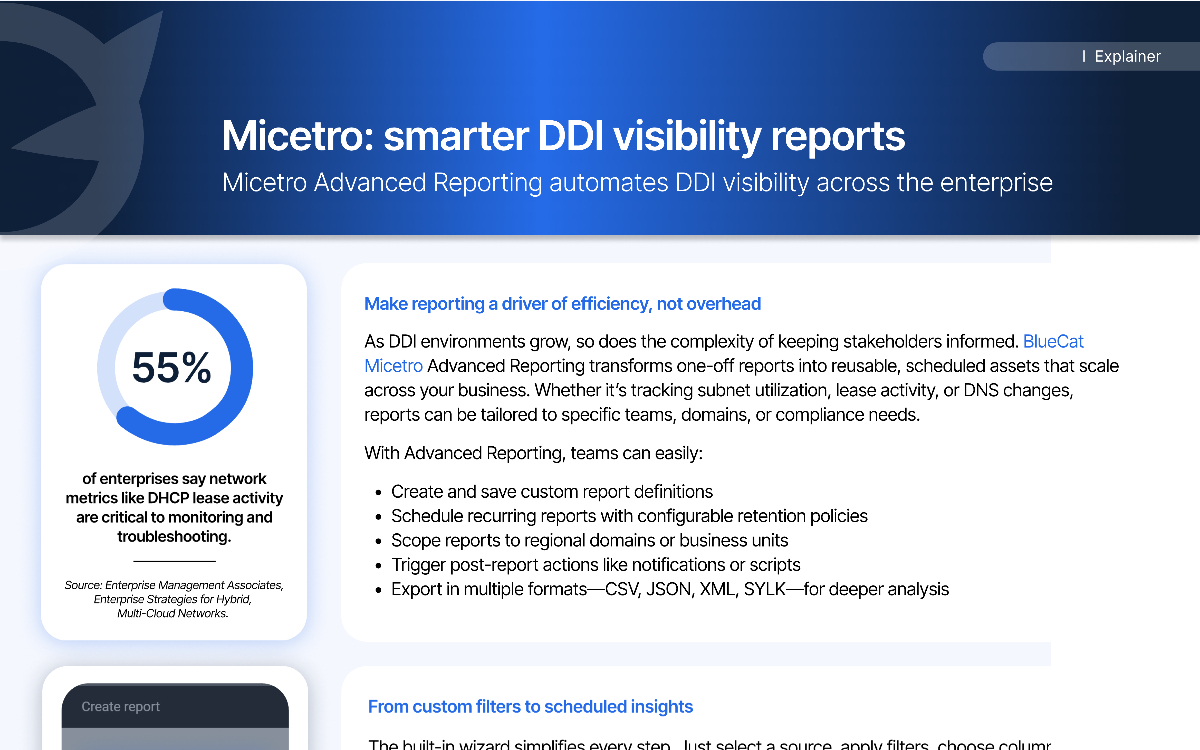
BlueCat Micetro Advanced Reporting automates DDI visibility with reusable, scheduled reports that scale across teams, domains, and compliance needs. With…
Read more ›
Centralize multi-vendor DHCP scopes, leases, and policies without re-architecting. Monitor, automate, and secure enterprise DHCP with Micetro’s unified…
Read more ›
IPAM for Microsoft DNS and DHCP that adds visibility, automation, and control. Manage IP address space across hybrid and multi-cloud environments.
Read more ›

The market is rapidly building toward a future state of more intelligent networks: self-healing, self-optimizing multi-vendor networks that operate autonomously, using AI and machine learning to predict, detect, and resolve issues in real time. It’s maximum agility, resilience, and future-readiness.
This advanced state depends on unifying DDI and linking foundational network services with a deep and predictive understanding of network health and performance. Learn more about the path to building the Intelligent Network.
We’re using cookies on this website to improve your experience. Cookies help us learn how you interact with our website and remember you when you come back so we can tailor it to your interests.
To learn more about cookies and how we use them, read our cookie notice.
Some cookies are essential, while others help us to improve your experience by giving us insight into how you are using our website. You may adjust your preferences for non-essential cookies below.
To learn more about cookies and how we use them, read our cookie notice. You can also review our privacy policy for more details on the personal data we collect, use, hold, and disclose when you visit our website or use our products and services.
Functional cookies are essential cookies that allow us to remember choices or changes you have made (such as to language settings or your choices regarding the use of cookies). These cookies cannot be turned off since they are essential for the operation of our Websites.
Analytics cookies are non-essential cookies that collect information on how visitors use our Websites. We use this information with your consent to measure the number of visitors to our Websites, determine whether specific content or communication has been viewed, and to help us improve our Websites and communication. These cookies can be turned off.
Personalisation cookies are non-essential cookies that collect information when you fill out a form on this website. We only use this information with your consent to pre-fill other forms on the site. These cookies can be turned off.
Marketing cookies are cookies that are placed by third parties to collect information about your visits and actions on our Websites so that they or we can deliver ads to you later, such as when you are on certain third-party sites or platforms. These cookies may be used by those third parties to build a profile of your interests and show you relevant ads on other websites. These cookies also enable visitors to our Websites to share content on social networks and to enable and evaluate interactions with our communication and social media tools. These cookies can be turned off.