DDI maturity drives multi-cloud automation and security
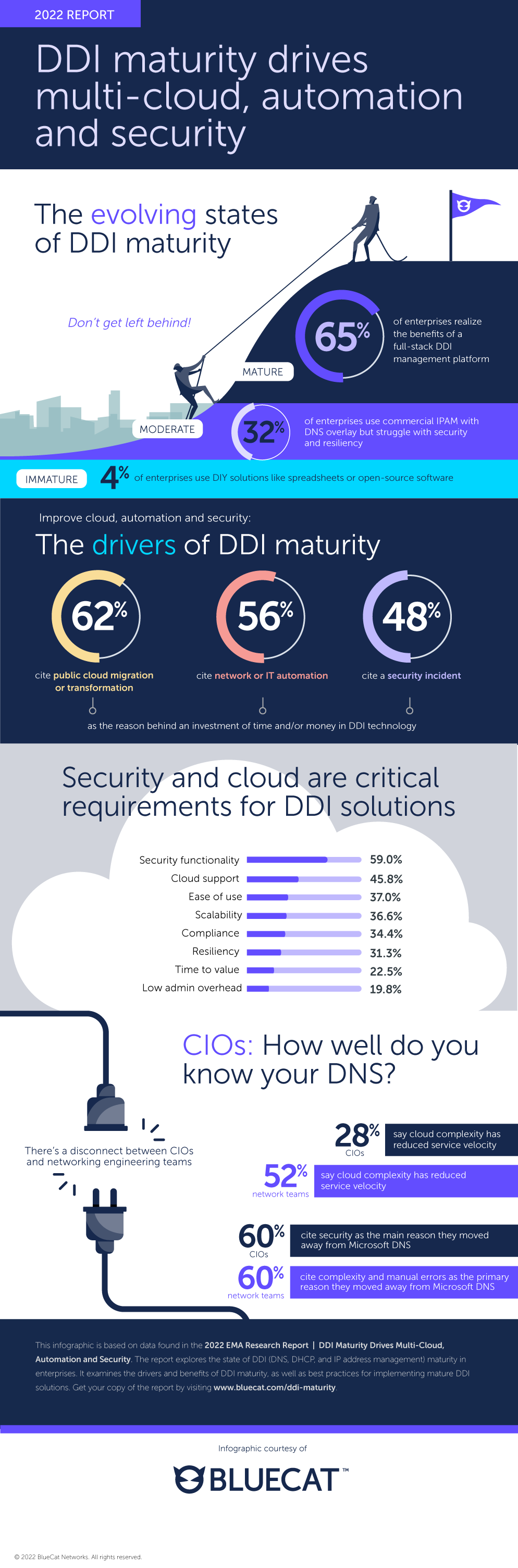
This infographic examines the evolving states of DDI maturity and how DDI maturity drives multicloud, automation, and security.



A report by Enterprise Management Associates explores the state of DDI (DNS, DHCP, and IP address management) maturity in enterprises. It examines the drivers and benefits of DDI maturity, as well as best practices for implementing mature DDI solutions.
Check out the main drivers of DDI maturity and the critical requirements which are based on a survey of 227 IT professionals from medium and large enterprises across North America and the United Kingdom.
 Key takeawaysKey takeaways are generated with AI assistance. Because automated summaries can occasionally contain errors or miss important context, always refer to the full blog post for complete information.
An Enterprise Management Associates report analyzes DDI (DNS, DHCP, IP address management) maturity across medium and large enterprises in North America and the United Kingdom, based on a survey of 227 IT professionals. The article outlines the main drivers pushing organizations toward higher DDI maturity, the operational and business benefits of mature DDI, and critical technical and organizational requirements for successful implementation. It highlights best practices and practical guidance for implementing mature DDI solutions to improve network reliability, automation, and address management at scale.
What was the scope and methodology of the DDI maturity study referenced in the article?
The study referenced is a report by Enterprise Management Associates that examined DDI maturity through a survey of 227 IT professionals drawn from medium and large enterprises across North America and the United Kingdom. The report explored drivers, benefits, and best practices for implementing DDI solutions, collecting data directly from practitioners responsible for DNS, DHCP, and IP address management. This empirical approach enabled the report to identify common requirements and maturity drivers grounded in the experiences of real-world enterprise IT teams.
What primary drivers push enterprises to pursue higher DDI maturity according to the article?
According to the article, the primary drivers for pursuing higher DDI maturity include needs for improved network reliability, automation to reduce manual tasks, and better IP address visibility and governance. Enterprises seek mature DDI to support scale, reduce operational risk, and enable faster provisioning and troubleshooting across distributed environments. These drivers reflect operational pressures on IT teams to deliver consistent service levels and to manage increasingly complex addressing and name resolution demands.
What outcomes and best practices for implementing mature DDI solutions does the report highlight?
The report highlights that mature DDI implementations yield benefits such as enhanced network reliability, streamlined operations through automation, and improved address management at scale. Best practices emphasized include aligning DDI capabilities with operational requirements, adopting automation to minimize manual intervention, and establishing governance and processes for IPAM. The findings suggest focusing on critical technical and organizational requirements identified by survey respondents to successfully transition to and sustain a mature DDI posture.