
Getting more from Microsoft DNS
Simplify, automate, and gain visibility across your Microsoft DNS environment—without replacing what already works

 Key takeawaysKey takeaways are generated with AI assistance. Because automated summaries can occasionally contain errors or miss important context, always refer to the full blog post for complete information.
This article explains how Micetro from BlueCat overlays Microsoft DNS to simplify management, reduce operational risk, and enable gradual automation without replacing existing DNS infrastructure. It describes real-world problems that arise as Microsoft DNS environments scale—fragmented visibility, manual processes, and inconsistent delegation—and the operational impact of harder troubleshooting and auditing. The piece highlights outcomes including centralized visibility and delegation control, safer DNS changes, and paths to automation via REST API, Ansible, and Terraform to improve governance and efficiency across on-premises and hybrid environments.
Microsoft DNS works well for many organizations. The challenge comes later, as environments grow across more servers, teams, and cloud services. Over time, DNS management becomes increasingly manual. Teams rely on spreadsheets, scripts, tickets, and institutional knowledge to keep operations running. This e-book explores how network teams can centralize management, improve visibility, reduce manual work, and introduce safer DNS change control—without replacing Microsoft DNS.
Where Microsoft DNS management gets more complex
Managing Microsoft DNS becomes more challenging over time—not because the platform falls short, but because the operational model doesn’t scale alongside it.
- DNS environments often grow organically, leading to fragmented visibility across servers, zones, and IP address tracking systems
- Teams rely on manual processes, spreadsheets, and individual expertise to maintain accuracy and continuity
- Adding more DNS servers increases operational overhead rather than solving core management challenges
- Lack of centralized control introduces risk, from inconsistent configurations to knowledge silos
- As hybrid and cloud environments expand, the need for unified visibility and governance becomes more urgent
As organizations look to simplify Microsoft DNS management without replacing what already works, many are turning to centralized management approaches, such as BlueCat Micetro, that extend existing services rather than replace them.
The operational impact of Microsoft DNS
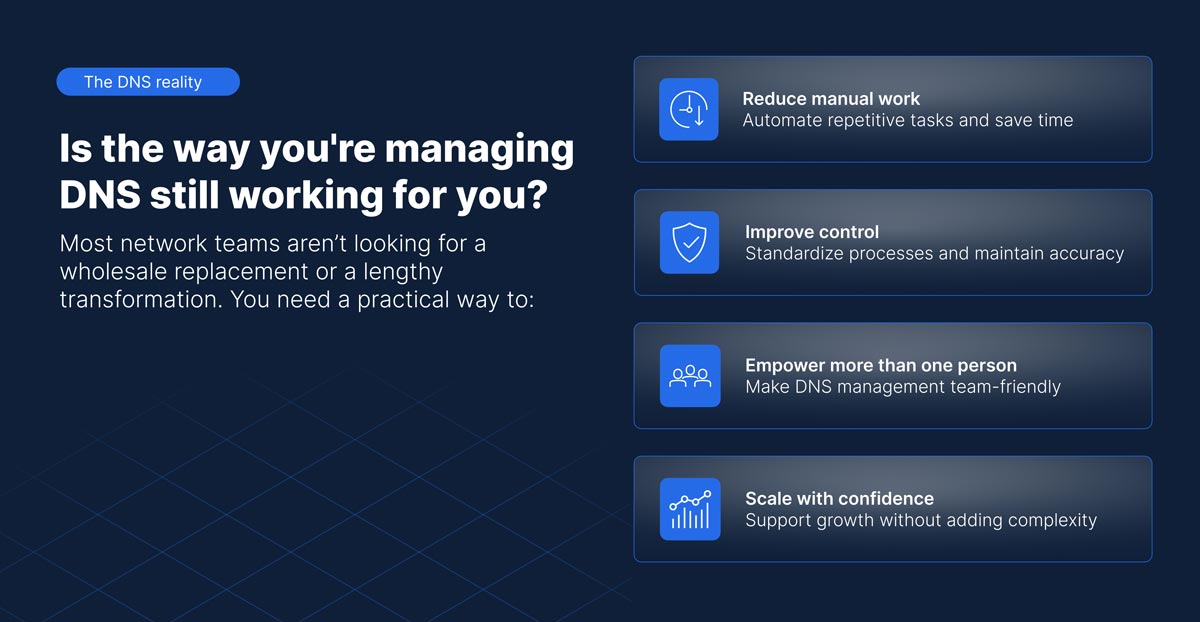
Microsoft DNS continues to meet the technical needs of most organizations, but the challenge is operational scale. As more servers, zones, sites, and cloud services are added, DNS management often becomes fragmented across native tools, spreadsheets, scripts, tickets, and institutional knowledge. Over time, routine DNS tasks require more coordination than they should. Troubleshooting becomes slower because the information teams need is spread across multiple systems and people. DNS changes become harder to standardize, and operational knowledge often becomes concentrated in the heads of one or two experienced administrators. Adding more DNS infrastructure does not solve these problems, but modernizing its management does. Centralized visibility, delegated access, workflow controls, and automation can help teams reduce operational overhead while continuing to use the Microsoft DNS infrastructure they already trust.
What this means for network teams
For network and infrastructure teams, the challenge isn’t whether Microsoft DNS works—it’s whether the current operating model can keep up with growth.
- Visibility gaps can make it harder to understand what exists and what has changed
- Manual processes slow down routine tasks and increase the likelihood of errors
- Knowledge silos can create operational risk and limit scalability
- Adding infrastructure alone does not address underlying management inefficiencies
- Hybrid cloud environments benefit from a more unified management approach
Improving DNS operations starts with simplifying how teams interact with their network environment. Centralized visibility, role-based delegation, and better change tracking allow teams to move faster without sacrificing control.
Getting more from Microsoft DNS
Access the full e-book
What you’ll learn:
- How to simplify Microsoft DNS management without replacing existing infrastructure
- Ways to improve visibility, delegation, and change control across your environment
- How to support hybrid and cloud growth with a more unified approach