
2026 Omdia Research Report: Network Observability in the Agentic AI Era
How AI-powered network observability is becoming essential for modern operations—and why NetOps, SecOps, and Cloud teams are converging around it.
 Key takeawaysKey takeaways are generated with AI assistance. Because automated summaries can occasionally contain errors or miss important context, always refer to the full blog post for complete information.
The article summarizes Omdia’s January 2026 research report, "Network Observability in the Agentic AI Era," which finds that AI-powered network observability is becoming operationally essential for NetOps, SecOps, and Cloud teams as they converge on shared visibility and automation needs. It highlights rising enterprise investment in observability over the next two years, agentic AI reshaping visibility, troubleshooting, and automation, and the importance of sharing observability data between teams to deliver actionable insight and context. BlueCat positions its network observability portfolio—combining real-time performance visibility, deep traffic analysis, assurance, and authoritative DNS/DHCP/IPAM intelligence—as a practical path to improve visibility, collaboration, and AI readiness across modern networks.
What key findings did the Omdia report identify about AI and observability spending?
The Omdia report reports several key signals: respondents expect increased spending on network observability over the next two years, and a majority indicate that AI is meeting or exceeding expectations in observability use cases. The research emphasizes accelerating investment as enterprises prioritize tools that enhance visibility, automation, and troubleshooting. These findings suggest organizations are allocating budget to solutions that combine real-time telemetry, analytics, and AI-driven insights to support converging NetOps, SecOps, and Cloud teams.
How does BlueCat describe the role of authoritative DNS, DHCP, and IP address services in observability?
BlueCat states that effective network observability depends on the insight and context delivered by data sources, and positions authoritative DNS, DHCP, and IP address services as foundational network intelligence. By combining these authoritative services with real-time network performance visibility, deep traffic analysis, and assurance capabilities, BlueCat’s observability portfolio aims to enrich telemetry with contextual naming, addressing, and allocation information. This enriched context is presented as critical for improving visibility, facilitating collaboration across teams, and enabling AI readiness in modern network operations.
What operational benefits does the article claim organizations can achieve by adopting BlueCat’s observability approach?
The article claims that organizations can translate Omdia’s research findings into operational outcomes by using BlueCat’s portfolio to improve visibility, collaboration, and AI readiness. Specifically, combining real-time performance metrics, deep traffic analysis, assurance, and authoritative DNS/DHCP/IPAM intelligence is intended to deliver actionable insights into network and application performance across devices, interfaces, and applications. These capabilities are presented as enabling more effective troubleshooting, better cross-team data sharing between NetOps and SecOps, and readiness for agentic AI-driven automation and analytics.
As AI-powered applications move into production, the network has become a critical dependency and a growing risk. At the same time, hybrid, multicloud, and containerized environments have made visibility more fragmented and harder to manage.
Traditional monitoring tools are no longer enough. Organizations are turning to network observability, enhanced by AI and emerging agentic architectures, to deliver the context, intelligence, and automation required to keep digital operations running.
As a result, network observability is no longer just a monitoring capability. It is becoming a foundational requirement for operating AI-driven systems reliably and at scale. Network observability goes beyond traditional monitoring by correlating performance, traffic, and dependency data to explain not just what is happening in the network, but why.
What the research reveals
This research explores how enterprises are responding and where gaps still remain. The research highlights strong engagement from Security Operations, Cloud Operations, DevOps, and Platform Engineering, reinforcing observability as a shared foundation for cross-team collaboration. Many organizations now view network observability as a key pillar of broader NetSecOps initiatives, supporting faster incident response and improved security posture.
Key research signals

80%+
expect increased
network observability
spending over the next two years

85%
say AI is meeting or exceeding expectations in observability
use cases

70%
say sharing observability data between NetOps and SecOps
is essential
These signals point to a clear conclusion: network observability is no longer optional infrastructure.
It is becoming a strategic capability.
Key findings:
1. AI is changing what observability must deliver
The research shows that AI is already widely used in network observability, with organizations applying it to performance optimization, security threat identification, and operational efficiency. Expectations are high, and in most cases, AI is delivering measurable value.
Agentic AI, while still emerging, is gaining real traction. More than half of organizations report active use today, with broader adoption expected as teams look to simplify integrations, close skills gaps, and move toward more autonomous operations.
2. Observability is driving cross-team convergence
Network observability data is no longer confined to networking teams. The research highlights increasing collaboration between NetOps and SecOps, with observability insights shared to reduce risk, improve response times, and support coordinated decision-making.
This convergence reflects a broader shift toward integrated operational models, where networking, security, and cloud teams rely on shared visibility to manage complex environments.
3. Complexity remains the biggest barrier
Despite increased investment, most enterprises still rely on three or more network observability tools. Tool sprawl, data fragmentation, and integration challenges continue to limit the effectiveness of observability initiatives.
The research makes clear that success depends not just on collecting more data, but on correlating it effectively and delivering insights teams can act on.
Chart 1: Level of agreement with statements related to network environments.

As AI technologies move into broader adoption and deployment, nearly everyone agrees that networking is becoming more critical. Download report to read more.
Chart 2: Status of AI technologies within or in conjunction with network observability.
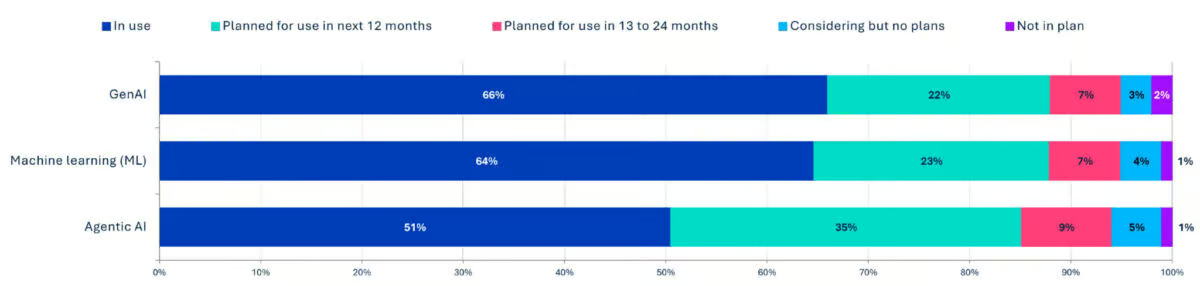
Network observability vendors have been working feverishly to add AI technologies into their products, while those using open source or building their own tools have increasingly ready access to AI componentry. Download report to read more.

What this means
The findings point to a future where network observability must:
- Provide comprehensive visibility across cloud, WAN, data center, and container environments
- Support AI-driven analysis and automation without increasing operational burden
- Enable collaboration across networking, security, and cloud teams
- Scale as AI workloads and digital dependencies grow
Organizations that treat observability as a foundational capability, rather than a set of disconnected tools, will be better positioned to support AI-driven operations.
Get more insights on network
observability’s AI future!
Download the report to understand how AI, and agentic AI in particular, is redefining
what network observability must deliver.
What you’ll learn from this report:
- Why network observability has reached “essential” status for modern IT operations
- The fastest-growing AI use cases in network observability, from performance
optimization to threat detection - How agentic AI is expected to simplify integrations and close skills gaps