
The Power of a Client-Facing DNS Firewall
Learn why Adaptive DNS is the foundation for scalable, secure networks and critical to all of your digital transformation strategies.


 Key takeawaysKey takeaways are generated with AI assistance. Because automated summaries can occasionally contain errors or miss important context, always refer to the full blog post for complete information.
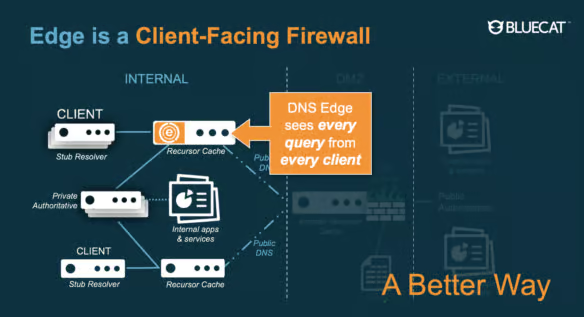
The video "The Power of a Client-Facing DNS Firewall" explains how Adaptive DNS provides a client-facing DNS firewall as a foundational component for scalable, secure networks and digital transformation initiatives. It addresses the real-world problem of protecting users and devices from malicious or inappropriate domains by enforcing security and policy at the DNS layer, which operates across on-premises, cloud, and hybrid environments. The outcome is improved threat prevention, simplified management of network security policies, and a scalable approach that supports modern digital transformation strategies while reducing operational complexity and risk.
What is Adaptive DNS and why is it important for network security?
Adaptive DNS is a client-facing DNS firewall approach that enforces security and policy at the DNS layer for users and devices. It is important because DNS is a universal protocol used by virtually all networked applications, allowing security controls to be applied early in the connection process to prevent access to malicious, suspicious, or non-compliant domains. By operating at the DNS level across on-premises, cloud, and hybrid environments, Adaptive DNS provides scalable threat prevention, consistent policy enforcement, and reduced operational complexity compared with per-application or endpoint-only controls.
How does a client-facing DNS firewall support digital transformation strategies?
A client-facing DNS firewall supports digital transformation by providing a scalable and centralized security control that works across diverse environments and modern application architectures. As organizations adopt cloud services, remote work, and IoT, DNS-based controls ensure consistent policy enforcement without requiring invasive changes to applications or complex endpoint agents. This simplifies operations, accelerates secure adoption of new services, and reduces risk by blocking malicious or non-compliant domain access before connections are established, enabling secure growth and agility in transformational initiatives.
What operational benefits can organizations expect from deploying DNS-layer protection?
Deploying DNS-layer protection delivers several operational benefits: it reduces the volume of incidents by preventing connections to known bad domains, lowers the need for extensive endpoint or network-based inspection, and consolidates policy management into a single control point. Because DNS is lightweight and ubiquitous, enforcement is less disruptive and easier to scale across distributed sites and cloud environments. The result is improved security posture with simpler administration, faster response to threats, and a reduced burden on downstream security tools and teams.

The Power of a Client-Facing DNS Firewall
Learn why Adaptive DNS is the foundation for scalable, secure networks and critical to all of your digital transformation strategies.