
Get answers from the LiveNX data you already have with LiveAssist
Learn how LiveAssist, the AI-powered add-on for LiveNX, turns your network data into fast, guided answers, with value you can see in days.



 Key takeawaysKey takeaways are generated with AI assistance. Because automated summaries can occasionally contain errors or miss important context, always refer to the full blog post for complete information.
BlueCat LiveAssist is an AI-powered add-on for LiveNX that transforms network monitoring data into actionable insights by providing root-cause analysis and recommendations through a natural language interface. The solution works with existing flow, packet, SNMP, and telemetry data collected by LiveNX across hybrid and multicloud environments, eliminating the need for new telemetry pipelines or dashboards. By leveraging AWS Bedrock and Model Context Protocol, LiveAssist enables network teams to resolve incidents faster, empower engineers at all levels with expert-level guidance, and turn network visibility into operational efficiency within days of deployment.
How does LiveAssist access and process network data from LiveNX?
LiveAssist accesses network data through LiveNX’s internal repositories containing flow records, SNMP data, packet data, and alerts. When engineers submit queries via the natural language interface, LiveAssist uses Model Context Protocol (MCP) to connect to these repositories and communicate with a large language model running in AWS Bedrock. The LLM determines which tools to invoke, and through MCP client calls, it fetches, correlates, and summarizes data from multiple sources before returning a comprehensive response. All queries remain within your network infrastructure for security.
What are the practical benefits of LiveAssist for network operations teams?
LiveAssist provides several operational benefits including prioritized morning snapshots of network issues, enabling junior engineers to receive expert-level remediation guidance through plain language queries, and accelerating the learning curve for new LiveNX users. The solution correlates multi-vendor telemetry across routers, firewalls, and cloud environments to identify whether issues stem from performance degradation, misconfiguration, or recent changes. Network teams typically see value within days of deployment, reducing mean-time-to-resolution and decreasing dependence on senior staff for routine troubleshooting.
What security and data governance measures does LiveAssist implement?
LiveAssist is built with secure connections to network data, ensuring that all queries stay within your network infrastructure rather than being sent to external systems. Importantly, BlueCat does not use your network data to train external models, protecting your proprietary information and operational details. The solution extends your existing LiveNX deployment while maintaining data privacy and governance requirements, making it suitable for organizations with strict security and compliance standards.
If your team runs BlueCat LiveNX, it captures flow, packet, SNMP, and telemetry data across your hybrid and multicloud environment. You get a real-time picture of overall network health, especially when something goes wrong.
The hard part, however, is turning that data into a fast decision before it becomes an outage.
LiveAssist, an AI-powered add-on for LiveNX, closes that gap. Because it works with data you already collect, network teams typically see value within days, not weeks, after rollout. The result is actionable insights that transform network monitoring.
In this post, we explore how LiveAssist uses your LiveNX data to generate root-cause analysis and recommendations. Next, we share several day-to-day use cases for LiveAssist. Finally, we highlight how adding LiveAssist to your LiveNX environment helps turn data into action.
LiveAssist works with the data you already have
LiveAssist works with the flow records, SNMP data, packet data, and alerts already flowing into LiveNX. There is no new telemetry pipeline to stand up and no new dashboard to learn. Engineers ask a question in plain language and get guided, step-by-step root-cause analysis in return.
LiveAssist is built for fast deployment and intuitive onboarding, so most network teams—including junior staff—can start asking questions and getting answers almost immediately.
LiveAssist works across the internal repositories that store the network data flowing into LiveNX. When you submit a query through its natural language interface, it uses Model Context Protocol (MCP) to access that data. This connects LiveNX’s capabilities to a large language model (LLM) running in AWS Bedrock.
LiveAssist combines queries made through its natural language interface with tools that access alerts, flow records, SNMP, and packet data in LiveNX’s data repositories. It passes this context to the LLM, which then decides which tools to invoke. Through the MCP client, the LLM calls the necessary MCP servers to fetch, correlate, and summarize the data before returning a response.
LiveAssist extends your existing LiveNX deployment. Built for a secure connection to your data, queries stay inside your network infrastructure. Furthermore, LiveAssist does not use your network data to train external models.
What LiveAssist looks like day to day
LiveAssist can play several roles in improving the efficiency of your day-to-day network operations. Here are a few examples:
Start the day with a prioritized view. Instead of digging through logs and tickets, engineers can ask LiveAssist what needs attention this morning. They get a clear, prioritized snapshot of the day’s most pressing issues and what may be trending toward a bigger problem.
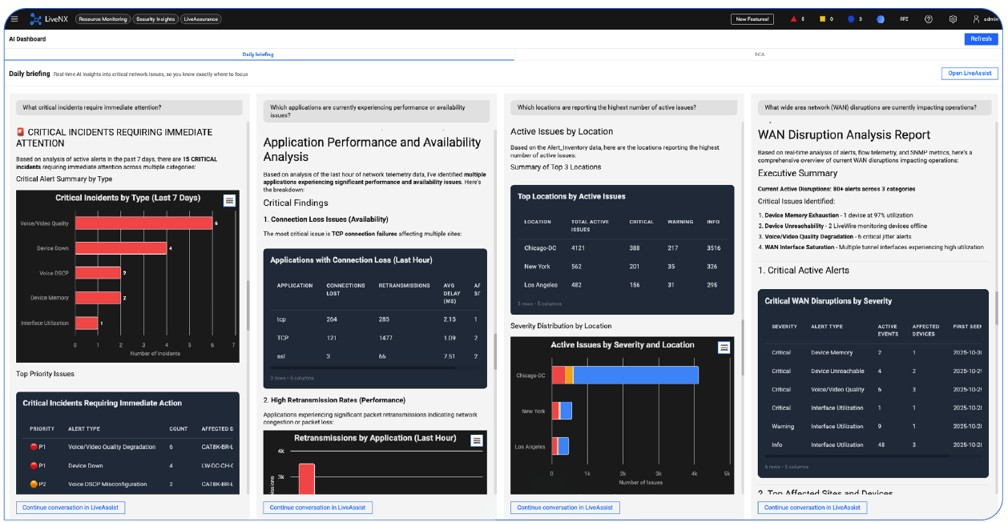
Give every engineer expert-level answers. Front-line and junior engineers can query LiveAssist in natural language and get the same guided remediation advice a senior engineer would give. This reduces dependence on your most experienced staff and eases alert fatigue.
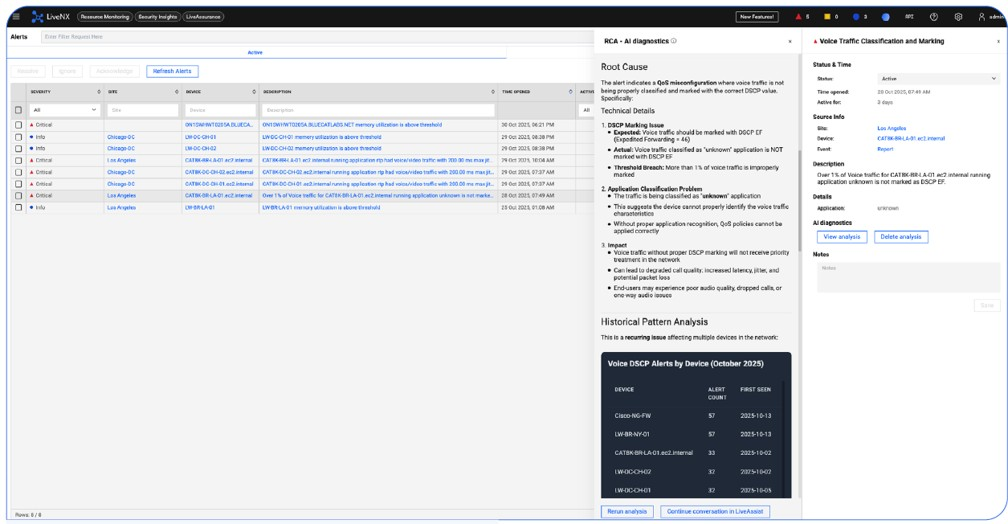
Accelerate the learning curve. With LiveAssist, NetOps practitioners who have little or no familiarity with LiveNX can use plain language to get guided root-cause analysis and step-by-step fixes for network issues.
Shorten the path to the root cause. When application slowdowns hit a multi-vendor environment, LiveAssist correlates telemetry across routers, firewalls, and cloud environments, along with recent configuration changes. It identifies whether the issue is performance degradation, misconfiguration, or a recent change, and explains its findings in plain language.
The benefit: Make network data not just available, but actionable
By correlating multi-vendor network telemetry and making it accessible through a natural language interface, LiveAssist helps teams work smarter, resolve incidents faster, and prevent issues before they spread.
Like having a chatbot for your network, LiveAssist takes LiveNX’s deep, granular data and supercharges it with AI to deliver faster insights, automatic correlation, and simplified access. It has all the power of LiveNX, made even easier, smarter, and more efficient.
LiveNX sees everything on your network. LiveAssist understands it. Together, they make network data actionable, not just available.
With LiveAssist, you can:
- Cut network downtime and speed up issue resolution
- Empower every network engineer on your team with expert-level insights
- Reduce operational costs while boosting productivity
- Gain confidence in your network’s performance and security
You’ve already invested in the visibility LiveNX provides. Now turn that visibility into faster answers for every network engineer on your team. Ask your BlueCat account team how to integrate LiveAssist with your current LiveNX deployment and see value from the first week, not the first quarter.
Contact your BlueCat account team today to integrate LiveAssist with your current LiveNX deployment.
Published in:

Rebekah Taylor is a former journalist turned freelance writer and editor who has been translating technical speak into prose for more than two decades. Her first job in the early 2000s was at a small start-up called VMware. She holds degrees from Cornell University and Columbia University’s Graduate School of Journalism.
Related content

Get total control of your DDI infrastructure with Micetro’s unified API
Stop juggling between network tools and use Micetro’s RESTful API for complete control over your DDI infrastructure and cloud environment.

BlueCat MCP servers bring network intelligence to your AI assistant
Our MCP servers provide a standard integration layer that makes it easy to connect the AI tools you already use to BlueCat products.
We bet on Intelligent NetOps two years ago. Infoblox now has too.
With Infoblox acquiring Kentik, BlueCat’s CEO confirms its vision for a single platform unifying DDI, network monitoring, and observability.
BlueCat DDI data boosts Cisco Cloud Control AI-driven operations
BlueCat’s integration with Cisco Cloud Control provides AI agents with access to trusted DDI data for network investigation and remediation.