
Disrupting DDI @ Networking Field Day (In Tweets)


 Key takeawaysThis key takeaway was generated through LLMs crawling the page and coming up with an overview of the content.
BlueCat Networks presented at Networking Field Day (NFD19) to explain their vision for disrupting DDI by advancing to Adaptive DNS, addressing real-world problems like inaccurate IPAM data and slow manual DNS/DHCP workflows in enterprise environments. In a technical environment focused on network automation, APIs, and unified data, presenters emphasized unifying DNS, DHCP, and IPAM as a single source of truth to monitor transactions, extract value from IP-related data, and improve deployment speed and security posture. The outcome highlighted by the talks and attendee reactions was that automation and Adaptive DNS can reduce manual errors, speed host record deployment, and provide stronger visibility for operational and security teams dealing with DNS-based attacks and complex networks.
What problem with traditional DDI did BlueCat highlight during their NFD19 presentation?
BlueCat explained that traditional DDI practices hold organizations back because many IPAM databases do not reflect reality—being largely manual and out of date—leading to slow workflows and inaccurate records. Presenters emphasized that manual processes can result in misconfigured PTR records and two-week host record deployment times in some companies. Their point was that unifying DNS, DHCP, and IPAM and applying automation can correct those inaccuracies, speed operations, and provide a reliable single source of truth for network teams.
How does BlueCat describe the role of Adaptive DNS and transaction data in network operations?
BlueCat positioned Adaptive DNS as the next level beyond basic query-and-answer DNS, where DNS, DHCP, and IPAM are unified to monitor DDI transactions and tell a story about the IPs behind those transactions. By extracting value from transaction data, teams can gain visibility into device behavior and security events (noting that DNS is heavily used in attacks). The presenters argued that this transaction-level insight, combined with API-driven workflows, enables automation and improved decision-making across IT and security operations.
What operational and technical capabilities did BlueCat emphasize for automating DDI?
BlueCat emphasized unification of the three DDI pillars—IP space, DNS, and devices—into a single source of truth along with robust API capabilities tied to custom workflows. They stressed that discovery must involve existing teams and tools, and warned there is no magic bullet for accurate data without integrating with current processes. The operational capabilities highlighted include monitoring DDI transactions, automating record deployment to dramatically reduce time to provision hosts, and using APIs to enable flexible, automated workflows that keep the IPAM database aligned with reality.
As first-time Networking Field Day presenters, the BlueCat team was thrilled to discuss the future of DDI (hint: it’s cloudy, plus a 100% chance of disruption by Adaptive DNS) with a dozen network-savvy delegates.
Kicking It Off
Check out the @BlueCatNetworks team getting ready to present to our #NFD19 delegates! pic.x.com/d5oM82cRrf
— Tom Hollingsworth (@networkingnerd) November 7, 2018
Getting ready to kick off #NFD19 with @BlueCatNetworks. Follow along for all the DNS goodness. https://t.co/KMIUm4SEyU
— Ryan M. Adzima (@radzima) November 7, 2018
IT’s a full first day at #NFD19 with the morning kicking off with @BlueCatNetworks at 10 PST. Tune into the livestream at https://t.co/XcL21Cl9At
— Rob Coote (@Rob_Coote) November 7, 2018
The Story: Disrupting DDI
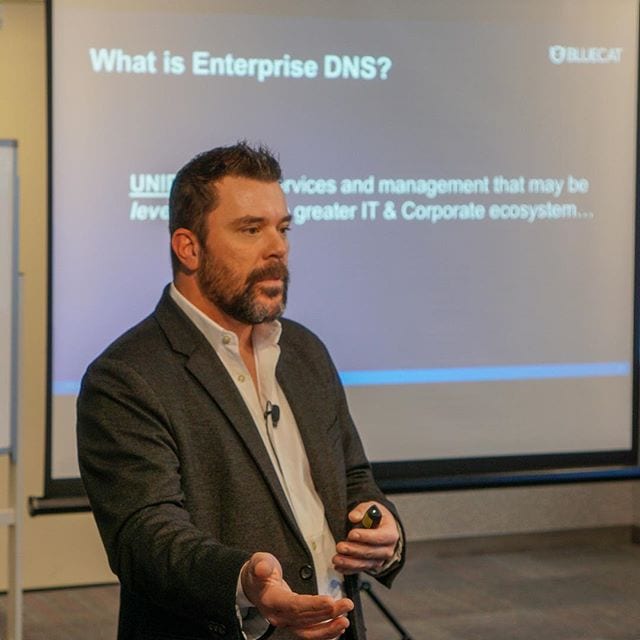
This writer’s boss took the stage first, with a synopsis of BlueCat’s history. Did you know we began selling DNS servers in 2001?

Jim Williams dropped some serious truth in his talk.
“Traditional DDI holds all these things back.” @jimcwilliams #NFD19 pic.x.com/iLL7MQMHF5
— BlueCat (@BlueCatNetworks) November 7, 2018
#NFD19 @BlueCatNetworks says that 91% of malware uses DNS in attacks. It really is the most necessary service on the Internet.
— Tom Hollingsworth (@networkingnerd) November 7, 2018
The Routing Table’s Kevin Blackburn had the right idea, too.
Basic DNS is nothing more than a query and an answer. @BlueCatNetworks is beginning to explain how they are taking this to the next level. If you are not watching yet, join us NOW: https://t.co/VckEXY2MbB #NFD19
— Kevin Blackburn (@TheRoutingTable) November 7, 2018
Oh, and this happened.
Laptop sticker game strong. #nfd19 @ecbanks @packetpushers pic.x.com/cCTTxTLiXq
— BlueCat (@BlueCatNetworks) November 7, 2018
Then, we got technical.
Adaptive DNS evangelist, Jason Davis, broke it down.

3 pillars are essentials in any enterprise IT infrastructure : – IP Space – DNS world and the devices themselves. @BlueCatNetworks offers a unified solution that links all 3 worlds together. #NFD19
— Nicolas MICHEL (@vPackets) November 7, 2018
Where @BlueCatNetworks has gotten with DDI (DNS, DHCP, IPAM) is unification of these 3 services into a single source of truth.
Monitor DDI transactions, and tell a story about the IP behind those transactions. Extract value from the transaction data.#NFD19
— Ethan Banks (@ecbanks) November 7, 2018
Discovery is a process that has to involve the teams and tools that are already in place. There is no magic bullet that you can fire into a network and get accurate data. #NFD19 @BlueCatNetworks
— Rob Coote (@Rob_Coote) November 7, 2018
We all but drew it out.

The @BlueCatNetworks story they are telling at #NFD19 gets more interesting when you put them in a role as a “single source of truth” for network automation.
The API capabilities tied back to custom workflows make the solution sound flexible to me. Hoping for more details here.
— Ethan Banks (@ecbanks) November 7, 2018
Sorry everyone, your PTR records are trash. #NFD19 @BlueCatNetworks
— Rob Coote (@Rob_Coote) November 7, 2018
In most customer environments, IPAM database does not reflect the reality because it’s usually a manual process. Automation is key in this industry to solve these problems #NFD19 @BlueCatNetworks
— Nicolas MICHEL (@vPackets) November 7, 2018
“We’re not just charting out the path to Adaptive DNS for customers, we’re helping figure out how to automate.” @wirespeed14 #NFD19 #networking #automation pic.x.com/KvhQtxthIx
— BlueCat (@BlueCatNetworks) November 7, 2018
Probably good that we didn’t draw it out. Apstra’s Carly Stoughton was miles ahead of us in that department…
Now THAT’S a whiteboard! #NFD19 @ApstraInc @_vCarly pic.x.com/kKN1q9QkrP
— Tom Hollingsworth (@networkingnerd) November 8, 2018
We did what we do best.
“It’s shocking that it takes some companies 2 weeks to deploy a host record.” @wirespeed14 #NFD19 pic.x.com/IjHCJLam68
— BlueCat (@BlueCatNetworks) November 7, 2018
We really mean it. It’s gold. #NFD19
— BlueCat (@BlueCatNetworks) November 7, 2018
Jason Davis presents for BlueCat Networks #NFD19 pic.x.com/8VcAw3h0S9
— Tech Field Day (@TechFieldDay) November 7, 2018
#NFD19 Was Sweet But Keeping Up With Everyone Will Be Sweeter
More great conversations between #NFD19 delegates and great presenters like @ApstraInc, @illumio, and @BlueCatNetworks! pic.x.com/cbjmhQc2PN
— Tom Hollingsworth (@networkingnerd) November 8, 2018
Thanks again @BlueCatNetworks, @jimcwilliams, @danaiskoldski, Noel Reynolds and Kevin Wilson for presenting during @TechFieldDay earlier this morning. #NFD19 #BlueCatNetworks
— Al Rasheed (@al_rasheed) November 7, 2018
Enormous thank you and ‘nice to meet you’ to everybody from NFD. You’re one in seven-point-seven billion.

BlueCat provides core services and solutions that help our customers and their teams deliver change-ready networks. With BlueCat, organizations can build reliable, secure, and agile mission-critical networks that can support transformation initiatives such as cloud adoption and automation. BlueCat’s growing portfolio includes services and solutions for automated and unified DDI management, network security, multicloud management, and network observability and health.
Related content

How to map your network with user-defined links in Integrity X
Map your network with user-defined links in Integrity X to define and manage custom relationships, such as dual-stack and NAT environments.

Automate your DDI modernization path by migrating with Micetro
Automate cross-platform DNS and DHCP migration with Micetro to reduce risk, eliminate manual effort, and modernize infrastructure faster.

Your journey to intelligent NetOps begins at Cisco Live
Visit BlueCat’s booth or book a meeting now to learn more about how our solutions can help you build a network that supports constant change.

Replace BIND and ISC with Micetro DNS/DHCP Server (MDDS)
Tired of patching and manually configuring BIND DNS and ISC DHCP? Discover how Micetro MDDS appliances can replace them for modern DDI.