
Replace BIND and ISC with Micetro DNS/DHCP Server (MDDS)
Tired of patching and manually configuring BIND DNS and ISC DHCP? Discover how Micetro MDDS appliances can replace them for modern DDI.



 Key takeawaysKey takeaways are generated with AI assistance. Because automated summaries can occasionally contain errors or miss important context, always refer to the full blog post for complete information.
Enterprises running BIND DNS and ISC DHCP on Linux face heavy maintenance costs, patching overhead, configuration drift, and resource drain that limit strategic initiatives; the article explains how BlueCat’s Micetro DNS/DHCP Server (MDDS) appliances provide a turnkey modernization path that reduces OS-level upkeep while preserving DDI flexibility. MDDS appliances come pre-integrated, hardened, and pre-validated with BIND and ISC DHCP, and are centrally managed by Micetro to deliver consistent security posture, real-time visibility, and policy enforcement across mixed environments. The combined solution yields measurable business benefits — lower operational costs, improved uptime and resiliency via built-in high availability and geo-redundancy, faster migrations through automated tools, and high-performance options with BlueCat Gen5 appliances.
For years, BIND DNS and ISC DHCP on Linux have been the reliable workhorses of the enterprise network. But in today’s complex network environments, these reliable, legacy tools often come with a heavy maintenance tax.
If your network team is buried under a mountain of constant operating system (OS) patches, security vulnerabilities, and complex manual configurations, you aren’t alone. Managing traditional, open-source DNS, DHCP, and IP address management (together known as DDI) is resource-intensive and leaves little room for the strategic projects that actually move your organization forward.
You shouldn’t have to sacrifice the flexibility of your DDI environment to get enterprise-grade stability. Instead, with Micetro, BlueCat’s DDI orchestration platform, you can add Micetro DNS/DHCP Server (MDDS) appliances to provide a seamless path to modernization.
In this post, we first touch on the hidden costs of running BIND DNS and ISC DHCP on Linux. Next, we offer three key reasons to switch to MDDS and highlight key BIND DNS challenges and how MDDS addresses them. Finally, we explore the business value that MDDS offers and highlight the power of MDDS appliances for today’s network environments.
The hidden costs of the status quo
Organizations running BIND DNS and ISC DHCP on Linux often face a common set of hurdles:
- The patching treadmill: Constantly testing and applying OS-level updates to stay ahead of Common Vulnerabilities and Exposures (CVEs).
- Configuration drift: Inconsistent setups across different servers that make troubleshooting a nightmare.
- Resource drain: High-level engineers spend their time maintaining the network rather than on innovation.
MDDS appliances are designed specifically for network teams that need a turnkey experience without the overhead of managing a Linux distribution.
Why make the switch to MDDS?
Below are three reasons to make the switch to MDDS with Micetro.
1. A true turnkey experience
- Simplified setup: An appliance-based solution provides pre-integrated BIND and ISC DHCP, reducing the time and expertise needed to install and harden everything from scratch.
- Pre-validated environment: Hardware and software are tested together, eliminating guesswork about versions or interactions between the OS and DNS or DHCP services.
2. Patching and updates
- No OS-level upkeep: BlueCat manages appliance OS patches and BIND and ISC DHCP updates, freeing your team from the ongoing burden of testing.
- Consistent security posture: Regular Micetro appliance updates from BlueCat ensure consistent, predictable security hardening across your entire deployment.
3. Centralized orchestration and visibility
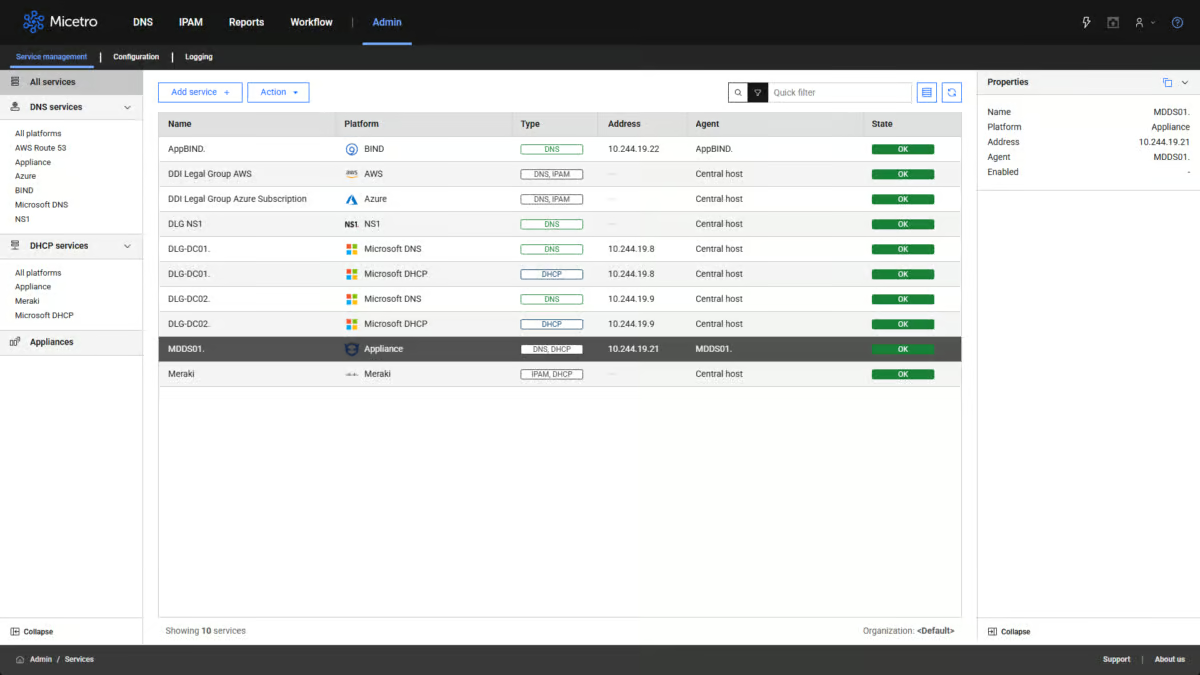
- Tight integration with Micetro: Micetro’s single pane of glass manages your DNS and DHCP services, providing real-time visibility, logging, and automation for all your resources.
- Policy consistency: Enforce uniform DDI policies from a single console, rather than juggling multiple servers and configuration files.
Comparing BIND challenges to MDDS advantages
The table below highlights several common challenges with BIND DHS and how MDDS addresses them.
|
BIND DNS challenge |
MDDS advantage |
|
Manual OS patches and upgrades |
Automated updates through Micetro’s centralized management |
|
Inconsistent configurations across servers |
Standardized appliance deployment with centralized management |
|
Complex disaster recovery |
Built-in high availability with simple failover configuration, automated backup and restore |
|
Difficult to scale |
Unlimited scalability with no appliance limits for Micetro customers |
|
Separate management interfaces |
Single pane of glass for all DNS and DHCP administration—BIND, Microsoft, MDDS, or others |
|
Limited integration capabilities |
Micetro API for automation and orchestration |
|
Security vulnerabilities |
Hardened appliance with regular security updates, applied to all appliances in just a few clicks |
The return on investment of modernization with MDDS
Beyond just technical specs, moving to MDDS delivers tangible business value:
- Reduced operational costs: MDDS eliminates the need for ongoing OS patching or BIND updates, resulting in fewer maintenance windows and reduced staff hours.
- Improved network uptime and resiliency: MDDS supports geo-redundancy and failover, mitigating single points of failure.
- Faster deployments and migrations: Micetro’s automated data cleansing and scope migration significantly shorten project timelines.
- Flexible growth path: MDDS allows for scaling with additional appliances as the business grows or keeping certain sites on BIND for a phased transition.
BlueCat Gen5 appliances for the highest performance
For environments that demand the highest performance, MDDS runs on our latest BlueCat Gen5 appliances. These rack-optimized systems feature dual-power AC/DC supplies and lights-out management, ensuring they can handle the most intensive enterprise throughput requirements.
The combination of Micetro’s orchestration and MDDS appliances offers the best of both worlds: the power of a modern DDI platform and the simplicity of dedicated hardware. Whether you are consolidating remote branch servers or finally moving away from manual Linux management, BlueCat is here to help you transform your landscape.
Ready to simplify your DNS infrastructure? Request a demo of Micetro and MDDS today to see how we can help you eliminate the maintenance tax and get back to building the future of your network.
Frequently asked questions
Find answers to common questions about replacing and modernizing BIND DNS infrastructure with Micetro and MDDS.
Still have questions?
Get real answers from a BlueCat representative.
Published in:

Josh Townsend is a Senior Technical Marketing Manager at BlueCat Networks.
Related content

Get answers from the LiveNX data you already have with LiveAssist
Learn how LiveAssist, the AI-powered add-on for LiveNX, turns your network data into fast, guided answers, with value you can see in days.

Get total control of your DDI infrastructure with Micetro’s unified API
Stop juggling between network tools and use Micetro’s RESTful API for complete control over your DDI infrastructure and cloud environment.

BlueCat MCP servers bring network intelligence to your AI assistant
Our MCP servers provide a standard integration layer that makes it easy to connect the AI tools you already use to BlueCat products.
We bet on Intelligent NetOps two years ago. Infoblox now has too.
With Infoblox acquiring Kentik, BlueCat’s CEO confirms its vision for a single platform unifying DDI, network monitoring, and observability.