
Why McMaster University didn’t want another CIO
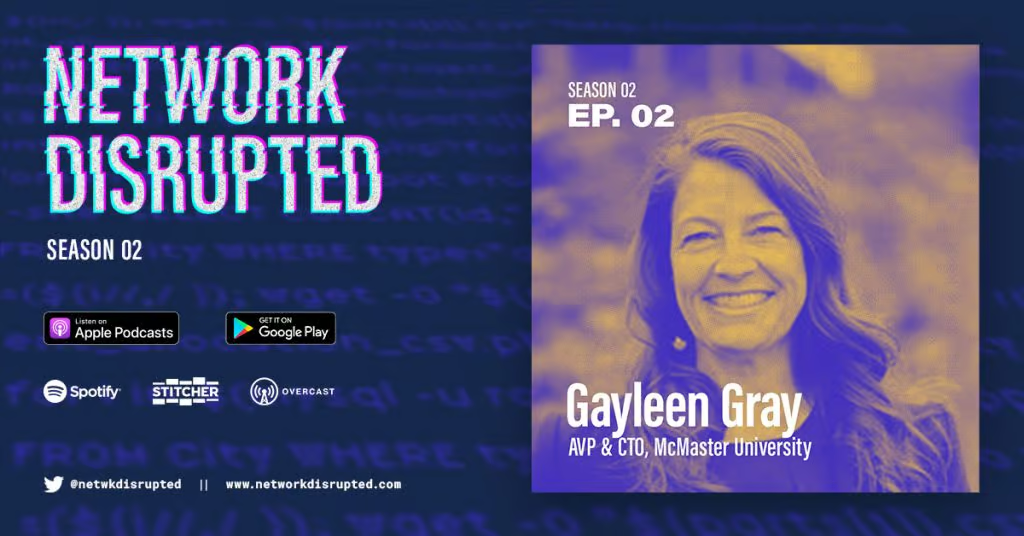
McMaster’s CTO, Gayleen Gray, highlights the importance of her unique role in a world where expectations of the CIO and CTO are colliding.


 Key takeawaysKey takeaways are generated with AI assistance. Because automated summaries can occasionally contain errors or miss important context, always refer to the full blog post for complete information.
The article profiles Gayleen Gray, McMaster University’s chief technologist (CTO), and her strategic approach to aligning IT with the university’s mission following a comprehensive peer-led IT services review. It describes how Gray prioritized three pillars—building a connected community, creating a seamless network and systems foundation, and delighting users with transformative solutions—while emphasizing radical transparency, storytelling over KPI fixation, and peer collaboration to improve operational efficiency and user trust. The piece highlights real-world operational impacts such as moving most course delivery online, standardizing campus networking and integrating systems with PeopleSoft, and delivering a virtual lab solution that improved teaching and learning.
Why did McMaster create the CTO role and how did the IT services review influence that decision?
McMaster’s CTO role emerged from a comprehensive, peer-led IT services review conducted by CIOs from higher education institutions in Canada and the U.S. The review surveyed campus stakeholders and identified gaps in efficiencies, capabilities, investments, and security, giving McMaster a clear view of where change was needed. The findings informed Gayleen Gray’s primary goals and allowed her to consolidate many technology teams and initiatives under a single technology leader, aligning IT strategy with the university’s mission and enabling prioritized work across the three strategic pillars she established.
What are the three strategic pillars Gray established and how do they affect daily operations?
Gray’s three strategic pillars are: 1) creating a connected community by bringing campus technology usage together so systems better serve the university, 2) establishing a seamless foundation by standardizing and strengthening the campus network and integrating new systems with PeopleSoft rather than building inside it, and 3) delighting users by delivering innovative, user-friendly technology that people want to use. Operationally, these pillars drove decisions to standardize wireless access (reducing BYON behaviors), prioritize integrations that simplify workflows, and focus on user experience through practical solutions like a Microsoft virtual lab environment that reduced teaching friction.
How does Gray use transparency, storytelling, and peer networks to achieve IT goals?
Gray practices ‘radical transparency’—openly communicating how decisions are made, who’s involved, costs, and expected service outcomes—to build trust and engagement across departments, which makes implementations easier. Rather than relying solely on KPIs, she emphasizes storytelling to surface the human impact of technology projects, exemplified by the virtual lab story where collaboration produced a better teaching tool. Additionally, Gray leverages peer networks such as the Canadian University Council of Chief Information Officers for advice and shared learning, reducing isolation in the role and informing strategy through trusted relationships with fellow IT leaders.
If you Google “McMaster University” and “CIO,” you’ll learn very quickly that they don’t have one. That’s because their chief technologist, responsible for technology deployments that propel the organization forward, has a different title.
Reader, meet Gayleen Gray, McMaster’s CTO.
“Ironically, I am the only CTO amongst all of my university peers across Canada,” she explains to Network Disrupted host and BlueCat Chief Strategy Officer Andrew Wertkin in Episode 2 of the podcast’s second season. While it’s still rare for a technology leader in charge of internal solutions to have a CTO title, she and Werkin note that it’s growing in popularity.
To Gray, the evolution to a CTO title for people in her line of work is indicative of a more collaborative mindset between departments. Because there are so many different teams dealing with technology and implementations across the university, it makes sense that they would all fall under the purview of the CTO.
In fact, she believes that, depending on the sector, the roles of CIO and CTO are flipping in terms of who has the “ultimate D,” or decision-making power. But sometimes the two roles will work in tandem.
However you look at it, McMaster University was one of the best-prepared organizations in Canada in the face of the COVID-19 pandemic. A public university based in Hamilton, Ontario, McMaster decided early that they weren’t going to bring students and staff back to campus. They long ago moved 95% of their course delivery online.
Lean on an independent review
At McMaster, the role of the CTO was created as the result of an IT services review the university undertook. For those hungry for a case study on how a large organization pulls together the interests of technology and the business into one department, read on.
Just like Vikas Mahajan aligning with the Red Cross’ mission, Gray’s strategic planning process is informed by aligning with the university’s mission. For the last three years, she’s been working on implementing changes that all started with the IT services review.
The peer-led review was a game-changer for the university. Together, CIOs from higher education institutions in both Canada and the U.S. did a comprehensive review of the full campus, surveying and engaging with multiple groups and individuals.
The review identified gaps in efficiencies, capabilities, investments, security, and more—and it was invaluable for Gray. It informed her primary goals coming into the role. And it helped her to establish and prioritize three strategic pillars for the university:
- Having a connected community at McMaster
To Gray, a connected community is a stronger community—and not just within the IT department. Her first pillar is the goal of bringing the entire community’s usage of technology together. In doing so, it can show how that technology and those systems can serve the university and its mission.
- Creating a seamless foundation
When Gray arrived at the university, the wireless network wasn’t used consistently across campus, which resulted in a sort of BYON (Bring Your Own Network) mentality. Now, a foundational piece of her plan is having a consistent and solid network that everyone can leverage. It’s the same way with technology. She wants to provide the tools and tech that are needed so that everyone has consistent access across campus. Additionally, McMaster is a PeopleSoft institution. Gray’s mindset is that instead of building more inside PeopleSoft, it can instead think about integrating new systems with it.
- Delighting with transformative knowledge
With her connected community and her seamless foundation in place, Gray’s next mission is to delight her users. Yeah, you read that right. How does she do this? To Gray, it’s not just about providing the tech to get the job done. It’s about providing innovative technology (with a seamless foundation) that people across the university actually want to use. Delight may not be measurable, but it does engage a user base.
Give [radical] transparency to get [radical] transparency
Implementing her strategic plan required Gray to exercise what she calls “radical transparency.” Because her strategic planning process required open communication with departments, she felt her team should give the same effort back.
I really believe it’s important that people understand, how are decisions getting made? Who’s involved in them? What’s the cost of this implementation? How is it going to serve me? And it’s heavily laden with communication over top of all of that so people stay informed.
Now, Gray has seen the results that matter most to her. When people across campus engage with her and bring her their ideas to see whether or not they can be done, that’s a huge moment for her. It means they trust her to help them. When people respect her and her department, it’s easier to implement the systems and tech that will move the institution closer to its goals.
Rethink the KPI mentality
Key performance indicators (KPIs) are something that every team focuses on. But to Gray, it’s the successes, and the stories behind the successes, that truly count.
Storytelling is important to her, as it’s a device to show how her team is supporting the institution.
Gray highlights the story of a faculty member that wanted a better solution for his students in a virtual lab environment. A lot of his teaching time was spent educating students on how to use the tools instead of teaching about his subject. Gray’s team partnered with him over two semesters to find a technology that would provide the control he needed and be user-friendly for students.
They settled on a Microsoft virtual environment. It gave Gray’s team a chance to try something new and solve issues for users instead of trying to shoehorn them into less-than-optimal (and already existing) solutions.
Learn from peer connections
One thing Gray hits on again and again is how important her community of peers has been. The Canadian University Council of Chief Information Officers has been a huge resource for Gray as she works within the university.
The role for CIOs and CTOs can be isolating in the higher education realm (now more than ever). Having trusted relationships with fellow experts to freely discuss careers, IT-specific knowledge, industry developments, and more is an invaluable resource.
“For me,” Gray says, “it’s been really a big part of why I love what I do.”
Published in:

BlueCat provides core services and solutions that help our customers and their teams deliver change-ready networks. With BlueCat, organizations can build reliable, secure, and agile mission-critical networks that can support transformation initiatives such as cloud adoption and automation. BlueCat’s growing portfolio includes services and solutions for automated and unified DDI management, network security, multicloud management, and network observability and health.
Related content

Get answers from the LiveNX data you already have with LiveAssist
Learn how LiveAssist, the AI-powered add-on for LiveNX, turns your network data into fast, guided answers, with value you can see in days.

LiveWire GEN3 device offerings
BlueCat LiveWire is a packet capture and network forensics platform that provides deep packet-level visibility across hybrid enterprise environments to help…

Get total control of your DDI infrastructure with Micetro’s unified API
Stop juggling between network tools and use Micetro’s RESTful API for complete control over your DDI infrastructure and cloud environment.
BlueCat MCP servers bring network intelligence to your AI assistant
Our MCP servers provide a standard integration layer that makes it easy to connect the AI tools you already use to BlueCat products.