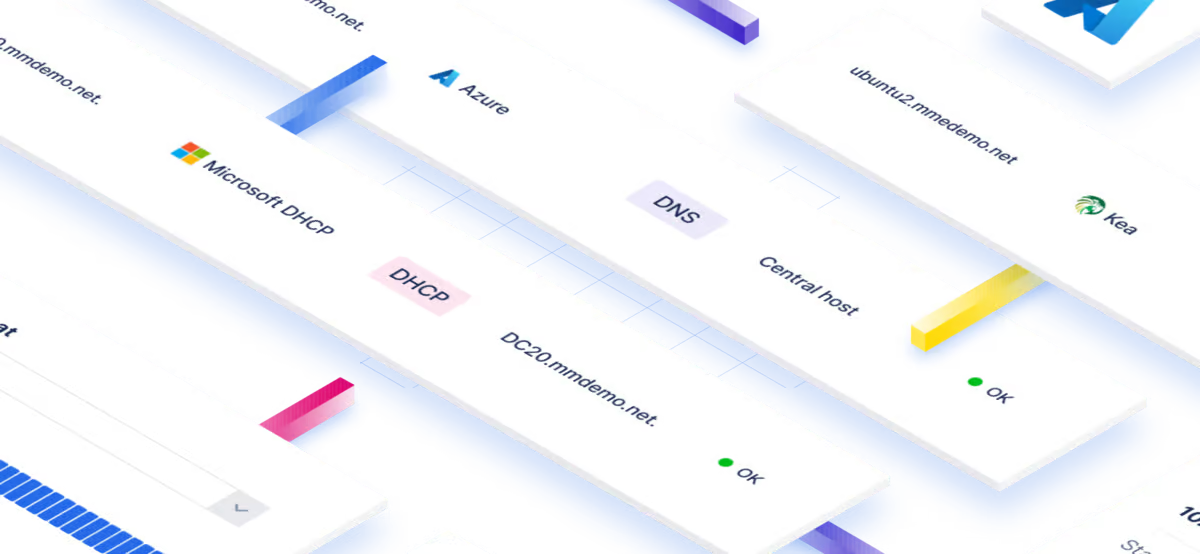
Extending enterprise DHCP Management to Cisco Meraki and SD-WAN branch deployments
SD-WAN DHCP management gets simpler with BlueCat Micetro, unifying Meraki branch DHCP, leases, scopes, and access control in one interface.
Read moreA DHCP scope is a configuration object on a DHCP server that defines the pool of IP addresses and related settings available for lease to clients on a single subnet, including the address range, exclusions, lease duration, and options such as default gateway and DNS servers. Scopes are fundamental to DHCP administration, and their proper configuration is critical because misconfigurations—such as pool exhaustion, overlapping ranges, incorrect gateway or DNS options, or scope-subnet mismatches—can cause clients to fail obtaining addresses, experience intermittent outages, or lose network connectivity. Tying scopes to an IP address management system provides a single authoritative record of ranges, utilization, and ownership, enabling more reliable audits, capacity planning, and reducing configuration drift across enterprise networks with hundreds or thousands of subnets.

A DHCP server uses a scope to decide which address and options to offer a client. The server matches the client's network location to a scope, then draws an address from that scope's pool.
Scopes can also hold reservations that tie a specific address to a client identifier, so a device always receives the same address. Terminology varies: some servers call the same construct a pool or subnet declaration. Many scopes can be grouped for failover or load sharing between servers.
Clients on busy networks such as guest Wi-Fi fail to get an address and fall back to self-assigned 169.254 addresses. The usual causes are a range too small for the device count or long lease times that hold addresses for devices that have already left.
Static devices lose connectivity or trigger duplicate address warnings when their addresses were never excluded from the range. The scope then leases an address already in use by a router or server.
Clients get an address but cannot reach other networks or resolve names. This happens when the default gateway or DNS server option was copied from another scope or left unchanged after a subnet renumbering.
Clients receive addresses with a wrong subnet mask or no offer at all. The scope does not match the actual subnet on the router interface or relay agent, so the server selects the wrong scope or none.
After a failover or manual edit, two servers hold different scope settings, so clients receive different options depending on which server answers. Changes made on one server and not replicated cause this.