

Blog
DNS glossary

 Key takeawaysKey takeaways are generated with AI assistance. Because automated summaries can occasionally contain errors or miss important context, always refer to the full blog post for complete information.
Reverse DNS lookup is a DNS query method that resolves an IP address to its associated hostname by querying a PTR record in the in-addr.arpa (IPv4) or ip6.arpa (IPv6) zone, enabling mail servers, logging systems, and security tools to display readable names instead of raw addresses. Organizations must create and maintain PTR records alongside forward DNS records to ensure consistency and support critical functions like mail delivery verification through forward-confirmed reverse DNS and accurate incident investigation through readable logs. Poor PTR management—including missing records, stale entries, and forward-reverse mismatches—causes legitimate mail rejection, confusing logs, and slow incident response, which can be mitigated by automating PTR creation through integrated IP address management systems.
A reverse DNS lookup turns an IP address into a name by rewriting the address as a domain name and asking for a PTR record. The delegation of reverse zones follows the address allocation hierarchy.
A PTR record is separate from the forward A or AAAA record, so the two can disagree. Administrators must create and maintain both. Some tools check consistency by resolving the returned name forward and comparing the result with the original address.
Hosts get addresses from DHCP or static assignment, but nobody creates the matching PTR record. Logs and traceroute output show bare addresses, and some mail servers reject or penalize messages from those hosts.
The PTR record returns a name whose A or AAAA record points to a different address, or to none. Forward-confirmed reverse DNS checks fail, and services that require matching records deny or flag the connection.
The network owner never receives delegation from the provider or address registry for the block. Queries return SERVFAIL or NXDOMAIN, or return the provider's generic names instead of the intended hostnames.
Addresses are reassigned, but old PTR records remain. Logs then attribute traffic to the wrong host name, which complicates incident investigation.
Tools that resolve every address, such as log viewers and firewalls, stall when reverse zones point to name servers that do not respond. The delay shows up as timeouts until the resolver gives up.

 Article
A method for planning, tracking, and managing IP address space on a network.
Article A distinct, contiguous portion of the domain name space for which administrative responsibility has been delegated to a single manager.
Article A domain name that specifies its exact location in the tree hierarchy of DNS.
Article The integration of DNS, DHCP, and IPAM into one management solution.
Article The fourth version of Internet Protocol that uses 32-bit addresses to route most of today’s internet traffic; the global supply of IPv4 addresses is exhausted. Learn More
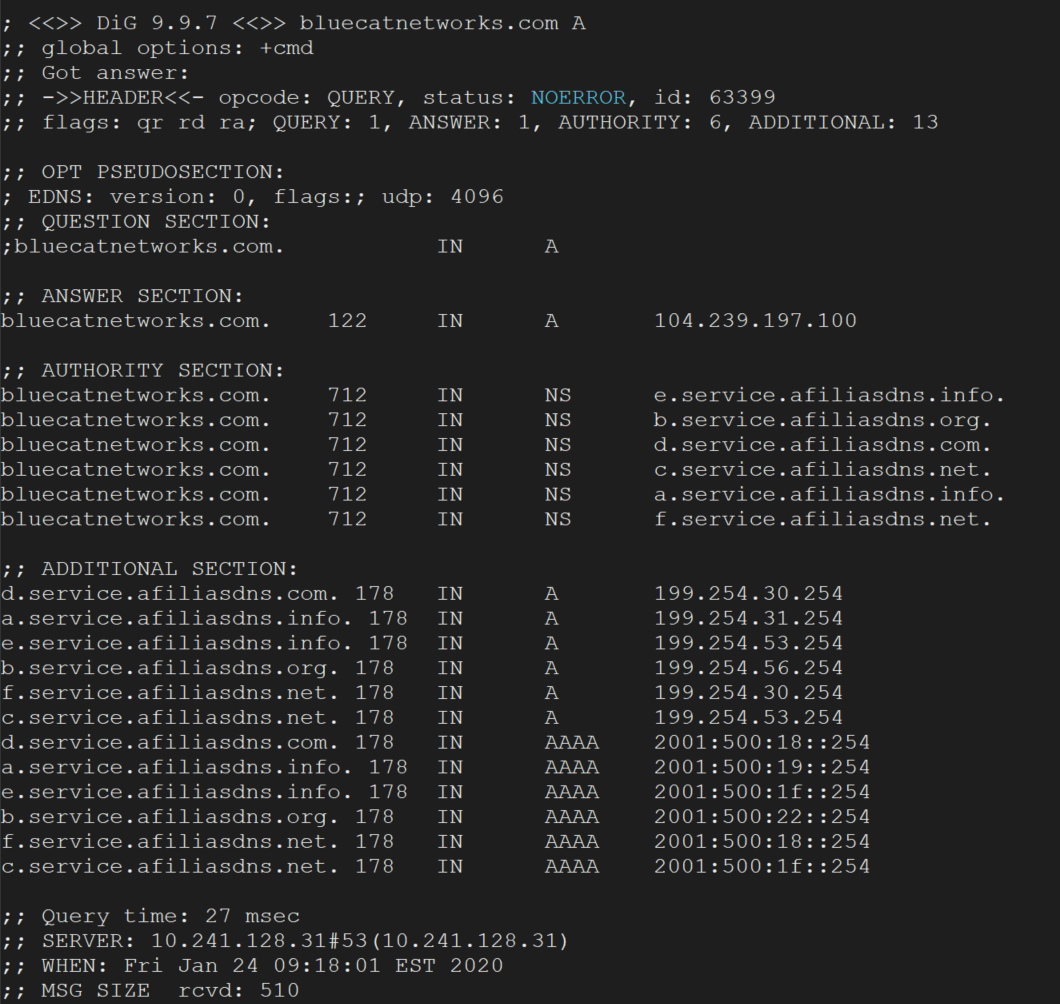
There are dozens of DNS record types. Understanding the most common ones can help you detect threats and keep on top of what's happening…
Read more
MAC address vs IP address: One is a unique hardware identifier, while the other identifies a device's network connection. Learn more with BlueCat.
Read more
Bad actors know that DNS makes a great weapon in producing massive amounts of traffic for successful DDoS attacks. Here's how.
Read more
DNSSEC authenticates DNS queries and responses by using cryptographic digital signatures. Learn more and how BlueCat can help to make implementation easier.
Read more
At a basic level, an NXDOMAIN response means “that site does not exist.” But it can also provide critical clues about your network’s security.
Read more