Hybrid, Microsoft-dependent environments make it hard to see what’s really happening across DNS, DHCP, and IPAM, especially when teams are lean and split between on‑prem and cloud. This piece shows how to pull every core DDI signal into a single, live view so you can spot issues faster, cut manual investigation time, and support cloud projects without creating new blind spots. We’ll walk through practical ways to unify data from Windows DNS, cloud DNS services, and IPAM into one operational pane, setting the stage for BlueCat’s Horizon‑style intelligent observability and automation.
What is DDI and why do enterprises need unified DNS, DHCP, and IPAM visibility?
DDI is the combination of DNS, DHCP, and IP address management, and enterprises need a unified view of all three because fragmented tools, spreadsheets,
and siloed servers create IP conflicts, outages, weak accountability, and blind spots that make automation, security, and hybrid cloud projects fragile.
Spreadsheets layered on top of Microsoft DNS or BIND lack centralized visibility and do not scale for networks spanning regions, hybrid clouds, and multiple business units. As the IP space grows, manual tracking practically invites errors and overlaps that can take down services, while role-based access and reliable reporting are essentially impossible.
Standalone IPAM tools improve address tracking but leave DNS and DHCP fragmentation untouched. As one BlueCat guide notes, “IPAM tools on their own can be helpful as a short term band-aid. But they do not solve the underlying problems inherent in decentralized network infrastructure systems.” The recommended approach is to rationalize DNS, DHCP, and IPAM into a unified DDI solution and single source of truth.
1source of truth
1 source of truth
The article stresses that using an IP address spreadsheet simply isn’t viable long term and that DDI data belongs in a single source of truth.
IPAM tools alone do not solve the underlying issues with decentralized network infrastructure systems such as Microsoft DNS and BIND.
6 min·Blog
Read more →
· 02 — Restoring cloud DDI visibility
How can on‑prem DDI teams regain visibility when cloud and DevOps manage their own DNS?
The practical way to regain visibility is to establish a consistent, enterprise-wide DDI model with a single source of truth,
then extend or integrate that DDI layer with cloud-native DNS services and expose it via automation so cloud and DevOps teams can self-service without creating shadow DDI.
Unmanaged cloud activity creates multiple concrete problems for on‑prem teams: overlapping IP assignments when cloud networks allocate space without a shared source of truth, complex DNS routing as workloads move, creeping fragmentation of DDI management, and gaps in continuous security and compliance. Network administrators carry responsibility for these failures but often lack authority or insight into what cloud teams are doing.
Addressing this requires a DDI architecture that “speaks the same language” across on‑prem and cloud. Core DDI must either extend into the cloud or integrate with cloud-native DNS such as Amazon Route 53 and Azure DNS so data and policy flow seamlessly. Once that foundation exists, network automation tools can provide self-service provisioning, giving cloud and DevOps teams speed while preserving centralized control and visibility in the cloud.
If your network team can't see what's happening in the cloud, you've got a serious challenge. Time for a DDI system that works in all environments.
6 min·Blog
Read more →
· 03 — Total visibility in hybrid environments
How does unified DDI visibility tame hybrid cloud complexity and enable safe automation?
Unified DDI visibility across on‑prem and cloud—down to every DNS query and endpoint—eliminates silos, reveals IP and zone conflicts,
and provides the single source of truth required to automate changes safely instead of relying on fragile manual forwarding rules.
An ONUG discussion highlighted four critical hybrid DDI challenges: DDI teams have zero visibility into cloud DNS, cloud and on‑prem DDI become silos with fragmented or overlapping IP space, automation stalls without a source of truth, and a growing tangle of forwarding rules and private endpoints consumes resources. As Zeus Kerravala notes, “trying to manually manage these things is going to lead to failure.”
For automation to work, “you can’t change something unless you can assert some sort of source of truth.” That means discovering services, seeing how each DNS query was resolved, and correlating authorities across internal private networks and cloud zones. With total visibility and a single DDI truth, teams can build automation and security segmentation that adapts as applications shift, instead of hand-curating conditional forwarders for every new dependency.
In an ONUG webinar, BlueCat’s Andrew Wertkin explains how DNS, DHCP, and IPAM visibility is key to automation and taming four hybrid cloud challenges.
6 min·Blog
Read more →
· 04 — Validating policy and compliance
What should teams look for in a platform to validate DDI changes against policies and compliance requirements?
Teams should look for a DDI approach that centralizes DNS, DHCP, and IPAM into a single policy-aware source of truth, separates management and services planes for resilience,
provides rich reporting on changes and IP usage, and supports automation so policy checks and audit trails are enforced consistently across hybrid environments.
A structured evaluation starts with requirements: scalability, security, compliance, reliability, environment, and support. Guidance from DDI experts stresses that projects fail when requirements are vague or fragmented between teams. Platforms should avoid artificial limits on database objects, support centralized rather than siloed environments, and enforce consistent naming policies so governance does not depend on manual review of every zone and record.
For compliance validation, DDI must act as a single authoritative data set that automation and reporting can trust. That includes robust IPAM that “ensures effective management of IP resources,” detailed change history, and the ability to parse DNS activity for risk indicators. Buyers are urged to “ask hard questions” about migration experience, reporting, and integrations so that DDI changes can be audited and policy aligned instead of buried in ad‑hoc scripts or spreadsheets.
You've decided your DNS, DHCP, and IP address management are too complex to DIY. Learn more from BlueCat about how to find the right solution partner.
10 min·Blog
Read more →
· 05 — Extending visibility with security tools
How can DDI integration with security platforms improve visibility into internal and external DNS traffic?
Integrating DDI resolvers as the first DNS hop with security platforms adds endpoint-level context and internal east‑west visibility to existing north‑south telemetry,
enabling granular DNS security policies and faster identification of infected devices without deploying separate sensors.
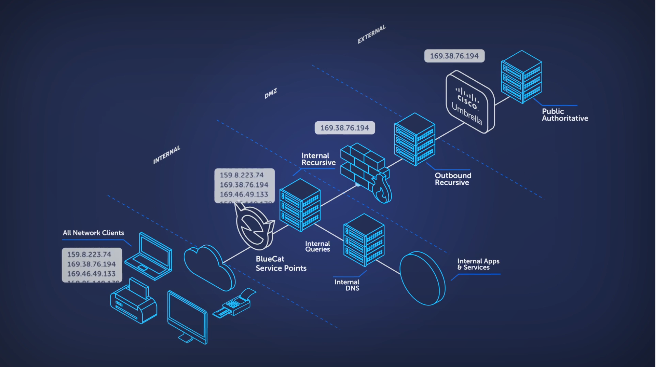
One integration pattern places the DDI resolver at the first hop so it sees the source IP and all internal queries before forwarding external requests to cloud-based defenses. This adds visibility into the roughly 60% of traffic flowing through internal DNS, which is otherwise a blind spot. As one customer noted, this level of endpoint detail was “a game changer for cybersecurity.”
With combined visibility, security teams can deploy granular DNS policies grounded in both external reputation and internal behavior. Lightweight service points enable traffic steering for SD‑WAN and hybrid cloud resolution without heavy hardware. Crucially, “with [the resolver] sitting at the first hop as a DNS resolver, all of that information is collected without all of that extra effort,” avoiding a separate sensor deployment project.
Working together, BlueCat and Cisco Umbrella extend the breadth and depth of domain name system security across the enterprise.
1 min·Blog
Read more →
· 06 — Measuring ROI and justifying modernization
How do you measure ROI for DDI modernization projects when moving off spreadsheets and legacy servers?
ROI for DDI modernization is measured by reductions in outages and incident time, labor saved from manual DNS/IPAM work, security and compliance risk reduction,
and agility gains such as faster provisioning and automation—all of which are hard to achieve with spreadsheets and disparate DNS servers.
Legacy environments built on “spreadsheets and disparate DNS servers” suffer from system fragmentation, security gaps, and manual processes that directly result in outages. Organizations often accept this because “if it’s not broken, don’t fix it,” but the hidden costs include slow incident response, duplicated effort across teams, and mounting audit pressure as hybrid complexity grows.
In contrast, unified DDI improves “the visibility, security, and resiliency of core network services.” Real-world migrations have reported “important operational gains (cost and agility)” once automation replaces ticket-driven changes. Metrics that resonate with leadership include fewer DNS-related incidents, shorter mean time to resolve, reduced hands-on changes per week, and the ability to support new projects without adding headcount.
BlueCat’s Solutions Architects explore the potential created by unifying DNS, DHCP and IPAM, including challenges and real-world solutions (enterprise and…
1 min·Blog
Read more →
Talk to a BlueCat expert about your environment. Get a practical 30-minute assessment — no slideware — focused on unifying DDI visibility across your Microsoft DNS, DHCP, and IPAM footprint.
· 07 — Centralizing visibility with SaaS orchestration
How can distributed networks centralize DDI visibility and control without disrupting local DNS and DHCP?
Distributed networks can centralize DDI visibility and control by adding a SaaS-based orchestration and reporting layer that connects to existing DNS, DHCP,
and IPAM via lightweight agents, synchronizes states bi-directionally, and surfaces metadata for insight while letting services execute locally for performance and resilience.
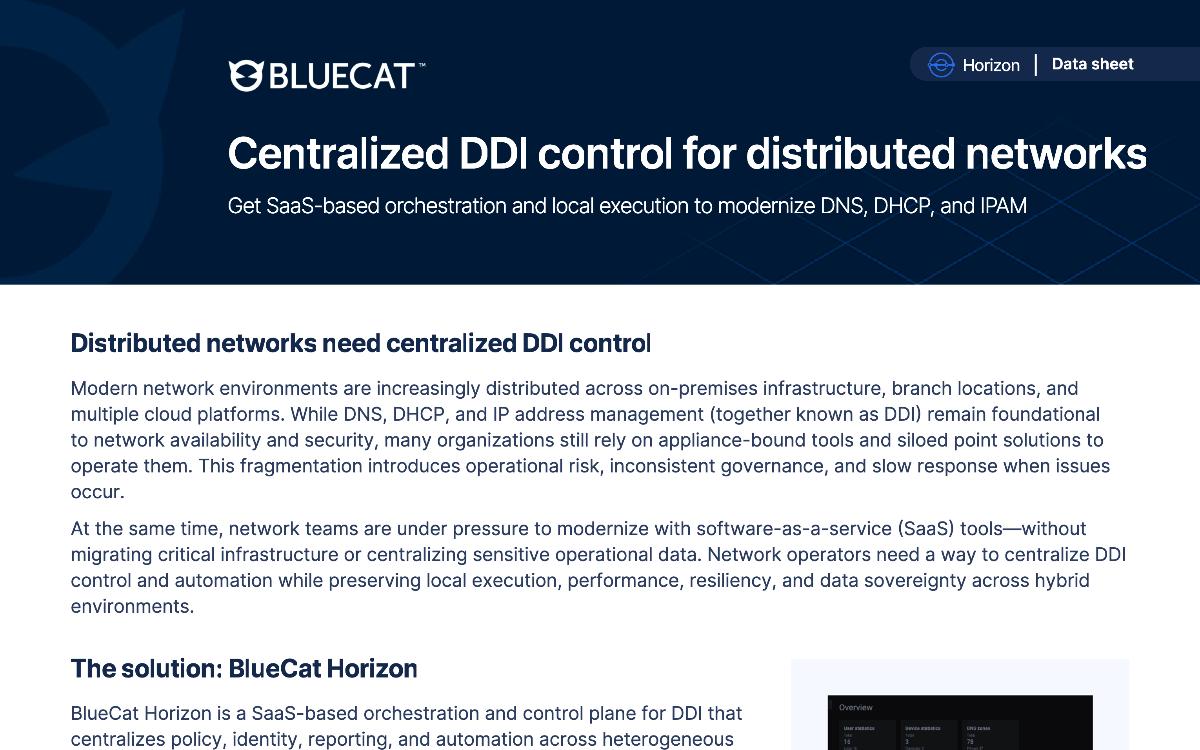
A data sheet describes this approach as a shared control plane that “connects to existing DNS, DHCP, and IPAM systems via lightweight agents and service points.” Those agents communicate outbound-only, linking on‑prem, branch, and cloud environments to a centralized orchestrator that applies consistent identities, policies, and automation. Local servers continue handling queries and leases, preserving performance and data sovereignty.
This is the design pattern implemented by BlueCat Horizon. Horizon “uses bi-directional synchronization between the shared control plane and connected systems so that changes made centrally or locally are reconciled automatically,” reducing operational risk and configuration drift. It also includes built-in reporting for IP utilization, DHCP lease activity, and configuration changes without separate licenses, forming a foundation for intelligent, AI-assisted NetOps over time.
3core insights
3 core insights
Horizon’s built-in reporting focuses on IP utilization, DHCP lease activity, and configuration changes as the starting set of operational visibility.
BlueCat Horizon is a SaaS-based orchestration and control plane that centralizes DDI policy, identity, reporting, and automation across heterogeneous,…
BlueCat Horizon is a SaaS-first Intelligent NetOps platform unifying DNS, DHCP, IPAM, security, and observability to automate modern network operations AI
6 min·Page
View Horizon →
· 08 — Paths forward
Which unified DDI visibility path is right for a Microsoft-centric hybrid network?
The right path depends on where DDI pain is sharpest—IPAM drift, cloud blindness, compliance pressure, or distributed operations—but in every case the destination is the same: a single, policy-aware DDI source of truth with centralized visibility, automation hooks, and local execution.
PATH 01
When spreadsheets and IPAM-only tools are the main bottleneck
Consolidate DNS, DHCP, and IPAM into one source of truth
This path fits teams fighting IP conflicts and stale records on top of Microsoft DNS. Retiring spreadsheets and treating DDI as one system eliminates manual reconciliations and gives automation a clean data set to work from. Unified DDI visibility also lays groundwork for IPv4/IPv6 governance and DNS security.
Integrate cloud DNS into centralized hybrid visibility
Here, the priority is integrating cloud-native DNS with on‑prem naming and IP space to eliminate blind spots and brittle forwarding rules. Establishing a consistent DDI model and exposing it through automation lets cloud teams move quickly without creating shadow DNS, while central teams regain full-path visibility and control.
When audits, change control, and policy drift dominate discussions
Establish a governance and compliance control plane
In regulated environments, focus first on centralizing policy, naming standards, and change history across DNS, DHCP, and IPAM. A platform that separates management and services planes, provides detailed reporting, and integrates with automation gives stakeholders the evidence they need for compliance and the guardrails needed for safe self-service.
When infrastructure is geographically dispersed and hard to replace
Add SaaS orchestration for distributed DDI estates
For organizations with many data centers, branches, or mixed DDI stacks, the pragmatic step is to add a SaaS control plane that connects existing systems via lightweight agents. This delivers unified visibility, reporting, and automation while preserving local performance and giving teams a platform for intelligent NetOps.
These answers focus on how unified DDI visibility improves day-to-day operations, compliance, and security in Microsoft-heavy hybrid networks.
The most relevant DDI KPIs focus on reliability, speed, and quality of change. Useful measures include DNS- and DHCP-related incident counts, mean time to detect and resolve name-service issues, percentage of automated versus manual changes, and IP utilization health. Additional indicators, like time to provision new applications and audit-finding rates tied to DDI, show whether unified visibility is working.
Unified DDI visibility typically shortens incident response because teams can see every query path, authority, and lease involved in a failure. Instead of chasing misaligned spreadsheets and local configs, responders start from an accurate, centralized view of zones, records, and IP assignments. Because Horizon correlates that DDI telemetry across distributed sites and integrates with security tooling, teams can pinpoint the exact endpoint or scope of impact and cut mean time to resolve.
Unified DDI visibility typically shortens incident response because teams can see every query path, authority, and lease involved in a failure. Instead of chasing misaligned spreadsheets and local configs, responders start from an accurate, centralized view of zones, records, and IP assignments. Integrations with security tooling can also pinpoint the exact endpoint or scope of impact, further reducing mean time to resolve.
In healthcare, DDI underpins secure access to clinical systems by ensuring that devices, applications, and users resolve only trusted internal and external services. Central IPAM reduces the risk of accidental overlaps that could expose sensitive segments, while DNS visibility helps detect anomalous traffic such as tunneling or exfiltration attempts. Strong audit trails for DDI changes also support regulatory requirements around access control.
Validation starts with codified policies in the DDI control plane: naming standards, IP allocation rules, and segmentation requirements. Changes should flow through that plane—via UI or automation—so they can be checked automatically before deployment. Reporting on configuration deltas, plus periodic reviews of zones and address space against those policies, then gives operations and compliance teams confidence that hybrid DDI remains aligned.
Integration usually involves connecting core DDI as an upstream authority or conditional target for cloud-native DNS zones and private endpoints. With a single source of truth for names and IPs, orchestration tools can publish or synchronize records into cloud services as applications scale. Horizon provides that source of truth and the SaaS orchestration layer to sync records into cloud DNS, so cloud ingress and service discovery work natively while network teams keep full visibility into where names resolve.
We’re using cookies on this website to improve your experience. Cookies help us learn how you interact with our website and remember you when you come back so we can tailor it to your interests.
To learn more about cookies and how we use them, read our cookie notice.
Some cookies are essential, while others help us to improve your experience by giving us insight into how you are using our website. You may adjust your preferences for non-essential cookies below.
To learn more about cookies and how we use them, read our cookie notice. You can also review our privacy policy for more details on the personal data we collect, use, hold, and disclose when you visit our website or use our products and services.
Functional cookies
Functional cookies are essential cookies that allow us to remember choices or changes you have made (such as to language settings or your choices regarding the use of cookies). These cookies cannot be turned off since they are essential for the operation of our Websites.
Analytics cookies
Analytics cookies are non-essential cookies that collect information on how visitors use our Websites. We use this information with your consent to measure the number of visitors to our Websites, determine whether specific content or communication has been viewed, and to help us improve our Websites and communication. These cookies can be turned off.
Personalisation Storage
Personalisation cookies are non-essential cookies that collect information when you fill out a form on this website. We only use this information with your consent to pre-fill other forms on the site. These cookies can be turned off.
Marketing cookies
Marketing cookies are cookies that are placed by third parties to collect information about your visits and actions on our Websites so that they or we can deliver ads to you later, such as when you are on certain third-party sites or platforms. These cookies may be used by those third parties to build a profile of your interests and show you relevant ads on other websites. These cookies also enable visitors to our Websites to share content on social networks and to enable and evaluate interactions with our communication and social media tools. These cookies can be turned off.