
Network Management Megatrends 2026: AI, automation, and the future of NetOps
EMA research uncovers that enterprises are transforming network operations by adopting AI, scaling automation, and simplifying complexity across hybrid and multicloud environments.
 Key takeawaysKey takeaways are generated with AI assistance. Because automated summaries can occasionally contain errors or miss important context, always refer to the full blog post for complete information.
EMA’s Network Management Megatrends 2026 report examines how enterprises are modernizing NetOps by adopting AI-driven automation and consolidating tools to manage hybrid and multicloud complexity; this shift aims to improve performance, resilience, and operational efficiency across distributed environments. The research highlights that trusted network data—especially DDI and DNS signals—plus unified visibility are essential to enable scalable automation, faster incident response, and stronger policy enforcement. BlueCat positions its platform to provide an authoritative source of network data, bridge fragmented ownership across NetOps, SecOps, and CloudOps, and automate workflows to reduce manual effort and operational risk.
Network operations is undergoing a fundamental transformation.
As hybrid and multicloud architectures expand and AI workloads accelerate, organizations are rethinking how they manage, secure, and optimize their networks. The Network Management Megatrends 2026 report from Enterprise Management Associates (EMA) highlights a shift toward more automated, integrated, and data-driven NetOps.
Even as enterprises still face skills shortages, fragmented tools, and rising complexity, they are progressing toward proactive operations. To get there, a new model is emerging—one that delivers automated action, real-time insight, and unified control across network operations.
BlueCat’s solutions support this shift by turning core DNS, DHCP, and IP address management (DDI) activity into continuous signals for real-time observability and intelligent operations.
What the research reveals
Enterprise network operations is evolving across technology, teams, and data. EMA found that:
- AI is now a primary driver of NetOps strategy, enabling automation and operational insight
- Automation is becoming foundational, especially for ongoing management and maintenance activities (known as Day 2 operations), such as troubleshooting and optimization
- Skills gaps are worsening, making it harder to scale operations without automation
- Operating models are shifting from traditional network operations centers (NOCs) to cross-domain NetOps, SecOps, and CloudOps teams
- Data quality and accessibility are emerging as critical success factors for modern network operations
Key research stats

79% of organizations say automating Day 2 operations is a high priority

AI-driven automation and insights are the No. 1 requirement for network management platforms

Skills gaps and fragmented tools are the top barriers to Day 2 automation

73% of enterprises may replace network monitoring tools within two years

Operations are shifting from traditional NOCs to cross-domain teams

DNS ownership is fragmented across teams—impacting visibility and control

42% struggle to collect network telemetry from cloud environments

Only 36% fully trust their network monitoring data, highlighting a barrier to automation
Key findings
NetOps teams are under significant pressure, with less than a third reporting successful network operations strategies. A major contributor to this issue is tool sprawl. Most teams rely on between four and 10 monitoring and troubleshooting tools, but only 32% are satisfied with them, and nearly three-quarters are considering replacing them.
AI has rapidly become the top strategic driver for NetOps, with nearly all organizations expecting to run AI workloads within the next two years. However, only 35% believe their current observability tools are ready to support operations for these workloads. Compounding the challenge are talent shortages: Over half of enterprises struggle to hire and retain skilled network engineers, particularly in areas like security, AI networking, and automation. Meanwhile, hybrid and multicloud environments add complexity, with limited visibility and skills gaps preventing many teams from effectively managing modern infrastructure.
Despite these challenges, AI is emerging as a critical enabler of NetOps transformation. More than half of organizations now view AI-driven capabilities as essential, particularly for automation and proactive operations. Teams that have adopted AI tend to be more mature, predictive, and efficient, reinforcing the need for modernization across tools, processes, and skill sets.
What the data shows
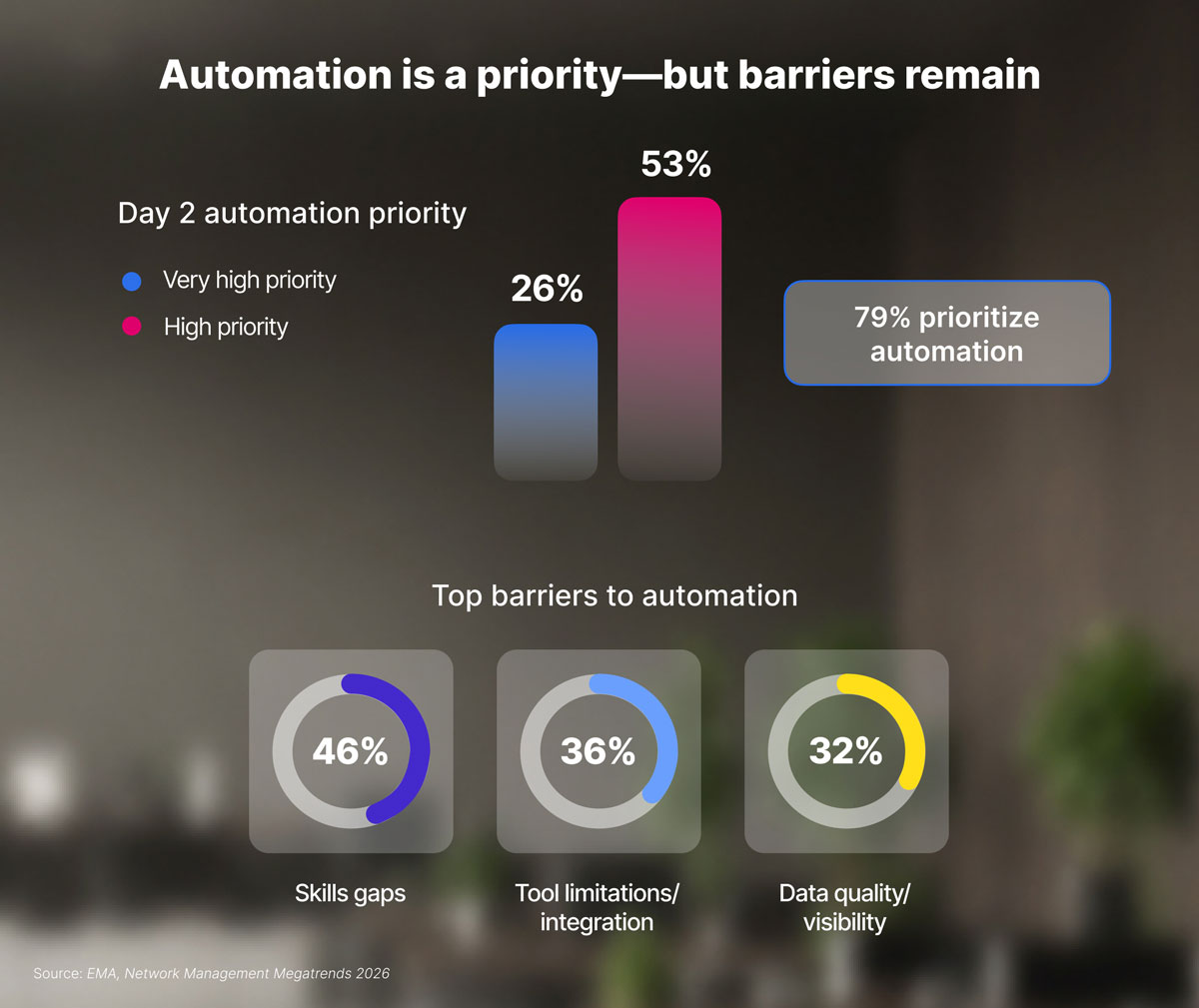
Automation is a priority, but barriers remain (Figure 34 + 37)
Most organizations consider automating Day 2 operations a high priority—but progress is often slowed by skills gaps and fragmented tooling. This reflects a central challenge in modern NetOps: scaling operations without scaling headcount. While automation is widely seen as essential, teams must address gaps in expertise, tooling integration, and data quality to fully realize its value.
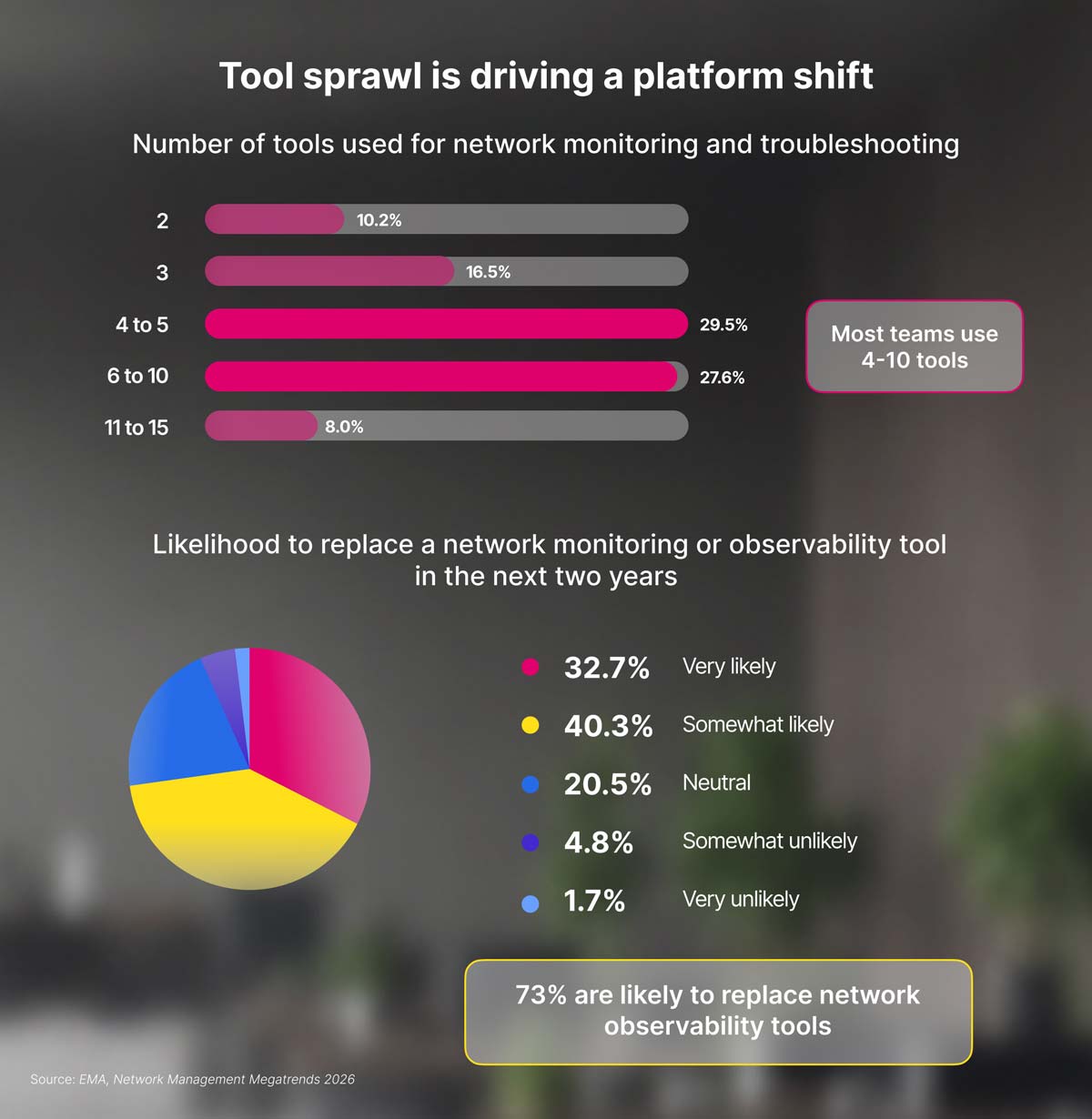
Tool sprawl is driving a platform shift (Figure 18 + 23)
Enterprises rely on multiple tools to monitor and troubleshoot networks, and most plan to make changes to their toolsets soon. This signals a broader shift toward platform consolidation and integration. Rather than adding more tools, organizations are simplifying their environments to improve visibility, reduce operational overhead, and enable more consistent management across hybrid and multicloud infrastructure.
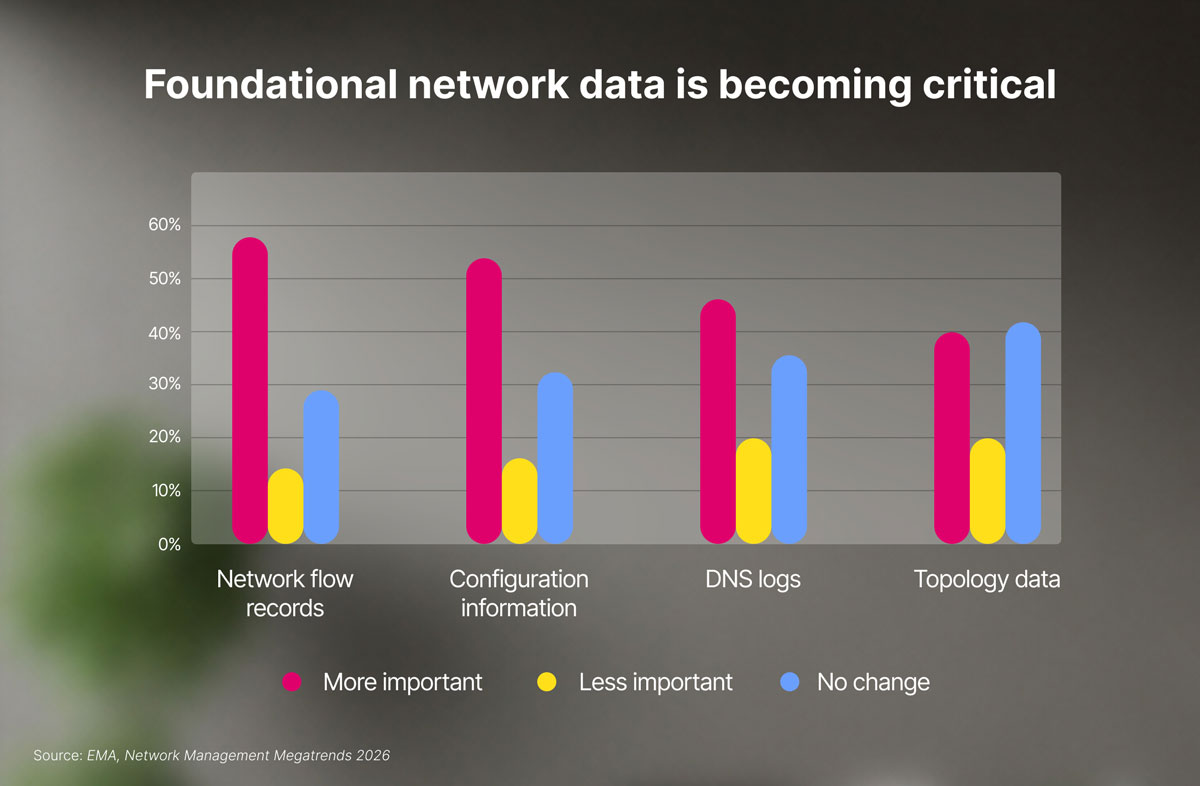
Foundational network data is becoming critical (Figure 30)
DNS logs and topology data are gaining importance—especially among more successful NetOps teams. As environments become more distributed, foundational data sources like DNS and topology provide essential context for understanding network behavior. These insights help teams correlate events across domains, accelerate troubleshooting, and strengthen security visibility.
What this means for network and security leaders
EMA’s research points to a clear direction for modern network operations: simplify, automate, and unify.
- Automation is essential for scaling operations and addressing persistent skills gaps
- Fragmented tools must be consolidated and integrated to improve visibility
- Trusted, high-quality data is foundational to effective automation and decision-making
- Cross-domain collaboration is critical as NetOps, SecOps, and CloudOps converge
- Faster resolution is becoming the priority—mean time to resolution (MTTR) matters more than detection alone
Organizations that align with these priorities will be better positioned to improve resilience, reduce downtime, and support increasingly complex digital environments.
Access the full EMA research report
Explore the trends shaping modern network operations
What you’ll learn:
- How AI and automation are transforming network operations
- Why organizations are consolidating tools and simplifying infrastructure
- Best practices for improving visibility, resilience, and performance