
8 Must-Have Capabilities For Firewall Monitoring Tools


Notice: This blog post was originally published on Indeni before its acquisition by BlueCat.
The content reflects the expertise and perspectives of the Indeni team at the time of writing. While some references may be outdated, the insights remain valuable. For the latest updates and solutions, explore the rest of our blog
The best firewall monitoring tools can quickly detect problems, recommend actionable remediation steps, provide proactive alerts and validate best practices. While network performance monitoring tools are a core component of network infrastructure, they are not designed for managing your security infrastructure.
Eight reasons why network performance monitoring tools may not be good enough for firewalls:
1. Too many undetected firewall issues
It is a challenge when you find out about a service outage from a user. Even more so when that user is the big boss. Detecting issues before they get noticed by users is expected. Unfortunately, many firewall issues and outages are undetected regardless of the number of monitoring tools you have in your environment.
Traditional network performance monitoring tools leverage SNMP polling to retrieve metrics from devices. While routers and switches typically have comprehensive management information base (MIB) instrumentation, it is not always the case with security devices. For example, a Border Gateway Protocol (BGP) peer down event can translate to loss of connectivity to the Internet. The challenge is that there is no predefined object identifier for BGP state for Check Point secure gateways. As a result, such a high impact event is undetected by network performance monitoring tools.
2. Firewalls have unique redundancy requirements
Unlike switches and routers, firewalls do not use routing protocols such as Virtual Router Redundancy Protocol (VRRP) and Gateway Load Balancing Protocol (GLBP) for redundancy. Instead, they are deployed in a High Availability (HA) clustered environment. Many outages can be traced to configuration not synchronized among the active, standby and backup firewalls. For example, you do not have the same static routes, policy-based routing rules, etc. causing outages.
The other side effect of HA is that the passive and backup firewalls are in standby mode. For example, the standby unit interfaces are in inactive states by design. Network performance monitoring tools are not aware of the HA state, they end up generating a lot of false positives.
3. More than just monitoring the device
Ensuring your security infrastructure is operating as intended requires more than just monitoring the device. Security devices have dependency on many services; both internal and external. For example, a firewall requires continuous access to the on-premise Active Directory for identity awareness to make the forwarding decision. External services are equally important. This can simply be requiring access to an external server hosting an external dynamic list of IP addresses, URLs, domains, etc. The firewalls dynamically import these objects at a regular interval for policy enforcement. Or this can be sophisticated threat intelligence data feeds providing updated information about potential sources of attack. Whatever that might be, firewalls need dynamic updates from many sources. Monitoring the connection to these critical services is essential.
4. The new tablestake: from reactive to proactive
Network performance monitoring tools are reactive in nature. Interesting finding from the Uptime’s 2021 annual survey reports that 76% of outages can be avoided if IT operations teams receive an advanced notice with respect to common issues stemming from hidden configuration skew, forgotten ongoing maintenance, or a combination of lack of adherence to vendor, industry and HA best practices. For example, if the accelerated path of the firewall is disabled, you want to immediately take action before services are impacted. Choosing the right tool with proactive capabilities is key to minimizing outages.
5. The need for actionable next steps
When problems occur, network performance monitoring tools report the issues and stop there. With the rising cybersecurity talent shortage impacting a growing number of organizations, you want all the help you can get. Ideally, your monitoring tool should offer a way to remediate the problem so you can quickly restore services. This also serves as a great way to train the IT operations teams and a way to advance their expertise and knowledge on the job.
6. Best practices for proactive monitoring
To ensure your firewall is working optimally, it starts with proper configuration based on best practices. This is a great step towards proactive monitoring. Your monitoring tool should be extended to continuously assess devices for alignment with configuration recommendations from vendors and seasoned security practitioners.
7. Beyond monitoring… automation the new trend
Given the growing cybersecurity skills gap, security engineers typically do not have enough time to attend to strategic work. One way to tackle this shortcoming is to accelerate the adoption of network automation. Automating mundane tasks such as ongoing maintenance, regulatory compliance and security vulnerabilities is a great way to offload these activities to an automated system. Thus resulting in precious security engineers focusing on higher order tasks.
8. Automated troubleshooting
When an issue is detected, what if a tool can automatically apply device-specific domain knowledge to the problem and perform analysis to accelerate troubleshooting. The tool can also collect pertinent information while the problem is happening so an accurate diagnosis is possible. The ability to automatically investigate a problem is truly taking automation to the next level.
Look beyond Network Performance Monitoring Tools
Monitoring is only one capability of most IT environments, albeit an important one. While network performance monitoring tools are a core component of network infrastructure, you need to shift from reactive to proactive strategies. If network automation is not on your radar, you should reconsider that. Not only does network automation improve efficiency and ensure consistency in operations teams, it can help with the knowledge skills gap many organizations are experiencing. Ultimately, network automation such as auto triage will improve the meantime to recovery (MTTR) and help you succeed in the digital economy.
Indeni is more than just a firewall monitoring tool, it provides security infrastructure automation with unprecedented visibility. We’ve automated the world’s best practices to deliver predictive, prioritized, and actionable insights that help you prevent costly disruptions. If you are new to Indeni, we invite you to try out our automation capabilities, download a free trial today.
 Key takeawaysKey takeaways are generated with AI assistance. Because automated summaries can occasionally contain errors or miss important context, always refer to the full blog post for complete information.
The article explains why traditional network performance monitoring tools are often insufficient for managing firewalls and security infrastructure, highlighting real-world issues like undetected outages, HA-specific behavior, and dependencies on external services that impact operations. It outlines a technical environment where firewalls require proactive, device-aware monitoring, configuration best-practice assessments, and automation to reduce false positives and prevent service-impacting incidents. Key outcomes recommended include shifting from reactive monitoring to proactive automation (including automated troubleshooting and remediation) to reduce MTTR, improve operational consistency, and address cybersecurity skills gaps.
Why do network performance monitoring tools miss important firewall problems?
Network performance monitoring tools often rely on SNMP polling and MIB instrumentation that are comprehensive for routers and switches but not always for security devices. Some high-impact events (for example, a BGP peer down on certain firewall vendors) have no predefined OID or equivalent metric, so they go undetected. Additionally, firewalls operate in HA clusters and have passive/standby interfaces intentionally inactive; NPM tools unaware of HA state generate false positives and fail to identify configuration skew between active and standby units that can cause outages.
What proactive capabilities should a firewall monitoring solution provide beyond basic monitoring?
A proactive solution should detect configuration drift and hidden issues before users notice outages, continuously assess devices against vendor and practitioner best-practice recommendations, and monitor connectivity to critical internal and external services (for example Active Directory, external dynamic lists, or threat intelligence feeds). It should provide advanced alerts with context and recommend or enable actionable remediation steps, reducing reliance on reactive responses and helping operations teams prevent common problems stemming from misconfiguration, forgotten maintenance, or HA inconsistencies.
How does automation improve firewall operations and incident response according to the article?
Automation reduces manual workload and compensates for cybersecurity skills shortages by handling repetitive maintenance, compliance tasks, and vulnerability management, allowing engineers to focus on higher-value work. Advanced automation can perform automated troubleshooting: applying device-specific domain knowledge, collecting relevant diagnostics during incidents, and even executing remediation steps or auto-triage to accelerate root-cause analysis. These capabilities lead to faster mean time to recovery (MTTR), fewer false positives, and more consistent, best-practice aligned operations.
Published in:

Ulrica de Fort-Menares is the Vice President of Product Management for Infrastructure Assurance.
Related content

Get answers from the LiveNX data you already have with LiveAssist
Learn how LiveAssist, the AI-powered add-on for LiveNX, turns your network data into fast, guided answers, with value you can see in days.

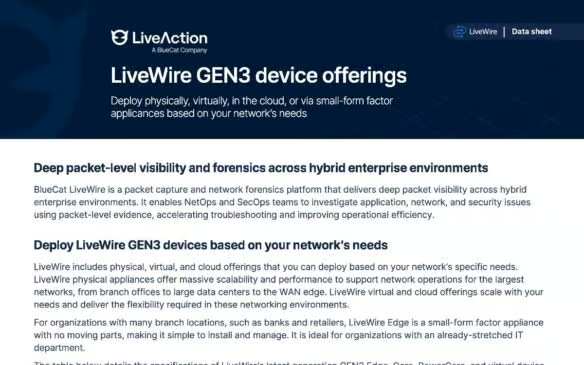
LiveWire GEN3 device offerings
BlueCat LiveWire is a packet capture and network forensics platform that provides deep packet-level visibility across hybrid enterprise environments to help…

Get total control of your DDI infrastructure with Micetro’s unified API
Stop juggling between network tools and use Micetro’s RESTful API for complete control over your DDI infrastructure and cloud environment.
BlueCat MCP servers bring network intelligence to your AI assistant
Our MCP servers provide a standard integration layer that makes it easy to connect the AI tools you already use to BlueCat products.