
Firewall Trends And Priorities For 2022


Notice: This blog post was originally published on Indeni before its acquisition by BlueCat.
The content reflects the expertise and perspectives of the Indeni team at the time of writing. While some references may be outdated, the insights remain valuable. For the latest updates and solutions, explore the rest of our blog
In the past two years, companies have experienced an unprecedented shift toward remote work as a result of the COVID-19 pandemic. This brought new challenges when it comes to network availability and security.
We wanted to learn more about how companies and their network engineering teams have adapted to these changes and how they plan to prioritize firewall spending and maintenance in the coming year.
We surveyed over 140 network engineers at companies of all sizes.
Here’s what we learned.
5 Key Firewall Trends and Findings
1. An increase firewall and network security spending
We often hear network boundaries are history to a point that some even questioned the need for a firewall. Firewalls have played a pivotal role in securing businesses, they will likely remain a fundamental component of organization’s security strategy.
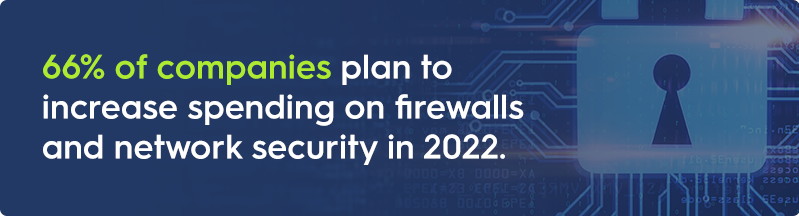
We wanted to gain insight into the future of firewalls. We asked the question about spending in 2022. Unsurprisingly…
Firewalls will continue to grow and evolve to meet new challenges.
2. Multi vendor has become the norm
Although there’s a desire towards best-of-breed security products, we were quite surprised to find 74% of companies have multi-vendor firewall environments. There is definitely complexity inherent in a multi-vendor environment. Extra effort is required to put in place for implementations, ongoing maintenance and training. Perhaps a good follow up question for the next survey is to gain more insight into the reason behind a multi-vendor environment. Is vendor lock-in the primary reason? Are companies opting for best-of-breed products? Or is it because some companies are in the process of migrating to a new firewall from another vendor?
3. A need for firewall engineers with more specialized skills
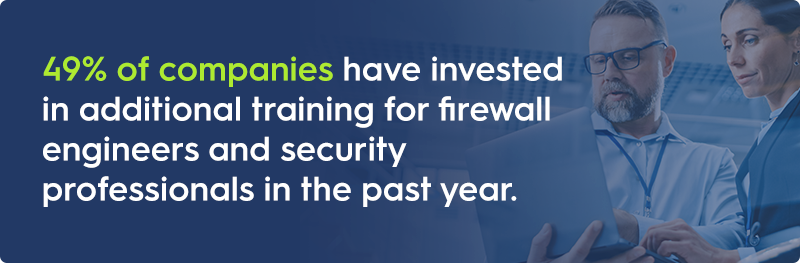
Much has been written about the knowledge gap in cybersecurity. As the rate of security breaches continues to increase, the knowledge gap is widening with the increasing complexity of cybersecurity threats. Organizations recognize the need to invest in user education and additional training. The results of the survey show 52% have invested in training employees in cybersecurity best practices.
4. Adoption of network automation is gaining momentum
With the rise of remote work culture, it is no surprise to see automation as a key initiative. 40% of companies report they have automated more manual tasks in the past year. Here at Indeni, we are a strong believer in automation.
Since there are different types of network automation use cases, we wanted to get more insight into the type of tasks that people automate.
We are thrilled to see troubleshooting the number one use case. 30% of respondents have automated some troubleshooting tasks in the past year. Incidentally, automating troubleshooting is the primary use case we focus on. We believe automating troubleshooting is imperative to solving the knowledge gap issue. It is also the best way to accelerate root cause analysis and minimize downtime.
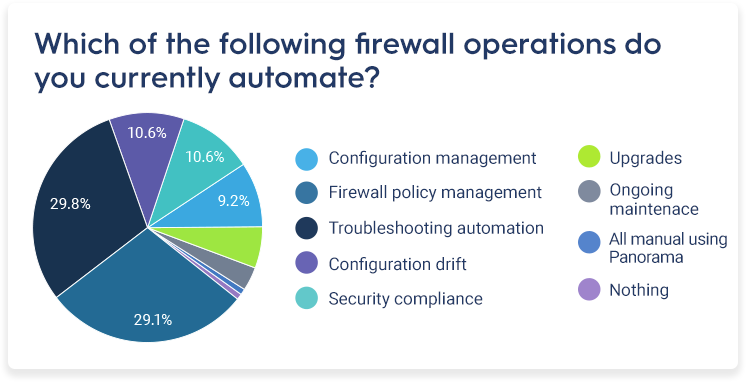
We are also very excited to learn that companies plan to automate many firewall tasks in the coming year.
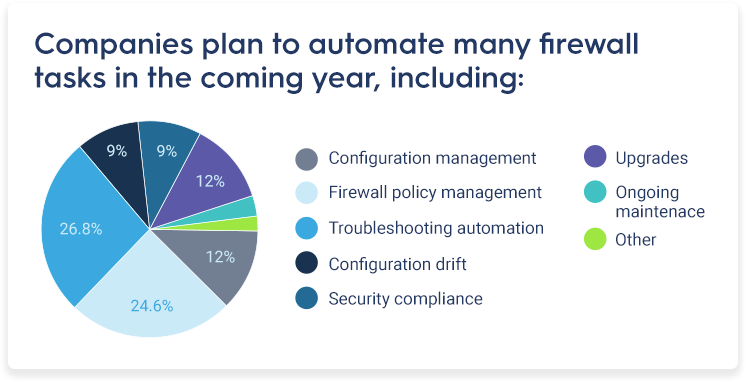
It makes sense to invest in troubleshooting automation as a lot of time is spent investigating firewalls issues. 50% of respondents spend 11-25 hours per week on troubleshooting firewall issues. 18% of respondents spend over 25 hours per week. If this is in your 2022 plan, let us bootstrap your effort.
5. Managing firewall is largely a manual process, still
While it is encouraging to see network automation gaining traction, there is still much work to be done.
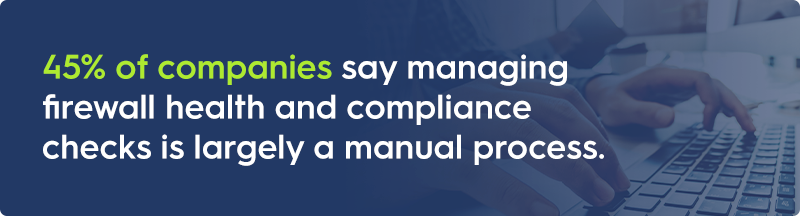
The adoption of network automation is still at an early stage of maturity, with a lot of potential remaining untapped.
See the full survey.
Improve network reliability and save yourself time in 2022
The results of the survey make it clear that network engineering teams are spending more time on firewall maintenance and their tasks are becoming more complex. Over 45% say these tasks are still largely manual. With most teams dealing with a multi-vendor environment that has inherent complexity, it’s difficult to keep up with it all.
Indeni’s security infrastructure automation platform simplifies firewall maintenance so you can identify issues sooner and resolve them before they lead to downtime.
 Key takeawaysKey takeaways are generated with AI assistance. Because automated summaries can occasionally contain errors or miss important context, always refer to the full blog post for complete information.
A recent survey of over 140 network engineers examined how the pandemic-driven shift to remote work affected firewall management, network security spending, and operations. Findings show rising firewall and network security investment, widespread multi-vendor firewall deployments that increase complexity, growing adoption of automation (especially for troubleshooting), and continued reliance on manual firewall management with significant weekly troubleshooting hours. The report highlights operational impacts such as longer troubleshooting time, a need for specialized firewall skills and training, and opportunities to improve reliability and reduce downtime through security infrastructure automation.
How has firewall spending changed and what does the survey predict for the future?
The survey indicates an increase in firewall and network security spending, driven by the challenges created by remote work and heightened security risks. Respondents expect firewalls to remain a fundamental component of organizational security strategy and to continue to evolve to meet new challenges. While specific budget figures are not provided in the article, the overall takeaway is that organizations plan to grow firewall investment in 2022 to address availability, security, and operational complexity.
What operational impacts arise from multi-vendor firewall environments according to the survey?
The survey found that 74% of companies operate multi-vendor firewall environments, which introduces added complexity for implementation, ongoing maintenance, and staff training. This complexity contributes to longer troubleshooting and maintenance tasks—over 45% of respondents say firewall tasks remain largely manual—and increases the demand for specialized firewall engineering skills. The article suggests that multi-vendor setups make it harder for teams to keep up with changes and may motivate automation and training investments.
What role does automation play in firewall management and which tasks are being automated?
Automation adoption is gaining momentum: 40% of companies reported automating more manual tasks in the past year, and many plan further firewall automation in the coming year. Troubleshooting is the primary automation use case—30% of respondents automated some troubleshooting tasks—and this aligns with the fact that 50% of respondents spend 11–25 hours per week on firewall troubleshooting while 18% spend over 25 hours. The survey positions troubleshooting automation as a way to close knowledge gaps, accelerate root-cause analysis, and reduce downtime.

Ulrica de Fort-Menares is the Vice President of Product Management for Infrastructure Assurance.
Related content

Get answers from the LiveNX data you already have with LiveAssist
Learn how LiveAssist, the AI-powered add-on for LiveNX, turns your network data into fast, guided answers, with value you can see in days.

LiveWire GEN3 device offerings
BlueCat LiveWire is a packet capture and network forensics platform that provides deep packet-level visibility across hybrid enterprise environments to help…

Get total control of your DDI infrastructure with Micetro’s unified API
Stop juggling between network tools and use Micetro’s RESTful API for complete control over your DDI infrastructure and cloud environment.

BlueCat MCP servers bring network intelligence to your AI assistant
Our MCP servers provide a standard integration layer that makes it easy to connect the AI tools you already use to BlueCat products.