
Route traffic intelligently with DNS-based GSLB for BlueCat Edge
Discover how DNS-based GSLB with BlueCat Edge empowers networking teams to control traffic steering, reduce costs, and improve resilience.



 Key takeawaysKey takeaways are generated with AI assistance. Because automated summaries can occasionally contain errors or miss important context, always refer to the full blog post for complete information.
The article explains how decentralized, hardware-centric DNS global server load balancing (GSLB) causes operational friction, higher costs, and slower recovery for enterprises, and presents BlueCat Edge’s DNS GSLB as a solution that returns control to DNS teams. In environments where traditional GSLB is siloed with application load-balancer teams, Edge centralizes policy-driven, per-query DNS decisioning with continuous health checks and network-aware routing, improving resilience and simplifying disaster recovery. Key outcomes include lower costs by using Edge Service Points instead of expensive load balancers, faster failover through real-time health-based responses, and easier policy management that aligns with network topology.
What specific operational problems with traditional DNS GSLB does the article identify?
The article identifies several operational problems: GSLB is often siloed within teams that manage dedicated, costly load-balancing hardware, creating fragmentation and ticket friction between networking and application teams. This separation slows response times and complicates routine tasks and disaster recovery, as DNS policy enforcement and traffic steering are handled by different groups. Financial cost is also a barrier—BlueCat research found 71% of surveyed networking professionals cited the expense of traditional GSLB as a significant constraint on adoption.
How does DNS GSLB within BlueCat Edge reduce downtime during outages?
BlueCat Edge reduces downtime by performing continuous, per-query health checks from each Edge Service Point and applying real-time GSLB policies before returning DNS answers. Edge evaluates every DNS query against live endpoint health, automatically removing failed services from responses without waiting for DNS TTL expiration, which enables near-instant failover. In a disaster scenario—such as primary data center subnet outages—Edge can dynamically reroute traffic to healthy alternate subnets, maintaining application availability without manual intervention.
Can BlueCat Edge work with existing GSLB or load-balancing solutions during migration?
Yes. Edge can act as the client’s first-hop DNS resolver and ingest DNS responses from upstream GSLB systems (for example, F5 Big-IP GTM or cloud-native services), refining those responses with client-aware logic. This allows Edge to enhance traffic steering based on its unique, network-aware vantage points while enabling a smooth coexistence or phased migration away from traditional load balancers. The plug-and-play approach supports selective deployment, so organizations can deploy DNS GSLB via Edge Service Points in regions where dedicated load balancers are cost-prohibitive.
DNS-based global server load balancing (GSLB) is an essential tool for intelligent traffic routing in modern enterprise networks.
However, for many organizations, DNS GSLB is decentralized, often managed by teams overseeing dedicated—and usually costly—load balancing hardware. This fragmentation creates operational friction, complicating routine tasks and disaster recovery efforts.
What if your networking team—the experts who already manage DNS infrastructure—could seamlessly take back control? DNS GSLB, integrated into our powerful BlueCat Edge platform, is now available to put intelligent DNS traffic management back where it belongs: with your DNS administrators.
The result is improved resilience, reduced costs, and simpler policy management.
In this post, we’ll explore why many enterprises struggle with traditional DNS GSLB. Next, we’ll delve into how DNS GSLB for Edge addresses these challenges and the benefits it offers. Finally, we’ll outline how DNS GSLB for Edge works and touch on some use cases that demonstrate tangible results.
Enterprises struggle with traditional DNS GSLB
Traditionally, DNS GSLB solutions are expensive, application-centric, and siloed within general load balancing solutions. This division leads to slower response times, increased ticket friction, and complexity in enforcing DNS policies.
Consider this common scenario that an enterprise network engineer recently shared with BlueCat:
“It’s incredibly frustrating to see our SLAs [service level agreements] slipping because we don’t have control over load balancing DNS. The F5 team is overwhelmed, juggling both application management and DNS GSLB. It would be a game-changer for my team to have control over DNS GSLB, allowing us to streamline our operations.”
Indeed, BlueCat’s research highlights these issues clearly: 71% of networking professionals that BlueCat recently surveyed noted that the financial cost of traditional GSLB significantly constrains adoption.
Benefits of DNS GSLB with BlueCat Edge
DNS GSLB for Edge solves these problems by enabling intelligent, policy-driven traffic steering directly within your DNS infrastructure. With Edge, networking teams gain:
- Lower costs: Deploy DNS GSLB via Edge Service Points in regions or sites where traditional load balancers are cost-prohibitive, significantly reducing expenses.
- Greater control: Create and enforce routing policies in real time, directly aligned with your network topology, without dependency on external teams or tools.
- Reduced risk: Edge dynamically adapts DNS responses based on real-time health checks, automatically managing traffic even during outages, thereby minimizing downtime and compliance gaps.
- Continuous health checks: Each Edge Service Point constantly assesses endpoint health from its unique vantage point on the network. It utilizes this real-time information intelligently, directing client traffic to the best available server.
- Resilience through per-query decisioning: Edge evaluates every DNS query against live endpoint health. Failed services are automatically removed from responses without waiting for time-to-live expiration. This ensures near-instant failover and keeps applications online during outages.
- Plug-and-play with existing GSLB solutions: Because Edge acts as the client’s first-hop DNS resolver, it can ingest and refine DNS responses from upstream GSLB systems (like F5 Big IP Global Traffic Manager or cloud-native services). This allows enhanced, client-aware traffic steering while supporting a smooth migration or coexistence strategy.
- Simplified, scalable policy configuration: Utilize network-based grouping to create broad, reusable rules, eliminating per-app configuration complexity and enabling faster rollouts across environments.
How DNS GSLB works in BlueCat Edge
The process to deliver DNS GSLB is straightforward yet powerful. Here’s a step-by-step breakdown of how it works:
- Client initiates query: DNS requests from users or devices first reach Edge.
- Edge processes request: Edge resolves DNS queries normally.
- Real-time policy application: Before returning responses, Edge applies GSLB policies, prioritizing endpoints based on network health and configured rules.
- Optimized delivery: Clients receive the most optimal DNS answer tailored to their network location and real-time service conditions.
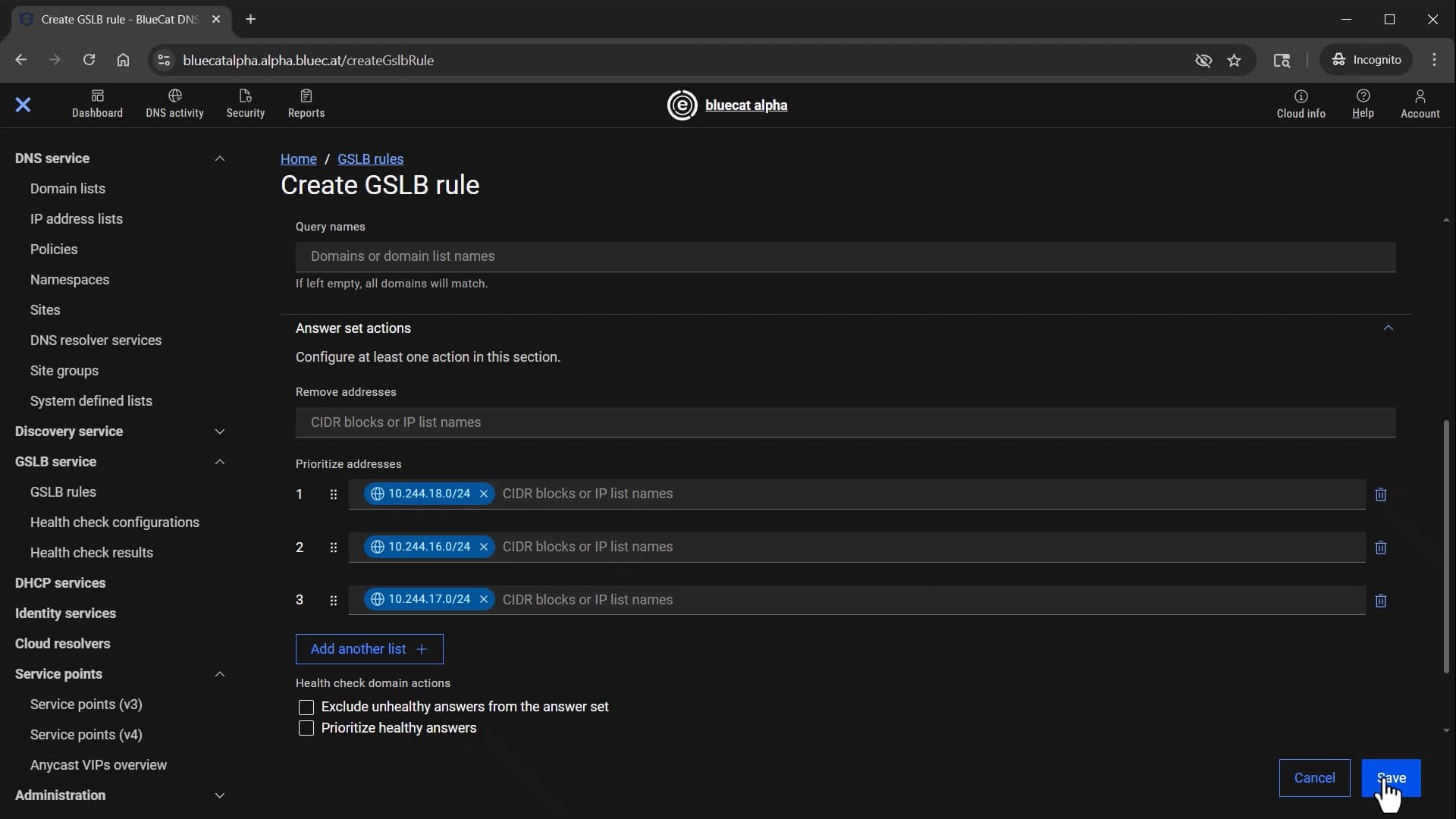
Real use cases and results with DNS GSLB for BlueCat Edge
Consider a disaster scenario when primary data center subnets experience outages. With Edge DNS GSLB, you can dynamically reroute traffic to healthy alternate subnets, ensuring continuous application availability without manual intervention.
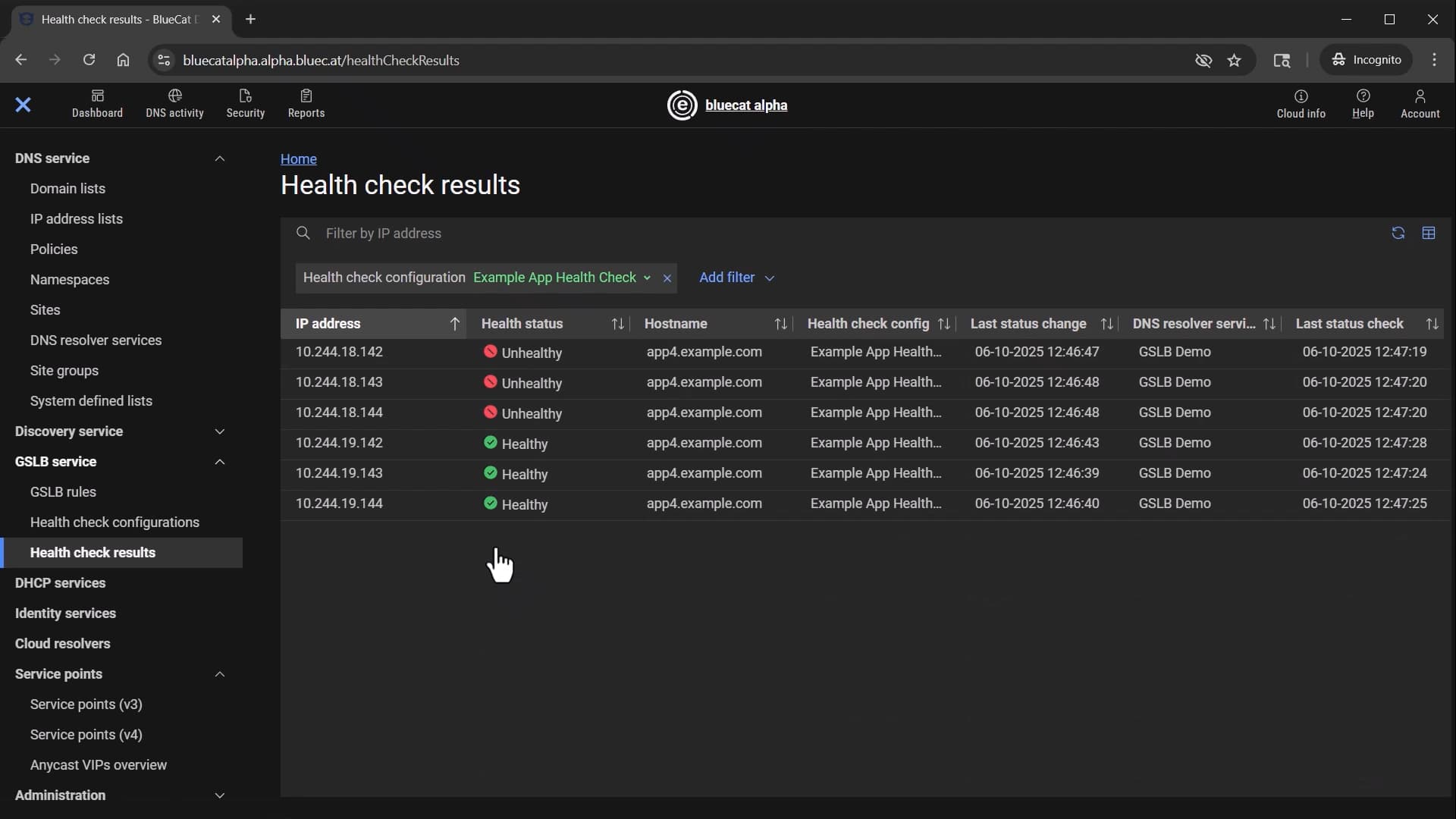
Edge also enables precise per-application traffic steering. For instance, internal teams, such as R&D, can route traffic to specialized subnets optimized for performance or compliance requirements, independent from general routing policies.
For more on how DNS GSLB works with BlueCat Edge, watch this demo:

By bringing DNS GSLB back under the control of networking teams, Edge delivers immediate and impactful outcomes.
- Optimized application delivery ensures consistent routing for users to the best application endpoints, based on real-time health checks and network conditions.
- Enhanced security limits DNS responses to a single, optimized IP address per query, reducing exposure and potential attack surfaces.
- Flexible deployment supports both standalone DNS GSLB implementations or complements existing load balancers, enabling selective deployment tailored to your network needs.
Ready to reclaim control over DNS GSLB with Edge? Learn more about how you can transform DNS from a simple resolution point to a powerful decision engine for smarter, faster, and safer traffic steering.
Published in:

Josh Townsend is a Senior Technical Marketing Manager at BlueCat Networks.
Related content

Get answers from the LiveNX data you already have with LiveAssist
Learn how LiveAssist, the AI-powered add-on for LiveNX, turns your network data into fast, guided answers, with value you can see in days.

Get total control of your DDI infrastructure with Micetro’s unified API
Stop juggling between network tools and use Micetro’s RESTful API for complete control over your DDI infrastructure and cloud environment.

BlueCat MCP servers bring network intelligence to your AI assistant
Our MCP servers provide a standard integration layer that makes it easy to connect the AI tools you already use to BlueCat products.
We bet on Intelligent NetOps two years ago. Infoblox now has too.
With Infoblox acquiring Kentik, BlueCat’s CEO confirms its vision for a single platform unifying DDI, network monitoring, and observability.