
Unified Goals of Network Engineers and CISOs: User Group Takeaways
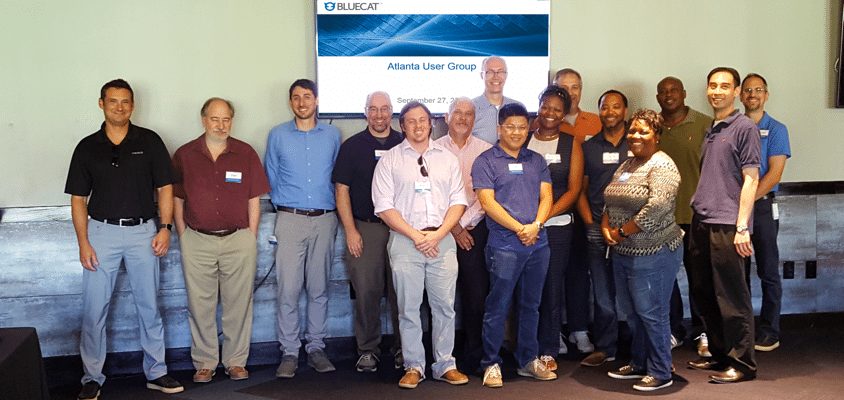
When you get senior network engineers from world-class enterprises like Coca-Cola, Cox Automotive and The Home Depot, in a room together – and toss in a round of golf – you get some great insights into their daily challenges, concerns, and long-term goals.


 Key takeawaysKey takeaways are generated with AI assistance. Because automated summaries can occasionally contain errors or miss important context, always refer to the full blog post for complete information.
The BlueCat Atlanta User Group gathered senior network engineers from enterprises like Coca-Cola, Cox Automotive, and The Home Depot to discuss the shared operational challenges of network teams and CISOs, focusing on automation, efficiency, and security. Participants emphasized the importance of Adaptive DNS, API scripting, and virtualization to accelerate network changes, simplify mergers and acquisitions, manage overlapping IPs, and reduce administrative time. A key security concern highlighted was internal east-west lateral movement, prompting a need for robust internal network controls alongside high availability and rapid service transition capabilities.
How did the User Group describe the role of automation in meeting CISO expectations?
Participants said automation has moved from preferred to expected, noting that repeated manual requests signal it’s time to automate. They discussed using API scripts to automate processes and virtualizing machines for better network management. Adaptive DNS was cited as a specific automation enabler that reduces administrative overhead and supports global enterprises by easing network combination tasks during mergers and acquisitions.
What efficiency challenges did network engineers identify and what solutions were discussed?
Engineers highlighted the need for network virtualization, high availability, and rapid service transition to keep up with fluid business demands. They described issues such as overlapping IP addresses and the consolidation pains during mergers and acquisitions. Solutions discussed included virtualization to improve manageability, tools to consolidate IP addresses into coherent networks, and Adaptive DNS capabilities to facilitate responsive, centralized network control across geographies.
Why was internal security, especially east-west traffic, emphasized by the group?
The group stressed that internal lateral activity poses the biggest risk, noting the frequency of large-scale breaches and the prominence of east-west malicious attacks. Because these threats occur inside the organization, participants prioritized robust internal network security controls. Their alignment with CISOs centered on increasing internal defenses, alongside automation and efficiency, to mitigate lateral movement and protect critical infrastructure.
When you get senior network engineers from world-class enterprises like Coca-Cola, Cox Automotive and The Home Depot, in a room together – and toss in a round of golf – you get some great insights into their daily challenges, concerns, and long-term goals.

The BlueCat Atlanta User Group did just that. We gathered network engineers from a number of sectors to learn more about their day-to-day responsibilities and how they support their CISOs.
The goals of CISOs and those of the network engineer aren’t particularly different. While the CISO is concerned with the more overarching, holistic goals of the company’s IT infrastructure, it’s the network professionals who implement solutions to support those goals.
From quickly executing network changes, to expanding the view of the network, to the ever-increasing concerns of malicious cyber attacks, all of our participants’ IT concerns were undeniably similar. No matter what their professional background, automation, efficiency, and security were key topics of conversation with their management.
When the CISO asks for automation…
Today, automation is not only preferred, it’s expected. And as one of our participants said, “if someone asks twice, it’s time to automate.” There was a lot of conversation regarding API scripts to help automate processes, and many of our network professionals mentioned the importance of virtualizing machines for better network management.
Adaptive DNS ultimately allows teams to better manage daily operations and reduce admin time. And since global enterprises regularly manage networks across different geographies, our Adaptive DNS API helps ease the pain of combining networks in mergers and acquisitions.
When the CISO asks for efficiency…
When it comes to efficiency, all our participants stressed the need for (and importance of) network virtualization. For network professionals and CISOs alike, high availability, as well as the ability to quickly transition services, are crucial. Networks are more fluid than ever. Businesses must turn on a dime and require tools that will help them with overlapping IP addresses, the growing pains of mergers and acquisitions, and facilitate the consolidation of IP addresses into a single, coherent and responsive network.
When the CISO asks about security…
With the number of large-scale breaches that have made the nightly news recently, security is a growing concern for both CISOs and network professionals. Malicious attacks are particularly common in east-west traffic. In fact, internal, lateral activity poses the biggest risk. Robust network security – especially internal to the organization – is at the top of everyone’s must-have list.
The diversity of our User Group provided great insight into the day-to-day lives of both CISOs and network professionals. Thanks to our incredible group of participants, we learned that network engineers and CISO’s are perfectly aligned when it comes to focusing on increasing efficiency, security, and automation.
Published in:

Anna is a passionate content writer who’s always eager to learn something new about cyber security.
Related content

Get answers from the LiveNX data you already have with LiveAssist
Learn how LiveAssist, the AI-powered add-on for LiveNX, turns your network data into fast, guided answers, with value you can see in days.

LiveWire GEN3 device offerings
BlueCat LiveWire is a packet capture and network forensics platform that provides deep packet-level visibility across hybrid enterprise environments to help…

Get total control of your DDI infrastructure with Micetro’s unified API
Stop juggling between network tools and use Micetro’s RESTful API for complete control over your DDI infrastructure and cloud environment.

BlueCat MCP servers bring network intelligence to your AI assistant
Our MCP servers provide a standard integration layer that makes it easy to connect the AI tools you already use to BlueCat products.