Lean teams rarely fail at DDI automation for lack of scripts. They fail because DNS, DHCP, and IPAM sit behind separate consoles, APIs, and data models, so the same record change gets written three times and maintained forever. The durable fix depends on what the team can operate. When the existing DNS and DHCP servers have to keep running under your own control, BlueCat Micetro orchestrates them behind one API. When the goal is to run fewer things at all, BlueCat Horizon delivers the same orchestration as SaaS.
· 01 — Why automation is now the primary driver for DDI investment
Why is automation now the number one driver for investing in DDI platforms?
Automation is the top driver for full-stack DDI investment because network and IT automation initiatives require an authoritative DDI source of truth to eliminate manual work,
reduce errors, and support cloud-native and application modernization at scale.
For small and medium international enterprises, network and IT automation is explicitly cited as the top driver of full-stack DDI investment, with 51% naming it their primary reason. Commercial DDI solutions remove many manual DNS, DHCP, and IPAM tasks and free network engineers to focus on higher-value work instead of ticket-driven upkeep.
Security concerns closely follow automation as a trigger to move from DIY DDI approaches to commercial platforms. Forty-nine percent of organizations seek stronger controls such as role-based access, automation to reduce configuration errors, and improved auditing and reporting, recognizing that DNS security features are now as critical as basic resiliency and cloud support.
51%
51%
51% of small and medium international enterprises cite network and IT automation as their primary reason for investing in full‑stack DDI.
EMA research found that automation is the top reason small and medium international enterprises invest in DDI solutions. What drives your enterprise?
8 min·Blog
Read more →
· 02 — Where DNS automation workflows deliver the highest operational value
Where do DNS and IPAM automation workflows deliver the most value for lean operations teams?
DNS and IPAM automation returns the most time where manual address and record work sits on the critical path of something else.
Provisioning, cloud onboarding, and application deployment all wait on DNS, so automating those workflows removes delay from every dependent activity rather than from one team’s queue.
Manual DDI processes take hours or days to complete, and they block the agility that hybrid and multicloud adoption, application modernization, and DevOps all depend on. Even a fully modern application stays unreachable without name resolution or an IP address, so DNS work that waits in a ticket queue holds up work that has nothing to do with DNS. Integrating DDI into DevOps pipelines reduces IP allocation and DNS change time from hours to minutes.
The gains compound where the same workflow repeats. One enterprise reported a 90 percent reduction in service delivery time after unifying DDI, and another cut cloud DNS management effort by 92.9 percent. Fragmented systems also carry an error cost that automation attacks at its origin: 60 percent of network outages are caused by human error, and centralized policy enforcement with role-based access reduces configuration errors rather than catching them later.
92.9%
92.9%
One enterprise cut cloud DNS management effort by 92.9 percent after unifying DDI, and another reduced service delivery time by 90 percent.
Discover with BlueCat how cost optimization, risk reduction, and accelerated digital transformation offer three reasons to adopt Unified DDI.
5 min·Blog
Read more →
· 03 — How cloud-first strategies change DDI automation requirements
How do cloud-first and multi-cloud strategies change the requirements for DDI automation workflows?
Cloud-first and multi-cloud strategies change the requirements because the DDI team stops being the only party provisioning DNS and IP space.
Cloud teams adopt DDI inside their own accounts without the core team involved, which fragments core network services across cloud and on-premises and leaves automation running against data nobody centrally owns.
The influence gap is measurable. EMA research across 333 IT professionals found that 44 percent of DDI teams believe they do not have enough influence over how DDI is implemented and managed in the public cloud, and that teams lacking that influence are more likely to report their overall DDI strategy as unsuccessful. The consequence is not just organizational. It is fragmented address space, overlapping ranges, and conditional forwarding rules that become brittle to maintain as the estate grows.
The corrective is centralization rather than restriction. Seventy-nine percent of enterprises already integrate their on-premises IP address management into their cloud environments to manage address space, and multicloud organizations are more likely still. Nearly half name centralized visibility and control as the single most important requirement for IPAM in public cloud, ahead of role-based access and usage tracking, and the organizations most successful with DDI are the most likely to want it.
Only 40% of enterprises believe they are fully successful with their DDI solution. Learn how to find greater success with new research from EMA and BlueCat.
8 min·Blog
Read more →
· 04 — What makes cloud DNS and IP data reliable enough to automate against
What makes cloud DNS and IP data reliable enough to automate against?
Automation is only as reliable as the data underneath it.
DDI data becomes safe to automate against when one system holds the complete picture of DNS, DHCP, and IP space across on-premises and cloud, when that record stays current as resources appear and disappear, and when the same data is reachable through an API rather than a console.
The first requirement is completeness. Real-time visibility into DDI usage through a single source of truth is what lets a workflow know that an address is genuinely free before it claims one, and what lets a decommissioning routine reclaim what it should. Without it, parallel automation processes compete for the same address from a finite pool, and the collisions get more likely as provisioning gets faster.
The second requirement is reach. Comprehensive APIs are what connect that record to DevOps pipelines, security tools, ITSM platforms, and infrastructure-as-code practices, so end-to-end workflows and self-service provisioning run against authoritative data rather than a copy of it. One Fortune 500 organization reduced network provisioning time from four hours to minutes on API-driven automation, and robust APIs are what keep the DDI investment compatible with tooling that has not been chosen yet.
Unify DNS, DHCP, and IPAM (DDI) to boost visibility, automation, and security. Explore nine reasons to modernize DDI and streamline network operations.
19 min·Blog
Read more →
Talk to a BlueCat expert about how this pattern shows up in your environment. We work with hybrid Microsoft DNS estates, lean IT teams modernizing without rip-and-replace, and DDI consolidation programs.
· 05 — What to ask DDI vendors about automation, visibility, and adoption
What should teams ask DDI vendors about automation workflows, visibility, and adoption before choosing a platform?
Teams should ask DDI vendors detailed questions about automation capabilities, centralized visibility across hybrid environments, architectural scalability,
and what adoption actually requires of the servers already running, and must define clear, stakeholder-aligned requirements before any evaluation begins.
The vendor-evaluation guidance warns that a DDI project is doomed to fail if requirements are not clearly articulated and aligned across stakeholders. Requirements should cover scalability, security, compliance, reliability, environment scope, adoption timelines, and ongoing support, rather than relying on vendors to define needs after a feature tour.
Evaluation must probe architecture and operational capabilities, including whether the platform offers a single source of truth with open automation, self-service IP provisioning, centralized visibility and policy enforcement across on-prem and cloud, and DNS-based threat analysis. Ask what the platform requires of the servers already running, because an approach that layers over existing DNS and DHCP carries a different risk profile from one that replaces them. Ask too whether every action in the interface has a documented API equivalent, since that boundary is where automation stops.
You've decided your DNS, DHCP, and IP address management are too complex to DIY. Learn more from BlueCat about how to find the right solution partner.
10 min·Blog
Read more →
· 06 — How lean teams automate without replacing the servers already running
How do lean teams automate DNS, DHCP, and IPAM (DDI) without replacing the servers already in production?
Where the existing DNS and DHCP servers have to keep running under the team's own control, the automation layer has to be an overlay rather than a replacement.
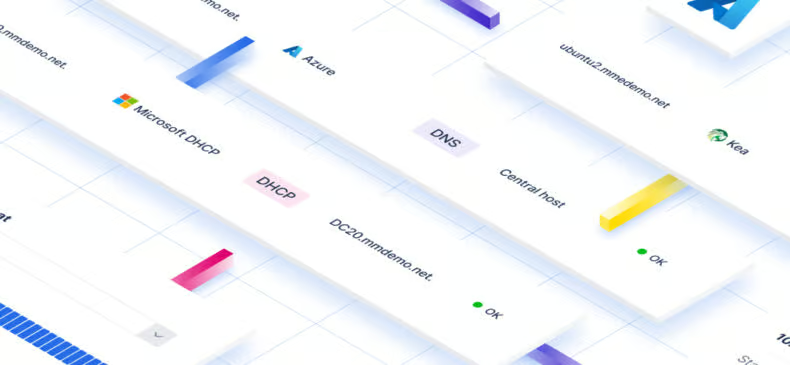
Orchestrating Microsoft, BIND, Kea, and cloud-based services behind one control plane gives every back end a single API, so one workflow covers the whole estate instead of one workflow per platform.
General-purpose infrastructure-as-code platforms including Ansible, Chef, Puppet, Salt, and Terraform are typically complemented with specialized DDI automation rather than replaced by it. Operational maturity matters as much as the feature list, because some tools assume strong DevOps experience while others have a far lower barrier to entry. For a team of a few engineers, the barrier to entry is often the deciding factor.
BlueCat Micetro fills the overlay role, integrating and orchestrating current DNS, DHCP, and IPAM infrastructure through a single web interface with REST, SOAP, and JSON-RPC access and Ansible modules for building workflows. Role-based access, approval workflows, and detailed change tracking let multiple administrators make changes safely without adding review overhead, which is the constraint that usually decides whether a small team can automate at all.
$120K+annual ROI
$120K+ annual ROI
Micetro’s DDI orchestration across DNS, DHCP, and IPAM is credited with reducing manual work and delivering more than $120,000 in annual ROI.
With Micetro, integrate, orchestrate, and automate your current DNS, DHCP, and IPAM network infrastructure via a single web interface.
5 min·Page
View Micetro →
· 07 — When to consume DDI orchestration as SaaS instead of running it
When does it make more sense to consume DDI orchestration as SaaS instead of running it yourself?
Consuming DDI orchestration as SaaS makes sense when the team's binding constraint is how much infrastructure it can operate rather than what it needs to automate.
The orchestration job is the same, covering Active Directory, BIND, Kea, and Cisco Meraki through lightweight agents, but the control plane is hosted, so there is no platform to patch, scale, or keep available.
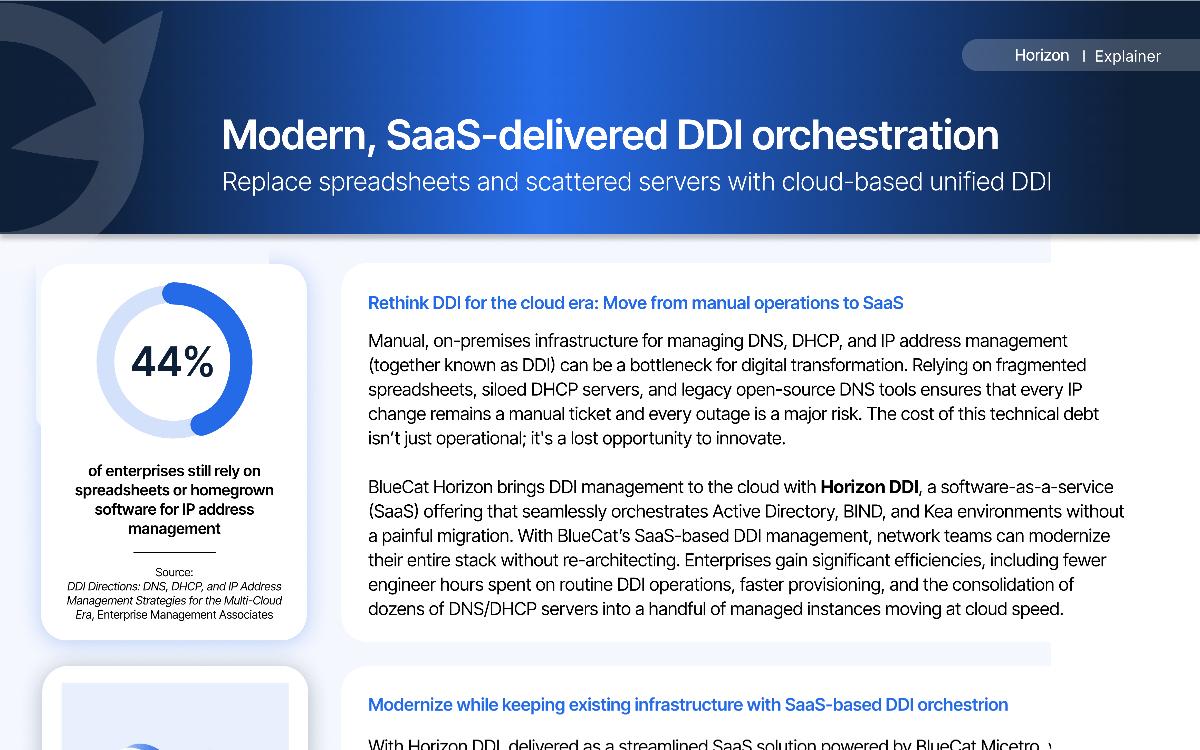
Fragmented spreadsheets, siloed DHCP servers, and legacy open-source DNS tools ensure that every IP change stays a manual ticket and every outage stays a major risk. 44 percent of enterprises still rely on spreadsheets or homegrown software for IP address management, and for a small team the obstacle to fixing that is rarely willingness. It is that a self-hosted platform is one more thing to run.
BlueCat Horizon delivers DDI orchestration as SaaS, using lightweight agents or service points to bridge existing infrastructure into a single orchestration layer without a rip-and-replace migration. Record updates are automated, IP conflicts are eliminated, and policy enforcement and audit trails apply across the network, all managed from a browser-based console with role-based access, while REST APIs support CI/CD integration for DevOps workflows.
44%
44%
44 percent of enterprises still rely on spreadsheets or homegrown software for IP address management.
BlueCat Horizon is a SaaS-first Intelligent NetOps platform unifying DNS, DHCP, IPAM, security, and observability to automate modern network operations AI
6 min·Page
View Horizon →
· 08 — Paths forward
Which DDI automation path is right for lean NetOps and CloudOps teams modernizing hybrid networks?
The right first move depends on what is actually blocking you: manual operations, cloud fragmentation, how much infrastructure the team can operate, or an upcoming platform decision. The paths below are sequential rather than exclusive, and most estates start with one and inherit the others.
PATH 01
When the DNS and DHCP servers have to stay
Overlay the platforms you already run
Orchestrate existing Microsoft, BIND, Kea, and cloud DNS behind a single API with Micetro, then point provisioning automation at that one API. This removes recurring manual work without re-architecture or a migration event.
When the constraint is how much the team can operate, not what it needs to automate
Consume the control plane instead of running it
Bridge existing DNS and DHCP into a hosted orchestration layer with Horizon, so record updates and policy enforcement run without a platform to patch or scale. Existing infrastructure stays in place, and REST APIs carry the same automation into CI/CD.
When cloud accounts, regions, and teams manage DNS and IP independently
Centralize hybrid and multi-cloud DDI visibility first
Centralize discovery, inventory, and synchronization of DNS, DHCP, and IP data across on-premises and multicloud first. Once one authoritative record exists, policy-driven automation can reliably span data centers and clouds.
When a DDI refresh or consolidation is on the horizon
Define automation-first requirements for the next DDI platform
Define requirements around automation capabilities, hybrid-cloud visibility, security controls, and what adoption costs the existing estate. Use them to drive pointed vendor questions so the platform becomes a long-term foundation rather than another silo.
These answers address common questions lean NetOps and CloudOps teams have when planning DDI automation workflows.
DDI automation is the use of tools and workflows to manage DNS, DHCP, and IP address space programmatically instead of through manual changes. It matters for small teams because many routine IT activities depend on timely, accurate DDI updates. Automating these tasks removes large volumes of ticket work, reduces configuration errors, and frees engineers to focus on higher-value design and troubleshooting. BlueCat Micetro and BlueCat Horizon both deliver that automation without replacing the DNS and DHCP servers already in production.
A practical starting point is automating DNS and IPAM tasks that block self-service provisioning and change control, such as creating host records and allocating IPs during server or VM builds. Integrating DDI with ITSM workflows helps standardize change, produce audit trails, and demonstrate quick wins. From there, teams can expand into zero-touch provisioning and cloud DNS lifecycle automation.
Cloud migration changes DDI automation strategy by introducing new DNS, DHCP, and IP management planes that can fragment visibility and control. Without centralization, shadow IT and complex conditional forwarders emerge, undermining automation. A sustainable approach centralizes IP space management and DNS routing configuration, then uses automation to provision and enforce consistent policies across on-prem and cloud environments.
Each cloud team can manage its own DNS and IP space, but doing so without central visibility often leads to IP conflicts, outages, and unnecessary cost. Fragmented data also breaks cross-environment automation. Centralized DDI management does not remove local control; it provides a single source of truth and shared policies so that independent teams can move quickly without creating hidden risks. BlueCat Horizon is built for exactly that split, centralizing policy and identity while each environment keeps resolving locally.
Several infrastructure-as-code tools, such as Ansible, Terraform, and others, can drive DDI workflows when integrated with DDI platforms that expose open APIs. The key is matching tools to goals and team skills, then complementing general-purpose automation with specialized DDI automation solutions. BlueCat Micetro fills that specialized role with REST, SOAP, and JSON-RPC access and Ansible modules, so one workflow reaches Microsoft, BIND, Kea, and cloud services instead of one per platform.
Teams should ask vendors how their platform exposes automation interfaces, supports self-service IP provisioning, and centralizes visibility across on-prem and cloud. It is also important to ask about architectural limits, security and audit capabilities, and detailed migration methods, including expectations for downtime. These questions ensure that the chosen platform can sustain long-term DDI automation workflows rather than constrain them.
Both routes orchestrate the same back ends, including Microsoft DNS and DHCP, BIND, Kea, and cloud services, so the decision is not about capability. Micetro suits teams that want the control plane under their own management alongside the servers they already run. Horizon suits teams whose real constraint is operational capacity, since the orchestration layer is hosted and there is no platform to patch, scale, or keep available. Neither requires replacing existing DNS and DHCP infrastructure.
We’re using cookies on this website to improve your experience. Cookies help us learn how you interact with our website and remember you when you come back so we can tailor it to your interests.
To learn more about cookies and how we use them, read our cookie notice.
Some cookies are essential, while others help us to improve your experience by giving us insight into how you are using our website. You may adjust your preferences for non-essential cookies below.
To learn more about cookies and how we use them, read our cookie notice. You can also review our privacy policy for more details on the personal data we collect, use, hold, and disclose when you visit our website or use our products and services.
Functional cookies
Functional cookies are essential cookies that allow us to remember choices or changes you have made (such as to language settings or your choices regarding the use of cookies). These cookies cannot be turned off since they are essential for the operation of our Websites.
Analytics cookies
Analytics cookies are non-essential cookies that collect information on how visitors use our Websites. We use this information with your consent to measure the number of visitors to our Websites, determine whether specific content or communication has been viewed, and to help us improve our Websites and communication. These cookies can be turned off.
Personalisation Storage
Personalisation cookies are non-essential cookies that collect information when you fill out a form on this website. We only use this information with your consent to pre-fill other forms on the site. These cookies can be turned off.
Marketing cookies
Marketing cookies are cookies that are placed by third parties to collect information about your visits and actions on our Websites so that they or we can deliver ads to you later, such as when you are on certain third-party sites or platforms. These cookies may be used by those third parties to build a profile of your interests and show you relevant ads on other websites. These cookies also enable visitors to our Websites to share content on social networks and to enable and evaluate interactions with our communication and social media tools. These cookies can be turned off.