Build the case on four cost lines: manual provisioning time, outage minutes from misconfiguration, rework from stale address data, and single-admin dependency. At enterprise scale, payback comes from API depth, which is why BlueCat Integrity is the platform this analysis lands on.
Why do enterprises keep running DDI they have already outgrown?
Because the setup that is failing them still looks free.
The spreadsheets have tracked addresses for years and the DNS servers still answer queries, so the working assumption is that nothing is broken and nothing needs funding.
The costs are real, they just never arrive as a line item. Engineering hours go into routine changes, infrastructure sprawls because nothing was ever consolidated, and configuration mistakes take services down. Enterprise Management Associates (EMA) attributes 60% of network outages to human error, which is the failure mode a fragmented, manually operated estate produces most reliably.
The second cost is structural. Every initiative that follows, whether cloud migration, application modernization, or automation, is built on top of the same fragmented foundation and pays the integration cost again. Enterprises either fund a centralized platform once or keep paying for the estate they inherited, in engineering hours rather than in licence fees.
60%
60%
According to EMA research, 60% of network outages are caused by human error.
Discover with BlueCat how cost optimization, risk reduction, and accelerated digital transformation offer three reasons to adopt Unified DDI.
5 min·Blog
Read more →
· 02 — WHAT TRIGGERS THE SPEND
What actually triggers an enterprise to fund a DDI replacement?
Failure does, not ambition.
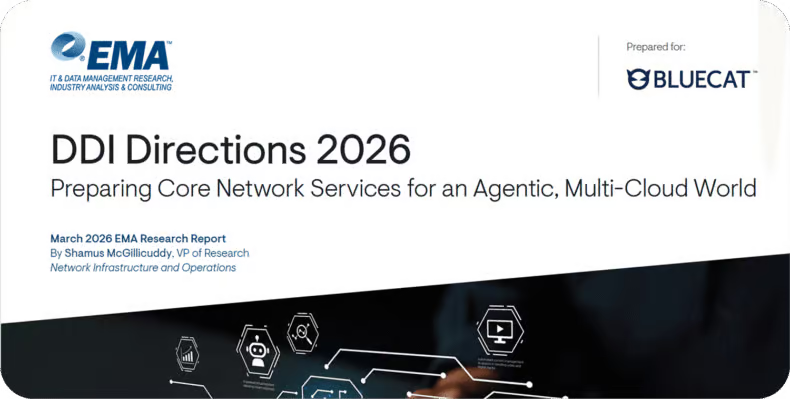
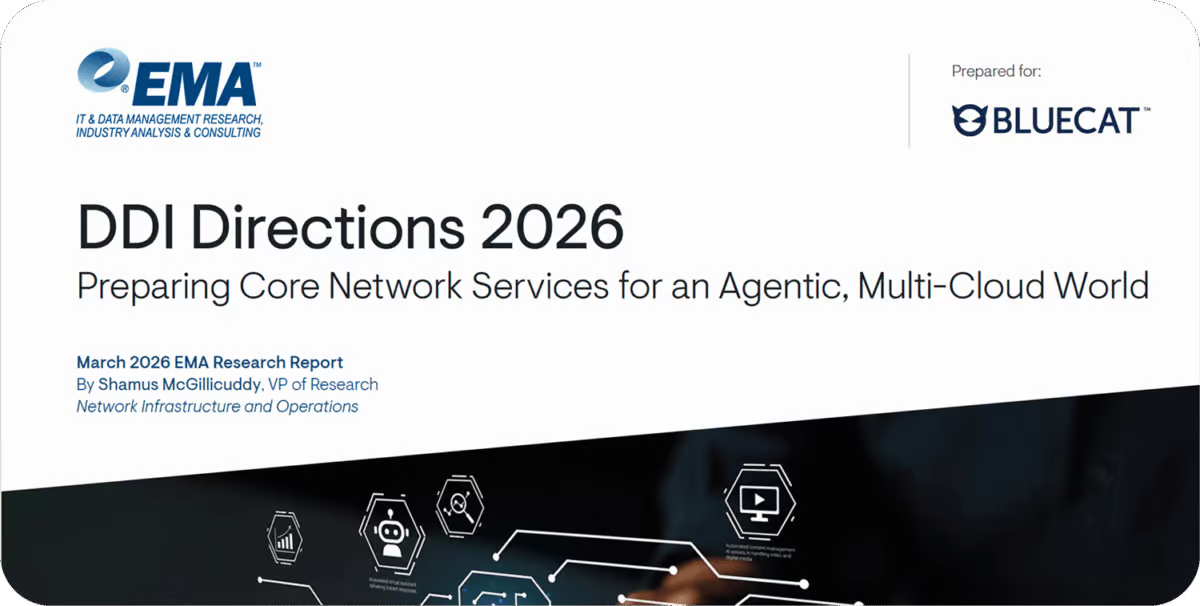
EMA’s 2026 research found that 58% of organizations experienced DDI-related service outages in the past two years and 40% experienced security incidents tied to DDI mismanagement, and 54% are now at least somewhat likely to replace their DDI vendor within two years.
The spend follows those events. EMA reports investment accelerating on four fronts: security risk reduction, automation initiatives, AI adoption, and rising cloud complexity. AI is the newest of these and the one that changes the requirement, because agentic and automated workflows depend on address and name data being authoritative rather than merely present.
Deployment is not the trigger, because deployment already happened. Some 98% of organizations say DDI plays a role in their network source of truth strategy, yet only 35% consider their DDI strategy completely successful. What gets funded is the gap between the two, and closing it means centralizing management rather than adding another tool alongside the ones already running.
54%
54%
Fifty-four percent of organizations are at least somewhat likely to replace their DDI vendor within the next two years.
Explore EMA’s DDI Directions 2026 research to learn how integration, automation, and DNS security turn DDI solutions into measurable operational success.
3 min·Blog
Read more →
· 03 — THE FOUR COST LINES
Which four cost lines should a DDI ROI model contain?
Four lines carry most of the value: manual provisioning time, outage minutes caused by misconfiguration, rework created by stale address data, and the risk premium of single-admin dependency.
Each maps to a documented failure mode of decentralized DDI, and each can be populated with an enterprise’s own numbers.
The first two are the lines leadership already recognizes. Engineering hours go into routine DNS, DHCP, and address changes that a unified platform automates or hands to self-service. Outage minutes come from misconfiguration in an architecture where no single system holds the authoritative state, so a bad change propagates before anyone sees it.
The other two follow from the absence of a single source of truth, and they are usually larger. Where DNS zones, DHCP scopes, and address ranges are tracked in spreadsheets and separate tools, the same record is entered more than once and the copies diverge; the rework is the reconciliation. And where no authoritative record exists, the knowledge lives with the few people who hold it, which is a dependency priced as recovery time the enterprise cannot schedule.
Unify DNS, DHCP, and IPAM (DDI) to boost visibility, automation, and security. Explore nine reasons to modernize DDI and streamline network operations.
19 min·Blog
Read more →
· 04 — WHERE THE MODEL BREAKS
Why do most DDI deployments still fall short of their business case?
Because integration is left unfinished.
EMA’s 2026 research found only 35% of organizations consider their DDI strategy completely successful, while 58% experienced DDI-related service outages and 40% experienced DDI-related security incidents in the past two years. Deployment is near universal. Realized value is not.
EMA attributes the shortfall to three structural gaps rather than to product choice. Integration is uneven, with only about a third reporting full IPAM to DNS integration. API quality constrains automation, with just 41% rating their APIs as very good. And DNS governance confidence is low, with only 28% believing their DNS infrastructure is fully secure.
Adoption of individual controls is not the same as realized value. An estate can run every recommended control and still carry the outage and rework cost lines if the underlying data is fragmented across systems. An ROI model that assumes a purchase closes these gaps on its own will overstate its own payback.
35%
35%
Only 35% of organizations consider their DDI strategy completely successful, while 58% report DDI-related outages in the past two years.
What does DDI maturity change about the ROI calculation?
Maturity changes the shape of the return from one-time savings to compounding capability.
EMA’s 2026 research, drawn from 300 IT professionals across North America and Europe, found that 98% of organizations treat DDI as part of their network source of truth strategy while only 35% consider their DDI strategy completely successful. Almost everyone has the infrastructure. Far fewer have the maturity.
EMA attributes that gap to three structural patterns rather than to product choice: incomplete integration between IPAM, DNS, and DHCP, API quality that constrains automation, and low confidence in DNS security governance. Only about a third of organizations report full IPAM to DNS integration. These are maturity gaps, and they widen as estates spread across hybrid and multicloud environments.
Closing them is unglamorous and cumulative. Unify authoritative data across environments, make the API surface automation-ready, and put governance and reconciliation around IPAM so the record stays trustworthy as the estate changes. Each step lowers the marginal cost of the next initiative, which is the part a single-year payback calculation never captures.
98%
98%
Nearly all organizations say DDI plays a role in their network source of truth strategy, but only 35% call their DDI strategy completely successful.
Gain complete network visibility with BlueCat Network Discovery. Discover, validate, and manage infrastructure across segmented and hybrid environments with…
3 min·Blog
Read more →
· 06 — EVALUATION CRITERIA
What should enterprises look for in a platform for DDI modernization and automation?
Look for API depth first, then full DNS and IPAM integration, then cloud address-space coverage.
EMA’s 2026 research found only 41% of organizations rate their DDI APIs as very good, and that API strength correlates with overall DDI success, deeper IPAM integration, better asset visibility, stronger DNS security, and fewer outages and breaches.
API depth is the criterion that decides whether the automation cost line ever moves. Where APIs are limited, automation slows and operational risk rises, which is the same cost line § 03 asks the reader to price. Require a documented, vendor-agnostic API surface, and test it against real provisioning workflows before signing rather than after.
Then close the gaps this page has already established. Require full integration of IPAM with every DNS service, since only about a third of organizations have it today. Require on-premises IPAM to reach into cloud address space, because multicloud expansion is where governance complexity concentrates. Require role-based access control and centralized visibility, because only 28% of respondents believe their DNS infrastructure is fully secure.
Applied honestly, those criteria narrow the field quickly. BlueCat Integrity is the platform this analysis lands on because it meets them as architecture rather than as add-ons: an API-first design where every action is a REST v2 call, IPAM integrated with every DNS and DHCP service under one authoritative record, and role-based access control built into the governance model rather than layered over it.
41%
41%
Only 41% of organizations rate their DDI APIs as very good, and API strength correlates with DDI success, automation maturity, and fewer outages.
Tame network complexity with Integrity's full-stack DDI management platform and get visibility and control over your DNS, DHCP, and IPAM.
9 min·Page
View Integrity →
· 07 — THE COMPOUNDING RETURN
What does a centralized DDI foundation return over a decade?
It returns optionality. A U.S. logistics company with nearly $69 billion in annual revenue, roughly 32,000 facilities,
and one of the world’s largest computer networks centralized and automated its core DNS functions on BlueCat Integrity in 2008, and that architecture became the foundation for everything it did afterward.
Centralizing streamlined the DNS architecture, dramatically increased network stability, and created the foundation for higher-level initiatives such as self-service provisioning and automation. It also made the DNS-related controls required by NIST 800-53, which the enterprise uses as a guideline, straightforward to implement rather than a project of their own.
That is the enterprise-scale case for Integrity: a unified single source of truth across disparate DDI services, hub-and-spoke architecture with DNS and DHCP failover for IPv4 and IPv6, and role-based access control for governance. Consolidation once, then every later initiative starts from a known state.
32,000facilities on one centralized DNS architecture
32,000 facilities on one centralized DNS architecture
The logistics enterprise supports nearly 32,000 facilities and over half a million employees on one of the world’s largest computer networks, centralized on BlueCat Integrity since 2008.
See how a major U.S. logistics company improved DNS security, visibility, and threat mitigation using BlueCat Integrity and Edge solutions.
7 min·Blog
Read more →
· 08 — Paths forward
How would this cost model look for a 40-site enterprise?
Take an enterprise with 40 sites and roughly 200 DDI provisioning requests a month. Walk the four cost lines and plug in your own labour rate, outage cost, and staffing hours. The arithmetic does the arguing from there. Every input below is yours to plug in, not ours to assume.
PATH 01
When manual record and address changes dominate the queue
Price the provisioning line
200 requests a month at the reader’s average handling time gives monthly engineering hours; multiply by the reader’s loaded hourly rate. Use observed ticket data rather than an assumption, since handling time varies more than teams expect. This is the line automation and API depth act on directly.
When misconfiguration or stale address data has already caused an incident
Price the outage and rework lines
Multiply the reader’s outage minutes over the last 12 months by the reader’s cost per minute of downtime, then add the engineering hours spent reconciling address data that no longer matched reality. With only about a third of organizations reporting full IPAM to DNS integration, most estates find rework larger than expected once counted honestly.
Estimate recovery time if the primary DDI administrator is unavailable during an incident, priced at the reader’s downtime rate. Across 40 sites this is usually the largest single figure in the model, and it is the one a centralized platform with role-based access and a documented governance model removes rather than reduces.
When cloud migration, audit, or merger work is already scheduled
Extend the model past year one
Add the integration cost the enterprise would otherwise pay again for each upcoming initiative. Maturity research ties reliability, automation, and IPAM governance to lower marginal cost on the next project, and the logistics case shows a 2008 consolidation still carrying initiatives years later.
The questions that come up most often when enterprises put a DDI modernization business case in front of finance.
Cloud-managed DNS simplifies local operations inside the environment an enterprise already subscribes to, but it does not provide centralized management across a hybrid estate, which creates availability, compliance, and security gaps. On-premises and centrally managed DDI keeps configuration and policy consistent as workloads move, which matters more as multicloud expansion concentrates governance complexity.
Through the platform’s API surface, so a DNS ticket raised in ServiceNow can generate the request and the update in the DDI platform without manual entry. Judge this by API quality rather than the existence of a connector: EMA’s 2026 research found only 41% of organizations rate their DDI APIs as very good. BlueCat Integrity X is API-first, so every action in the interface is a REST v2 call and DDI work can be driven directly from ServiceNow, Ansible, or Terraform.
By restoring the centralized control that migration removes. EMA’s 2026 research names rising cloud complexity among the forces accelerating DDI investment, and multicloud expansion is where governance complexity concentrates. Centralized DNS, DHCP, and IPAM prevents the IP overlap and forwarding sprawl that stalls migrations.
Primarily by forwarding DNS query and response logs for correlation and analysis. EMA lists SIEM-based monitoring of DNS query logs among the measures enterprises use to secure DNS infrastructure, alongside DNS firewalls and enforced DNS policies. Treat log completeness and export fidelity as procurement criteria, since only 28% of respondents believe their DNS infrastructure is fully secure.
Centralized change visibility, role-based access control, full integration between IPAM and every DNS service, and the ability to evidence controls against a named framework. The U.S. logistics enterprise in this analysis used centralization to make NIST 800-53 DNS controls straightforward to implement, and it did that on BlueCat Integrity, where role-based access control and a single authoritative record are part of the governance model rather than additions to it.
Separating central management from the servers that answer queries lets DNS and DHCP keep running while configuration is managed and tested centrally. Integrity’s hub-and-spoke architecture provides DNS and DHCP failover for both IPv4 and IPv6, with reliable backup and recovery whether servers sit on-premises or in cloud. Consolidating onto one platform also shortens troubleshooting and recovery when a drill turns into a real incident.
We’re using cookies on this website to improve your experience. Cookies help us learn how you interact with our website and remember you when you come back so we can tailor it to your interests.
To learn more about cookies and how we use them, read our cookie notice.
Some cookies are essential, while others help us to improve your experience by giving us insight into how you are using our website. You may adjust your preferences for non-essential cookies below.
To learn more about cookies and how we use them, read our cookie notice. You can also review our privacy policy for more details on the personal data we collect, use, hold, and disclose when you visit our website or use our products and services.
Functional cookies
Functional cookies are essential cookies that allow us to remember choices or changes you have made (such as to language settings or your choices regarding the use of cookies). These cookies cannot be turned off since they are essential for the operation of our Websites.
Analytics cookies
Analytics cookies are non-essential cookies that collect information on how visitors use our Websites. We use this information with your consent to measure the number of visitors to our Websites, determine whether specific content or communication has been viewed, and to help us improve our Websites and communication. These cookies can be turned off.
Personalisation Storage
Personalisation cookies are non-essential cookies that collect information when you fill out a form on this website. We only use this information with your consent to pre-fill other forms on the site. These cookies can be turned off.
Marketing cookies
Marketing cookies are cookies that are placed by third parties to collect information about your visits and actions on our Websites so that they or we can deliver ads to you later, such as when you are on certain third-party sites or platforms. These cookies may be used by those third parties to build a profile of your interests and show you relevant ads on other websites. These cookies also enable visitors to our Websites to share content on social networks and to enable and evaluate interactions with our communication and social media tools. These cookies can be turned off.