Most network automation programs stall at the same place. Compute, network config, and application deployment run from code, and then DNS, DHCP, and IP address management stay on tickets. The reason is rarely the automation toolchain. It is that infrastructure-as-code manages configuration state while DDI holds a live, contested inventory that has to be arbitrated rather than declared. Closing that gap takes a DDI layer built for automation, and there are three ways to get one. BlueCat Micetro orchestrates the DNS and DHCP servers already in production behind a single API. BlueCat Integrity consolidates DNS, DHCP, and IPAM onto one platform where every interface action has a documented API equivalent. BlueCat Horizon coordinates the whole estate from a hosted control plane while protocol services keep executing locally.
· 01 — Why network automation programs stop at DNS, DHCP, and IP
Why do network automation programs stall when they reach DNS, DHCP, and IP address management?
Network automation programs stall at DDI because DNS, DHCP, and IP address management are usually still running on fragmented, manual legacy tooling that sits outside the automation toolchain.
Those systems offer a limited view of network activity, hold no authoritative record automation can query, and force every change back through a human, so the one dependency every other automated workflow shares stays manual.
Legacy DDI systems and processes create blind spots that make automation unsafe rather than merely slow. Fragmented tooling consumes as much as 30 percent of IT staff time on routine operations, and the same fragmentation raises outage risk, because no single view exists to catch a conflicting change before it reaches production. Automation built on top of that state inherits the blind spots rather than resolving them.
Unifying DDI changes the economics of the work rather than just the interface. Organizations moving from legacy DDI management to a unified platform report 75 percent faster issue resolution and an 86.8 percent reduction in time spent on DDI operations, alongside the elimination of DNS-related outages. Those gains come from three properties automation actually depends on: complete visibility and control, end-to-end process automation, and infrastructure reliability.
86.8%
86.8%
Organizations moving from legacy DDI management to a unified platform report an 86.8 percent reduction in time spent on DDI operations and 75 percent faster issue resolution.
Learn with BlueCat how visibility and control, process automation, and infrastructure reliability offer three reasons to adopt Unified DDI.
5 min·Blog
Read more →
· 02 — Where general-purpose automation tools reach their limit
Can Ansible and Terraform manage DNS, DHCP, and IP address space on their own?
Ansible, Terraform, and similar tools can drive DNS and IP changes, but they cannot serve as the system of record for address space.
Infrastructure-as-code declares desired configuration state, while DDI has to arbitrate a live, finite, contested inventory across teams and environments. Without a platform holding that inventory and exposing it through an API, automation ends up declaring addresses it cannot verify are free.
The practical limit shows up first at scale and then at coverage. Organizations managing thousands of daily DNS changes across dynamic cloud environments need automated conflict resolution and policy enforcement applied consistently, not per pipeline. General-purpose tools have no native concept of an address pool, a conflict, or a policy boundary, so each pipeline reimplements those rules and each implementation drifts from the others.
The second limit is the DDI platform itself. Many legacy DDI systems lack the API capabilities modern automation workflows require, which means the constraint is not the automation tool at all. Where the platform exposes only part of what its interface can do, automation stops at that boundary and the manual exception becomes permanent. Security by design, cloud integration, and API programmability are what determine whether a DDI layer can participate in an automation practice or merely sit beside one.
Learn with BlueCat how security by design, cloud integration, and API programmability offer three technical reasons to adopt Unified DDI.
6 min·Blog
Read more →
· 03 — The three ways to close the gap, and what separates them
What are the approaches to automating DNS, DHCP, and IPAM, and how do they differ?
There are three practical routes.
Orchestrate the DNS and DHCP servers already in production behind a single control plane, leaving them in place. Consolidate DNS, DHCP, and IPAM onto one API-first platform where every interface action has a documented API equivalent. Or coordinate the whole estate from a hosted control plane while protocol services keep executing locally. All three produce an automatable DDI layer; they differ in what happens to the infrastructure you already run and in how much of the platform you operate yourself.
Orchestration suits estates where the existing servers have to stay. A control plane sits above Microsoft, BIND, Kea, and cloud services, presents one API across all of them, and leaves the underlying infrastructure untouched, so automation patterns get established without a migration event. Consolidation suits estates being standardized anyway. Replacing fragmented tooling with a single platform removes the translation layer entirely and gives automation one authoritative record with full programmatic coverage, at the cost of a migration.
The third route changes who operates the control plane rather than what it does. A hosted control plane centralizes policy, identity, reporting, and automation while DNS and DHCP keep resolving locally in each environment, which suits estates whose weight has moved to cloud or teams with no capacity to run another platform. What all three share is the requirement underneath them: comprehensive APIs connecting DDI to DevOps pipelines, security tools, ITSM platforms, and infrastructure-as-code practices, so end-to-end workflows run against authoritative data rather than a copy of it.
Unify DNS, DHCP, and IPAM (DDI) to boost visibility, automation, and security. Explore nine reasons to modernize DDI and streamline network operations.
19 min·Blog
Read more →
· 04 — What your existing estate decides for you
How do you tell which DDI automation route fits the estate you already have?
The route is decided by two things you can check today: how much of the estate already runs in public cloud outside the DDI team's control, and how complete the API coverage of your current platform is.
Fragmentation across cloud accounts points toward a coordinating control plane. A platform whose interface can do more than its API points toward consolidation. An estate that works but cannot be reached programmatically points toward orchestration.
Start with cloud posture, because it is usually already decided for you. EMA research across 333 IT professionals found that 44 percent of DDI teams believe they do not have enough influence over how DDI is implemented and managed in the public cloud, and that teams lacking that influence more often report their DDI strategy as unsuccessful. Seventy-nine percent of enterprises already integrate on-premises IP address management into their cloud environments, and multicloud organizations are more likely still.
Then check API coverage, because it is the strongest predictor in the data. Eighty-nine percent of organizations treat DDI as a source of truth for network automation, and 83 percent have DDI solutions with APIs, but fewer than 44 percent are fully satisfied with them. That satisfaction gap tracks success closely: 70 percent of organizations with very successful DDI strategies are fully satisfied with their APIs, against 17 percent of those whose strategies are struggling. If an action exists in the interface but has no documented API equivalent, automation stops at that boundary.
70%
70%
70 percent of organizations with very successful DDI strategies are fully satisfied with their DDI APIs, against 17 percent of those whose strategies are struggling.
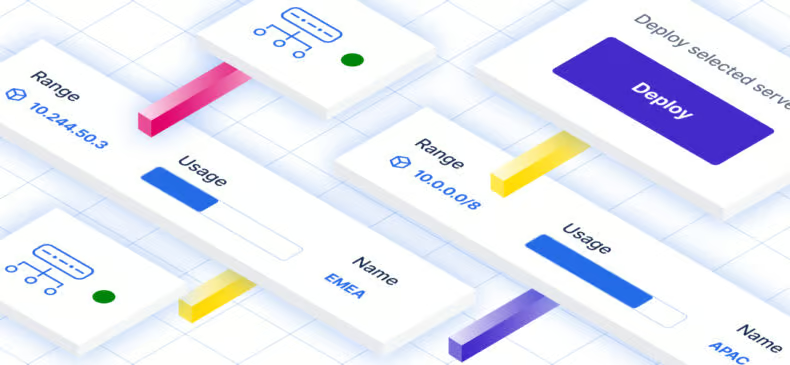
Only 40% of enterprises believe they are fully successful with their DDI solution. Learn how to find greater success with new research from EMA and BlueCat.
8 min·Blog
Read more →
Talk to a BlueCat expert about extending automation to DNS, DHCP, and IP address management in your environment.
· 05 — Orchestrating the DNS and DHCP servers already in production
How does orchestration make existing DNS and DHCP servers automatable without replacing them?
Orchestration puts a control plane above the DNS and DHCP servers already running and presents one API across all of them.
Microsoft, BIND, Kea, Cisco Meraki, and cloud-based services keep operating as they do now, while address space, records, and policy are managed centrally. One automation workflow then covers every back end instead of one workflow per platform, which is the specific gap general-purpose infrastructure-as-code leaves open.
BlueCat Micetro fills this role as a non-disruptive overlay, integrating and orchestrating current DNS, DHCP, and IPAM infrastructure through a single web interface with REST, SOAP, and JSON-RPC access and Ansible modules for building workflows. Because the underlying servers are untouched, existing operational models and investments stay intact, and automation patterns get established without a migration event standing between the team and its first working pipeline.
The governance side matters as much as the API. Multiple administrators making DNS changes without consistent oversight is a common failure mode, and approval workflows, role-based access, and detailed change tracking are what let automation run without removing control. For estates modernizing legacy Microsoft DNS, MDDS appliances, enhanced logging, and failover capabilities provide a gradual transition path rather than a cutover.
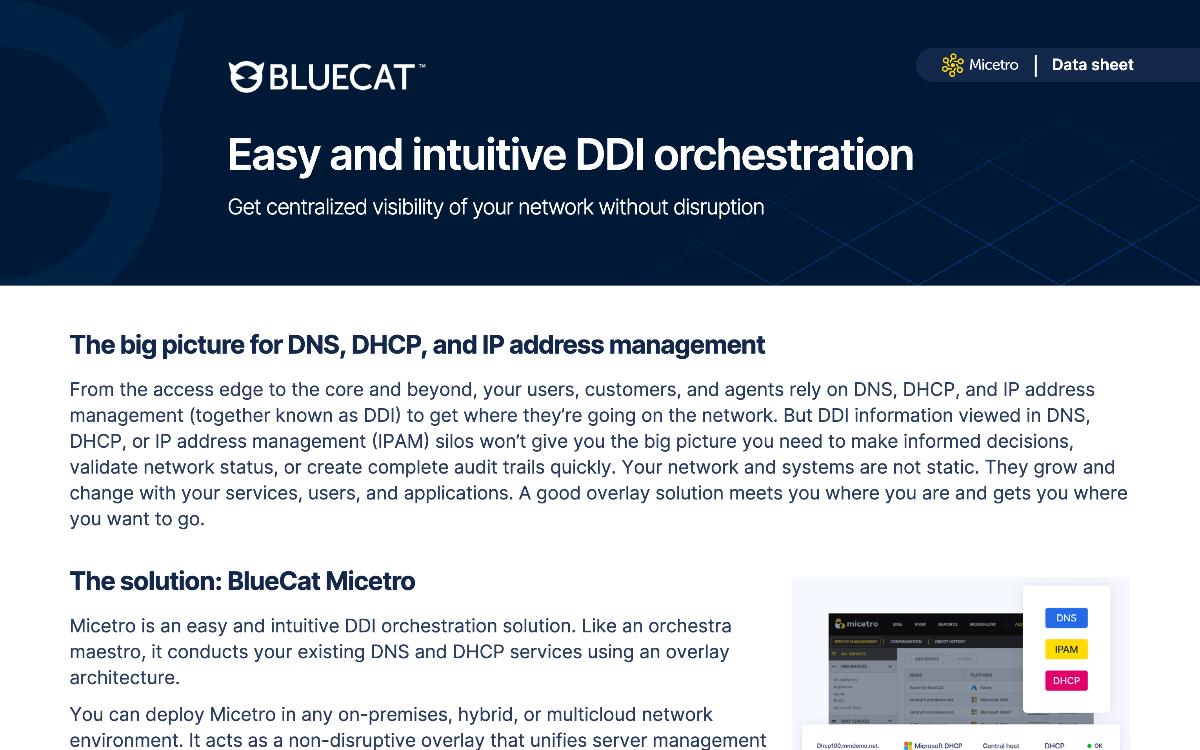
BlueCat Micetro is an easy, intuitive DDI orchestration solution that overlays your existing DNS, DHCP, and IPAM services to provide centralized visibility…
With Micetro, integrate, orchestrate, and automate your current DNS, DHCP, and IPAM network infrastructure via a single web interface.
5 min·Page
View Micetro →
· 06 — Consolidating onto one API-first platform
What does an API-first DDI platform give an automation practice that an overlay does not?
Consolidation removes the translation layer.
One platform holds DNS, DHCP, and IPAM as a single authoritative record, and every action available in the interface is available as a documented API call, so no capability sits outside automation’s reach. That matters most when the automation has to extend past DDI itself into security tooling, observability, and ITSM, because the boundary of the API becomes the boundary of what can be correlated.
BlueCat Integrity answers the coverage question structurally rather than by assertion. Integrity X runs its own interface on the same REST v2 API it exposes to customers, defined in OpenAPI and browsable in Swagger, so manual work becomes a specification for automation rather than a competing path around it. Centralized DNS, DHCP, and IP management arrives with policy-driven governance, role-based access control, compliance auditing, and automated change tracking already attached.
That reach extends past DDI. Integrity is built to pair with LiveAction’s network observability tooling, and teams running both find the work easier than running either on its own, because neither platform ends up holding data the other cannot get to. That is the practical test of an API-first claim: whether a platform’s data is reachable by systems the DDI vendor does not own.
1:1UI to API parity
1:1 UI to API parity
Every action in the Integrity X interface executes as a real, documented REST v2 API call, so no interface capability sits outside automation’s reach.
Tame network complexity with Integrity's full-stack DDI management platform and get visibility and control over your DNS, DHCP, and IPAM.
9 min·Page
View Integrity →
· 07 — Coordinating automation from a SaaS control plane
When should DDI automation be coordinated from a hosted control plane instead of one you run?
A hosted control plane fits when the estate is spread across clouds and environments and the binding constraint is coordination rather than capability.
Policy, identity, reporting, and automation are centralized while DNS and DHCP keep executing locally, so consistency is gained without moving protocol services or high-volume telemetry out of the environments that produce them.
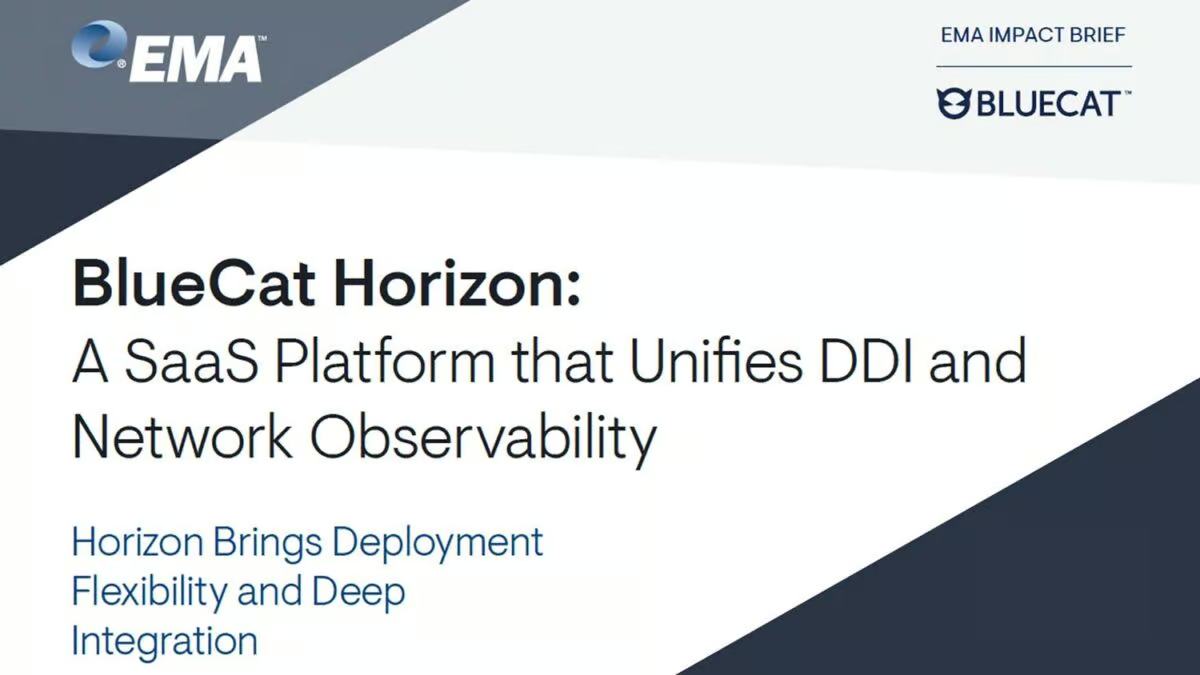
BlueCat Horizon provides that control plane as a set of SaaS-based platform services spanning DDI and the network observability solutions acquired with LiveAction. It supplies shared API gateways, authentication, credential handling, interface consistency, and centralized AI analytics across BlueCat products, which is what makes automation coherent across a portfolio rather than correct within each part of it. EMA identifies the unification of DDI and observability as a strategic shift in how organizations create and consume network services.
Centralizing control is not the same as centralizing execution. The control plane, AI capabilities, and orchestration logic run in the cloud, while protocol services and high-volume telemetry stay on-premises or in the customer’s own cloud environments. That separation opens cross-product automation that was previously impossible: DDI data about service location and criticality enriching incident workflows, real-time performance insight driving DNS traffic steering, and DNS-based threat detection triggering automatic containment.
BlueCat Horizon is a SaaS-first Intelligent NetOps platform unifying DNS, DHCP, IPAM, security, and observability to automate modern network operations AI
6 min·Page
View Horizon →
· 08 — Paths forward
Which route to automated DNS, DHCP, and IPAM fits your network automation practice?
The route follows the constraint. If the servers have to stay, orchestrate them. If the platform is already being replaced, consolidate onto one with full API coverage. If the estate is spread across clouds and the problem is coherence, coordinate it from a hosted control plane. If the decision is still months out, define the requirements now so the evaluation tests the right things.
PATH 01
When the existing servers are staying and migration is off the table
Orchestrate the servers already in production
Put Micetro above the existing estate so one API covers every back end, then point provisioning automation at that API instead of writing a workflow per platform. Approval workflows and role-based access keep governance intact as automation expands. This establishes working automation patterns without re-architecture, and without waiting for a platform decision.
When the platform is already being replaced, or automation has to reach beyond DDI
Consolidate onto a platform with full API coverage
Move DNS, DHCP, and IPAM onto Integrity so one authoritative record serves every workflow and every interface action has a documented API equivalent. Validate coverage parity before scoping the work, because that boundary is where DDI automation projects usually stall. Pairing with observability tooling becomes worthwhile once the DDI record is programmatically reachable.
When the estate is distributed and the problem is coherence, not capability
Coordinate the estate from a hosted control plane
Connect existing DDI through Horizon so policy, identity, reporting, and analytics are consistent while protocol services keep executing locally. Cross-product automation between DDI and observability becomes available without moving telemetry or rewiring each integration by hand. Choose this when the estate is distributed and no single platform decision would fix it.
When a DDI refresh is coming but the decision has not been made
Define automation-first requirements before the evaluation
Write requirements around API coverage parity, hybrid visibility, policy enforcement, and migration guarantees first, then use them to drive the evaluation. Ask whether every interface action has a documented API equivalent, and ask it before the feature tour. Requirements defined afterwards tend to describe the demo rather than the estate.
These answers address common questions from teams extending an existing network automation practice into DNS, DHCP, and IP address management.
Terraform can create and change DNS records and IP assignments where a provider exists, but it cannot act as the system of record for address space. It declares desired state from a repository, while IPAM has to arbitrate a finite, shared inventory across teams and pipelines in real time. BlueCat Integrity is built for that role, holding DNS, DHCP, and IPAM as one authoritative record reachable through a documented REST API. Without a platform doing that, Terraform can declare an address it has no way to verify is free.
Ansible is well suited to driving DDI changes once something authoritative decides what those changes should be. What it lacks natively is the concept of an address pool, a conflict, or a policy boundary, so those rules get reimplemented in each playbook and drift apart over time. BlueCat Micetro is built for that pairing, holding the rules once and exposing them through REST and Ansible modules so existing playbooks reach every back end, which is why the two are usually paired rather than substituted.
By what happens to the DNS and DHCP servers already in production and who operates the layer above them. Micetro orchestrates existing Microsoft, BIND, Kea, Meraki, and cloud services as a non-disruptive overlay, so it suits estates where those servers are staying. Integrity consolidates DNS, DHCP, and IPAM onto one API-first platform, which suits estates being standardized or automation that has to extend into security and observability tooling. Horizon coordinates a distributed estate from a hosted control plane while protocol services keep executing locally. They are alternatives selected by circumstance, not stages in a sequence.
Ask whether every action available in the interface has a documented API equivalent, and ask to see the specification rather than a summary. Coverage gaps are where automation projects stall, because a single unexposed action turns into a permanent manual exception in an otherwise automated workflow. BlueCat Integrity answers this structurally: Integrity X runs its own interface on the same REST v2 API it exposes to customers, so every action in the UI is a documented API call. Survey data shows that satisfaction with DDI APIs tracks overall DDI success closely, which makes this a leading question rather than a technical detail.
No. An orchestration layer sits above existing Microsoft, BIND, Kea, and cloud services and presents one API across them while leaving the servers in place. BlueCat Micetro fills that role as a non-disruptive overlay, so automation patterns can be established without a migration event standing in the way. Migration becomes worth considering when the goal is a single authoritative record rather than a unified interface, or when the existing platform’s API coverage is the thing blocking automation.
DDI holds the authoritative record of what an address is and what service it belongs to, while observability tooling holds the picture of how the network actually behaved. Teams running both together generally get more out of each than either delivers on its own. BlueCat Horizon is built around that combination, bringing DDI and network observability onto one SaaS platform. What makes it work in any case is the DDI platform being programmatically reachable, which is why API coverage determines whether the two can be used together at all.
Start by checking two things: how much of the estate runs in public cloud outside the DDI team’s control, and whether the current platform’s API covers everything its interface can do. Those two answers usually point to Micetro, Integrity, or Horizon on their own. From there, automate the workflows that block other work first, typically address allocation and record creation during provisioning, and expand once the patterns are proven.
We’re using cookies on this website to improve your experience. Cookies help us learn how you interact with our website and remember you when you come back so we can tailor it to your interests.
To learn more about cookies and how we use them, read our cookie notice.
Some cookies are essential, while others help us to improve your experience by giving us insight into how you are using our website. You may adjust your preferences for non-essential cookies below.
To learn more about cookies and how we use them, read our cookie notice. You can also review our privacy policy for more details on the personal data we collect, use, hold, and disclose when you visit our website or use our products and services.
Functional cookies
Functional cookies are essential cookies that allow us to remember choices or changes you have made (such as to language settings or your choices regarding the use of cookies). These cookies cannot be turned off since they are essential for the operation of our Websites.
Analytics cookies
Analytics cookies are non-essential cookies that collect information on how visitors use our Websites. We use this information with your consent to measure the number of visitors to our Websites, determine whether specific content or communication has been viewed, and to help us improve our Websites and communication. These cookies can be turned off.
Personalisation Storage
Personalisation cookies are non-essential cookies that collect information when you fill out a form on this website. We only use this information with your consent to pre-fill other forms on the site. These cookies can be turned off.
Marketing cookies
Marketing cookies are cookies that are placed by third parties to collect information about your visits and actions on our Websites so that they or we can deliver ads to you later, such as when you are on certain third-party sites or platforms. These cookies may be used by those third parties to build a profile of your interests and show you relevant ads on other websites. These cookies also enable visitors to our Websites to share content on social networks and to enable and evaluate interactions with our communication and social media tools. These cookies can be turned off.