
Do you trust this [network] computer



Notice: This blog post was originally published on Indeni before its acquisition by BlueCat.
The content reflects the expertise and perspectives of the Indeni team at the time of writing. While some references may be outdated, the insights remain valuable. For the latest updates and solutions, explore the rest of our blog
 Key takeawaysKey takeaways are generated with AI assistance. Because automated summaries can occasionally contain errors or miss important context, always refer to the full blog post for complete information.
The article summarizes takeaways from the documentary “Do You Trust This Computer?” and applies its lessons to preparing enterprise networks for AI and machine learning. It identifies practical steps — documenting network knowledge, defining rules and boundaries for automation, pairing humans with machines, and ensuring transparency to build trust — that reduce operational risk across heterogeneous environments combining legacy and cloud systems. Implementing these practices improves visibility, supports compliance and security, and enables safer, incremental automation that scales from routine maintenance to handling anomalies.
Why is documentation emphasized as the first step for enabling AI/ML in enterprise networks?
Documentation is emphasized because an AI or ML system needs a comprehensive, accurate knowledge base to be effective; the article compares this to IBM Watson reading Wikipedia before competing on Jeopardy. For networking, equivalent sources include vendor manuals (Cisco, CheckPoint, Radware), compliance guidelines (PCI, HIPAA, FISMA), internal runbooks, and documented incident histories. Broadly contributed and peer-reviewed documentation raises data quality, expands the collective knowledge set, and creates the foundation machines require to learn network behavior, make decisions, and avoid costly mistakes when automating tasks.
What does the article recommend when defining rules and boundaries for automated network actions?
The article recommends explicitly programming what metrics a machine should analyze, how to classify captured data (urgent, important, normal), and the ensuing actions after analysis. It stresses converting human operational experience into code for routine maintenance, visibility, availability, security best practices, and compliance demonstrations before attempting automation. Because modern environments blend virtualization and cloud with legacy firewalls, routers, and switches, starting with basic documented steps and progressively adding edge cases and peer-learned behaviors helps ensure safe, reliable automation.
How does the article describe the role of humans alongside machines in a self-operating network?
The article argues that humans remain essential even when machines outperform people at repetitive tasks, using the Baxter robot example: while robots can be more productive and less error-prone, factory humans still oversee processes and intervene during unexpected failures. In networks, humans will monitor automated systems, handle incidents that exceed the machines’ programmed capabilities, and address escalations and novel edge cases. This human-machine pairing preserves safety and accuracy, ensuring machines operate within vetted boundaries and humans retain oversight for complex or unforeseen situations.

How to set AI and Machine Learning up for Success in Enterprise Networks
A documentary titled “Do You Trust This Computer?” was recently released, and it is worth the hour and 20 min investment to watch if you haven’t seen it yet. It discusses the current and future state of artificial intelligence, and the risks it presents to our society.
At Indeni we are working towards our vision of a self-driving network and wanted to share a few of our takeaways from this film. By following these steps we can enable advancing technologies like machine learning and AI to make a positive impact on our networks and wreak less havoc in the future.

#1. Create Documentation. In the film, IBM watson (a question answering computer system) was shown winning Jeopardy. Watson prepared for the challenge by reading the entire Wikipedia website. Say there is a Watson for networking or security operations, what is the equivalent knowledge source that he or she would need to read to be effective? A network engineer could read Cisco, CheckPoint or Radware documentation, PCI, HIPAA or FISMA compliance guidelines, in addition to internal runbooks, and even after that, they would be partially up to speed.
Similar to the approach Wikipedia has taken to documenting common knowledge to the most obscure incidents, we must do the same and document our networks. If more professionals contributed their knowledge, and others acted as peer reviewers, we could collectively expand our knowledge set, improve the quality of our data, and pave the way for machines to follow in our footsteps.
#2. Define Rules and Boundaries. To get a machine to do something autonomously, it must be programmed. Therefore, someone or a group of people have to set boundaries for that machine:
- What metrics to analyze?
- How to know data captured is important? Urgent? Normal?
- After you’ve analyzed the data, what do you do next?
Before we can automate anything, including a robot or a network, we need to turn our experience into code and teach it the right thing to do. The growing adoption of virtualization and cloud platforms, paired with the continued use of legacy firewall, routing and switch technology, creates a complex web of statuses and dependencies for a person or machine to navigate. To get started, it is important for us to document the basic steps of how to perform:
- Routine Maintenance
- Gain Network Visibility
- Ensure Availability
- Implement Security best practices
- Demonstrate Compliance
Once the basics are in place, we can add in edge cases and anomalies and even learn from peer networks before automating actions at large.

#3. Pair Humans & Machines to Ensure Accuracy. In the film, a machine named “Baxter” was placed on an assembly line. The company decided to replace humans with Baxter since it cost less than 3 human workers and “they never get tired, they never take breaks.” In other words, Baxter is more productive and generated less errors that his human counterparts. While this may be frightening, there is hope. Did you notice that the factory still included humans? While the human does not perform the same tasks as the machine, they are there to oversee the process and intervene when $&@! hits the fan (because it always does). This pairing of humans and machines will be the same relationship in a self-operating network. A human will always be needed to intervene when an incident escalates beyond the machines experience, or programmed capabilities to control.
#4. Earn Our Trust. The first step to trusting a person or a machine is transparency. It was alarming to hear from one of the interviewees that he didn’t know how their robot learned to recognize faces. Visibility into the code and ensuring ethical boundaries are programmed in place can avoid many “surprises” like this from happening. Which circles back to the importance of maintaining up to date documentation.
What are your takeaways from this film? What steps have you taken steps to program your network? Learn how Indeni is automating routine tasks with an open development approach here.
Related content

Get answers from the LiveNX data you already have with LiveAssist
Learn how LiveAssist, the AI-powered add-on for LiveNX, turns your network data into fast, guided answers, with value you can see in days.

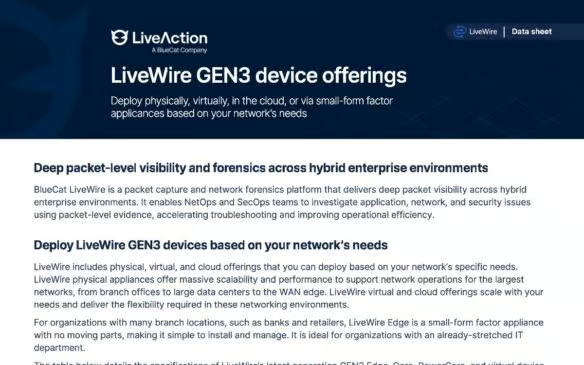
LiveWire GEN3 device offerings
BlueCat LiveWire is a packet capture and network forensics platform that provides deep packet-level visibility across hybrid enterprise environments to help…
Get total control of your DDI infrastructure with Micetro’s unified API
Stop juggling between network tools and use Micetro’s RESTful API for complete control over your DDI infrastructure and cloud environment.
BlueCat MCP servers bring network intelligence to your AI assistant
Our MCP servers provide a standard integration layer that makes it easy to connect the AI tools you already use to BlueCat products.