Automated DNS failover has three moving parts: overlapping availability methods underneath, zone content replicated across every provider that answers for the domain, and automation that closes the gap between detecting a failure and changing the answer. What ties them together is a control plane holding the record of what should exist where. BlueCat offers two routes to it: Micetro orchestrates the Microsoft DNS, BIND, and DHCP services already running, and Integrity consolidates DNS, DHCP, and IPAM onto a single platform.
Why does a single DNS server put every service on the network at risk?
Having just one DNS server is a single point of failure.
When it stops answering, name resolution stops, and the network and any public-facing site become unreachable regardless of how healthy the underlying servers are.
High availability aims to guarantee a level of operational performance or uptime, and in many cases a service level agreement mandates a specific percentage. The configuration that delivers it has to be both redundant and resilient, with failover ready before the failure happens rather than assembled during it.
There are four avenues to achieve high availability for DNS services: hardware failover, DNS protocol redundancy, distributed architecture, and load balancer health checks. Redundant hardware takes over automatically in the same location. DNS protocol redundancy lets clients try another server. Distributed architecture means any single server outage has no service impact. Load balancer health checks pull an unhealthy target out of rotation before clients reach it. Each has limits, which is why they belong together, and automation sits on top of all four rather than replacing any of them.
4
4
There are four avenues to achieve high availability for DNS services: hardware failover, DNS protocol redundancy, distributed architecture, and load balancer health checks. Together they form an overlapping safety net that no single method delivers alone.
If you have just one DNS server, what happens if it fails? Four avenues to DNS high availability are the key to a redundant and resilient network.
5 min·Blog
Read more →
· 02 — FAILOVER MECHANICS
How does automated DNS failover actually work?
Automated DNS failover runs in four steps.
First, a health check detects that a target is unreachable. Second, that result triggers a change through the DNS control plane’s API rather than a console. Third, the record or zone content is updated across every authoritative copy at once. Fourth, clients follow when their cached answers expire. The TTL on the record, not the speed of the automation, determines how long that final step takes.
Detection decides what counts as a failure, and it is where most homegrown failover breaks. A health check against the application endpoint tells you far more than a ping to the server hosting it, and the threshold has to be conservative enough not to fire on a transient blip while still beating the SLA. The change itself should be an API call rather than a console edit, because a console edit reaches one platform and stops there. Comprehensive API support across REST, SOAP, and JSON-RPC lets those workflows be scripted and repeated instead of performed by hand under pressure.
Propagation is where hybrid estates come apart. Where zones are replicated into a redundancy group, one API call lands on every member, so the standby answer is already correct before failover fires instead of being written during the incident. Recursive resolvers then age out the old answer on the TTL clock. That is why TTL values on DNS A records should be lowered to around 300 seconds ahead of planned changes and returned to 3600 or more once the environment is stable.
An A record in DNS is the fundamental record type used to assign an IP address to a DNS name. Devices on their own do not understand how to communicate with…
1 min·Page
Read more →
· 03 — DISASTER RECOVERY GAP
Why do DNS, DHCP, and IPAM get left out of disaster recovery planning?
DNS and DHCP are commonly overlooked in disaster recovery plans, and IP address management is almost never considered at all.
Teams assume server-based defaults and manual tracking are sufficient, then discover during planning that nothing in the environment records what should exist where, so failover cannot be tested, only attempted.
One organization found during disaster recovery planning that DNS was answering from every domain controller across a main data center, a backup site, and multiple geographic facilities. DHCP carried more than 100 scopes split awkwardly between two servers. The record of which IP addresses were in use lived in an Excel spreadsheet backed up to someone’s cloud storage.
The problem was not the servers themselves. It was that no system held the complete picture of the environment, so there was no way to verify a standby would answer correctly until traffic proved it. Once address data and DNS configuration lived in a single platform rather than in tribal knowledge and a spreadsheet, failover became something the team could rehearse and confirm, and the tested event ran with no service loss and no human interaction required.
A BlueCat customer discusses why organizations can’t afford to overlook DNS, DHCP and IPAM when planning for a disaster.
4 min·Blog
Read more →
· 04 — DRIFT ACROSS PROVIDERS AND VIEWS
How can network teams stop DNS records drifting between providers and between internal and external views?
Drift is reduced by making one system the source of truth and letting it synchronize downstream, rather than editing the same zone in several consoles.
That synchronization has to cover internal views as well as external ones, because a failover that updates only the public zone leaves internal clients resolving to the failed address long after the public cutover succeeded.
Manual updates across multiple management consoles are a documented source of outages, and they leave three gaps behind: single points of failure where one provider carries a zone alone, limited mitigation when that provider is attacked, and fragmented visibility across separate interfaces. When redundancy is built from replicated live zone copies, each server keeps its own appropriately unique NS and SOA records while A, CNAME, MX, and the rest stay in sync, so no copy quietly diverges from the others.
Split-horizon DNS doubles the number of places an answer has to change. Add conditional forwarders pointing at cloud resolvers, per-VPC private zones, and Active Directory integrated zones on domain controllers, and a single logical failover becomes a change that has to land in four or five systems in the correct order. The fix is scope rather than effort: internal and external copies of a zone have to sit inside the same synchronization boundary, so a change made once propagates to both.
Discover how Micetro’s xDNS® simplifies hybrid cloud DNS management with redundancy, protection against DNS attacks, and enhanced visibility.
4 min·Blog
Read more →
· 05 — EVALUATION CRITERIA
What should teams look for in a platform for automated DNS failover across hybrid environments?
Look for four things: zone content replicated across every copy that answers for the domain, an API-first control plane with infrastructure-as-code integrations, centralized role-based access with full audit logging, and tested recovery tooling.
Each is the inverse of a failure mode documented earlier on this page. How the platform is deployed, over the servers already running or as the platform an estate standardizes on, is a separate decision that follows from team size and modernization plans.
Replication and API control do the failover work. Records have to be identical across every authoritative copy before an incident rather than written during one, and the change that shifts them has to be a single API call rather than a console edit repeated per platform. A platform meeting both criteria makes failover something a team can rehearse on a schedule instead of attempting under pressure.
Governance and recovery decide whether it holds. Every transaction and configuration change should be authenticated, logged, and auditable, with multi-step approval workflows for change control and role-based permissions granular enough to reach individual zones and DHCP scopes. Clustering with synchronized databases, scheduled backups, and documented migration and recovery paths cover the recovery side.
Learn with BlueCat how visibility and control, process automation, and infrastructure reliability offer three reasons to adopt Unified DDI.
5 min·Blog
Read more →
· 06 — ORCHESTRATING WHAT YOU RUN
How do teams hold DNS and DHCP to their SLA without re-architecting the network?
BlueCat Micetro holds DNS and DHCP to their service levels by orchestrating existing servers through a non-disruptive overlay rather than replacing them.
Organizations keep Microsoft DNS, ISC BIND, ISC DHCP, and Kea DHCP in production while gaining unified control, redundancy, and change governance above them.
Micetro installs on a virtual machine, in the cloud, or on bare metal in under an hour, with no forklift upgrade to existing DNS and DHCP services. A single proxy agent replaces agent sprawl across Microsoft servers, and granular role-based permissions on individual DHCP scopes and DNS zones limit the unnecessary changes to domain controllers that affect uptime.
On the availability side, xDNS redundancy reduces exposure to single points of DNS failure and strengthens mitigation of DDoS and other DNS attacks. Redundancy groups can span BIND, Windows DNS, Azure DNS, Amazon Route 53, NS1, Dyn, and Akamai Fast DNS, with an alternate member continuing to serve the zone authoritatively during an outage. Centralized DHCP management and DNS workflow queues put requests and approvals behind every change.
Today’s enterprise networks span data centers, cloud environments, and distributed edge systems. DNS, DHCP, and IP address management (together known as…
With Micetro, integrate, orchestrate, and automate your current DNS, DHCP, and IPAM network infrastructure via a single web interface.
5 min·Page
View Micetro →
· 07 — CONSOLIDATING ONTO ONE PLATFORM
How do teams consolidate DNS, DHCP, and IPAM onto one platform for tested failover?
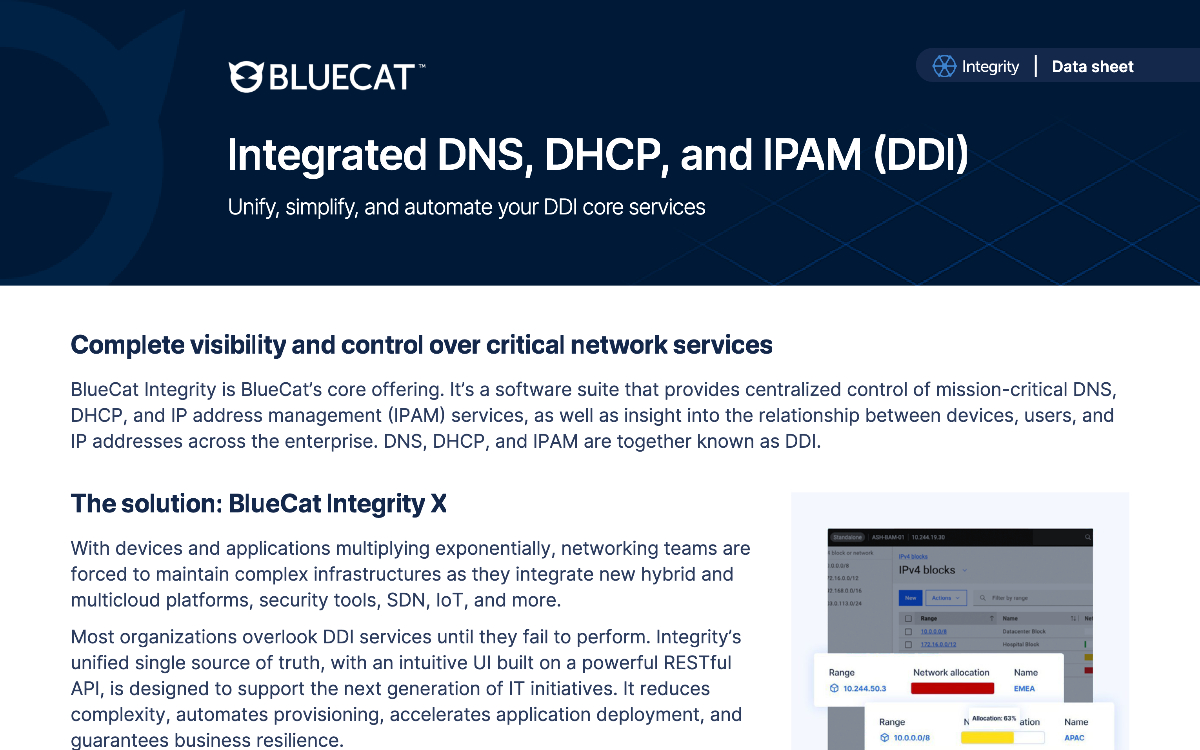
BlueCat Integrity consolidates DNS, DHCP, and IP address management onto a single platform holding one source of truth, so a standby configuration can be verified before an incident rather than tested by traffic.Integrity and Micetro are two routes to the same outcome: organizations choose one or the other, not both.
Integrity combines BlueCat Address Manager with BlueCat DNS/DHCP Servers in a hub-and-spoke architecture, where one enterprise-grade appliance manages thousands of DNS and DHCP servers. Phased upgrades let environments come under central control in sequence rather than in a single cutover, and DNS and DHCP failover maintain service uptime for both IPv4 and IPv6. Built-in disaster recovery and high-availability insights let teams validate readiness, which is what turns a recovery test into something scheduled rather than something that happens to them.
Governance and automation arrive with it. A vendor-agnostic RESTful OpenAPI lets automation drive DNS, DHCP, and IPAM programmatically and integrate with third-party services such as ServiceNow for self-service provisioning. Role-based access controls, network templates, and IP modeling tools define how address space is structured once, and Prometheus-based real-time metrics surface problems before they become downtime.
Tame network complexity with Integrity's full-stack DDI management platform and get visibility and control over your DNS, DHCP, and IPAM.
9 min·Page
View Integrity →
· 08 — Paths forward
Which failover approach is right for your environment?
The right approach depends on where the current fragility sits: in the topology, in the gap between copies that should agree, or in the fact that redundancy exists but is maintained entirely by hand. Three paths follow from the sections above.
PATH 01
Resolution depends on one server or one site, whatever the platform
Fix the topology before automating it
Combine hardware failover, DNS protocol redundancy, distributed architecture, and load balancer health checks so each covers the others’ limits. Automation on top of a single point of failure only automates the outage. Once a second answer exists, the automation has something to fail over to.
Microsoft-centered estate staying in production, no appetite for a cutover
Orchestrate what you already run
Put a non-disruptive orchestration layer over the DNS and DHCP already in production. Role-based control, audit trails, and approval queues arrive without a migration, and the spreadsheet stops being the system of record. Test the failover once the control plane can prove what it will do.
Estate being standardized, or disaster recovery testing that has to be proven
Consolidate onto one platform
Bring DNS, DHCP, and IPAM under a single platform so one source of truth holds what should exist where. Phased migration avoids a single cutover, and a rehearsed failover replaces one that is only ever attempted.
Questions network teams ask when planning DNS failover across on-premises and cloud environments.
The three most common are single points of failure where one provider carries a zone alone, limited mitigation when that provider is attacked, and fragmented visibility across separate management consoles. Each cloud has its own console, API, and data model, which makes consistent policy enforcement difficult. Replicating zones across providers under one control layer addresses all three.
Detection and the record change itself can complete in seconds when automated. Reaching users takes as long as the TTL on the affected records, because recursive resolvers continue serving the cached answer until it expires. A 3600 second TTL can leave clients pointed at a dead address for up to an hour after a technically successful failover, which is why TTLs are lowered ahead of planned changes.
Internal and external resolution follow different paths. External queries reach the public authoritative zone that failover updated, while internal clients resolve through internal views and conditional forwarders that were never included in the change. Those clients keep receiving the old address long after the public cutover succeeded, which is why a failover can appear complete from outside and broken from inside. The fix is to bring internal and external copies of a zone inside the same synchronization boundary.
Route changes through a controlled workflow rather than direct console edits, apply role-based permissions down to individual zones and DHCP scopes, and log every transaction so change history is auditable. Restricting who can alter records on domain controllers prevents the mistakes that replicate downstream and cause outages. On BlueCat Integrity, role-based access controls and a full-featured RESTful API let a team define policy once and apply approved changes consistently across the estate.
A recovery plan can only be rehearsed if something records what should exist where. When DNS configuration and address data live in separate consoles and a spreadsheet, a standby cannot be verified until live traffic proves it. BlueCat Integrity holds DNS, DHCP, and IPAM as one source of truth, with DNS and DHCP failover for IPv4 and IPv6 and built-in disaster recovery and high-availability insights that let teams validate readiness ahead of an event rather than during one.
By what the organization intends to do with the DNS and DHCP servers already in production. Micetro orchestrates them where they are, as a non-disruptive overlay over Microsoft DNS, BIND, ISC DHCP, and Kea, which suits estates where those servers are staying and there is no appetite for a migration. Integrity consolidates DNS, DHCP, and IPAM onto a single platform, which suits estates being standardized or disaster recovery testing that has to be proven. Both deliver one source of truth, API-driven change, and audited failover that can be rehearsed. They are alternatives rather than layers.
No. Micetro installs as a non-disruptive overlay on a virtual machine, in the cloud, or on bare metal in under an hour, and it orchestrates the DNS and DHCP servers already in production. Microsoft DNS, ISC BIND, ISC DHCP, and Kea DHCP stay exactly where they are while Micetro adds unified control, redundancy, and audit logging above them.
xDNS redundancy replicates zone content across on-premises and cloud DNS providers, including Windows DNS, BIND, Azure DNS, Route 53, NS1, Dyn, and Akamai Fast DNS, while each member keeps its own unique NS and SOA records. If one provider goes down or is attacked, an alternate provider in the redundancy group continues serving the zone authoritatively without manual intervention.
We’re using cookies on this website to improve your experience. Cookies help us learn how you interact with our website and remember you when you come back so we can tailor it to your interests.
To learn more about cookies and how we use them, read our cookie notice.
Some cookies are essential, while others help us to improve your experience by giving us insight into how you are using our website. You may adjust your preferences for non-essential cookies below.
To learn more about cookies and how we use them, read our cookie notice. You can also review our privacy policy for more details on the personal data we collect, use, hold, and disclose when you visit our website or use our products and services.
Functional cookies
Functional cookies are essential cookies that allow us to remember choices or changes you have made (such as to language settings or your choices regarding the use of cookies). These cookies cannot be turned off since they are essential for the operation of our Websites.
Analytics cookies
Analytics cookies are non-essential cookies that collect information on how visitors use our Websites. We use this information with your consent to measure the number of visitors to our Websites, determine whether specific content or communication has been viewed, and to help us improve our Websites and communication. These cookies can be turned off.
Personalisation Storage
Personalisation cookies are non-essential cookies that collect information when you fill out a form on this website. We only use this information with your consent to pre-fill other forms on the site. These cookies can be turned off.
Marketing cookies
Marketing cookies are cookies that are placed by third parties to collect information about your visits and actions on our Websites so that they or we can deliver ads to you later, such as when you are on certain third-party sites or platforms. These cookies may be used by those third parties to build a profile of your interests and show you relevant ads on other websites. These cookies also enable visitors to our Websites to share content on social networks and to enable and evaluate interactions with our communication and social media tools. These cookies can be turned off.