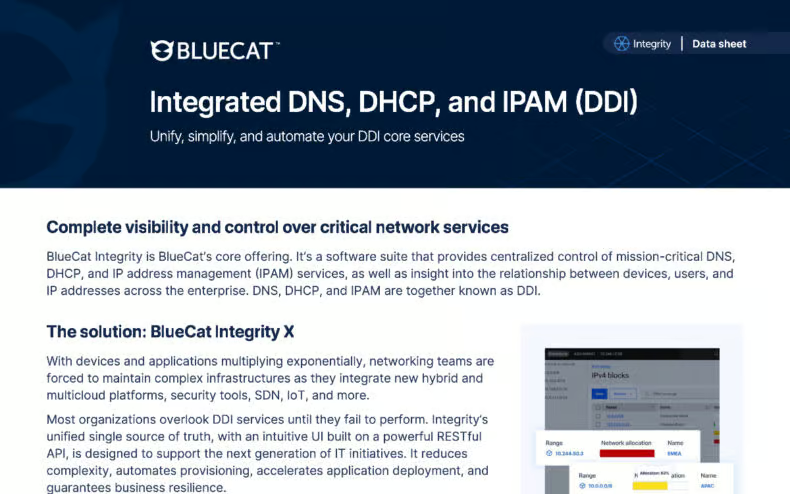
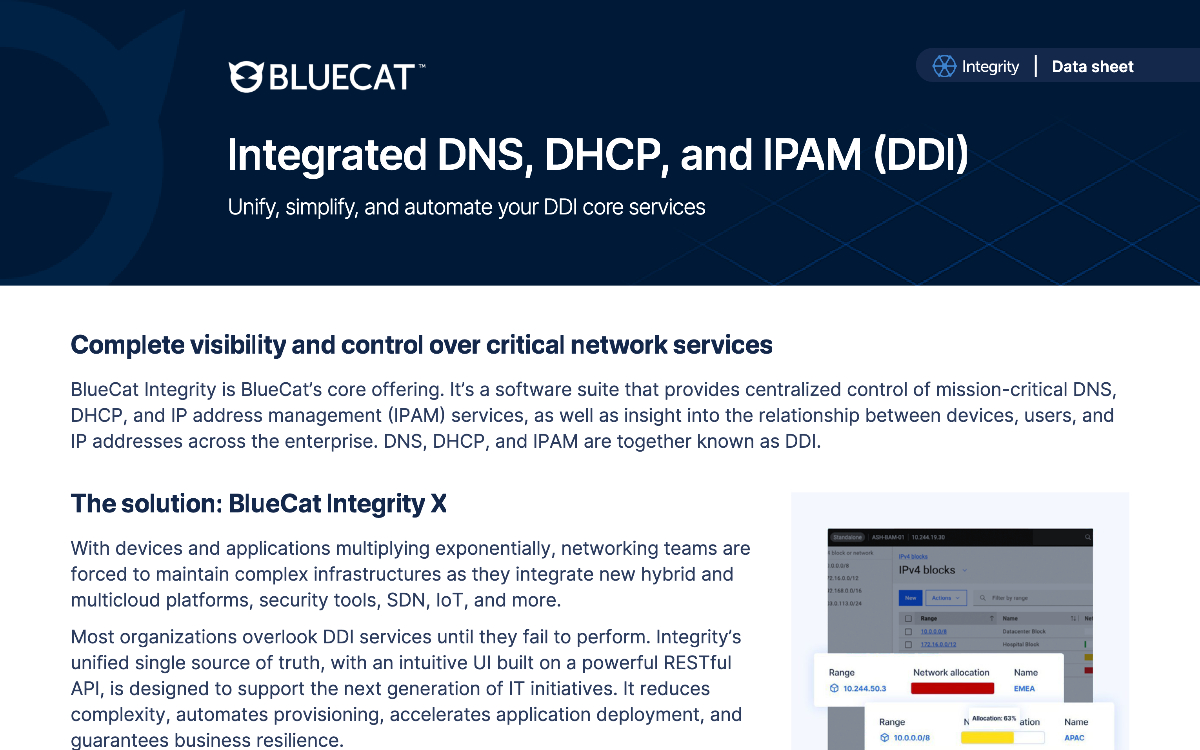
Native cloud DNS services are not the problem; the absence of a single authority above them is. Enterprises resolve this by consolidating DNS, DHCP, and IPAM into one unified DDI platform. BlueCat Integrity is one such platform, discovering, synchronizing, and governing cloud and on-premises records together.
What is DDI, and why do enterprises need unified DNS, DHCP, and IPAM?
DDI stands for DNS, DHCP, and IP address management (IPAM), and describes the integration of these three core networking components into one management solution.
Enterprises need them unified because when they are managed separately, records drift out of step with actual IP address usage, and no single place holds the truth.
DNS provides IP addresses, DHCP assigns them, and IPAM plans and tracks the address space. Bringing these core DNS, DHCP, and IP address services together into one platform solution can transform network management. With a centralized solution, network administrators get visibility and control of their network from a single pane of glass.
Integration is what produces the operational gain. Instead of having a gap between records and actual IP address usage, records are updated in real-time: adding a host record updates the IP assignment, and DHCP ranges can be changed with confidence that a static device is not already present. Modern platforms extend this to hybrid cloud resources, IPv6 transition, and automation.
DDI stands for DNS, DHCP, and IP address management (IPAM) and describes the integration of these core networking components into one management solution.
1 min·Page
Read more →
· 02 — THE LIMITS OF CLOUD-NATIVE DNS
What are the limits of each cloud’s native DNS service at enterprise scale?
Each provider's DNS is built to serve workloads inside its own tenant.
It resolves well there and stops at the boundary, so no cloud’s own toolset can govern names, addresses, or policy across the other clouds and the data center.
AWS has Route 53 and Amazon DNS, Azure has Azure DNS, Google Cloud has Google Cloud DNS. Cloud teams use them by default because they are the closest DNS at hand, and inside a single tenant they work well. The limits show up at the edges.
Support for enterprise DNS features differs by provider, so a control the network team relies on in one cloud may not exist in another. Each provider also turns an essential network component into a third-party dependency: when a provider has a resolution outage, every application depending on it goes down too, and the enterprise has no recourse inside that provider’s tooling.
Automation runs into the same wall, and this is where the cost compounds. Each cloud’s native DDI services automate only within their own environment, so there is no single interface a network team can drive change through. Provisioning one record across three clouds means three tools, three credential sets, and three scripts to maintain. The work does not scale with the estate; it multiplies with it.
An enterprise platform closes that gap only if its own automation is complete. Partial or legacy APIs push teams back into brittle workarounds, so what matters is whether every action available in the interface is also available programmatically, through documented, standards-based endpoints that DevOps toolchains can call directly.
Discover API-first DDI with Integrity X by using REST v2 to automate DNS, DHCP, and IPAM for scalable, secure network operations.
5 min·Blog
Read more →
· 03 — THE FIVE CLOUD CHALLENGES
What happens to DNS, DHCP, and IPAM visibility during a hybrid or multi-cloud migration?
The cloud-first transition splinters the network visibility and control that NetOps has fought to attain.
IP conflicts arise due to overlapping IP space, and the result is outages to critical services and applications.
Five patterns recur. Departments and teams run their own cloud accounts, so shadow IT becomes the norm and no single source of truth governs IP space. Cloud and on-premises DDI become separate entities, so orchestrating changes turns into an intensive manual process that introduces errors and slows innovation.
The remaining three compound it: a rat’s nest of conditional forwarding rules that need constant updating and usually falls to one person; inefficient routing of traffic to SaaS services such as Office 365 and Salesforce; and a shared responsibility model that leaves the enterprise on the hook for everything outside the provider’s infrastructure.
5cloud DDI challenges
5 cloud DDI challenges
Cloud adoption reliably produces five distinct DDI failure patterns: decentralized accounts, split cloud and on-premises control, forwarding-rule sprawl, inefficient SaaS routing, and outsourced security telemetry.
The cloud-first transition has splintered network visibility and control for NetOps. But the DNS, DHCP, and IPAM hurdles they face can be overcome.
4 min·Blog
Read more →
· 04 — THE COST OF FRAGMENTATION
What does fragmented DNS, DHCP, and IPAM actually cost an enterprise?
Fragmented DDI is not free.
Its cost shows up as endless hours of engineering time spent on routine tasks, expensive infrastructure sprawl, and the high price of network downtime. Most of that downtime is self-inflicted.
Enterprise Management Associates research puts the average enterprise loss at $12,900 per minute during IT outages. That is not only a financial drain; it is a direct hit to customer satisfaction and brand reputation. Fragmented systems, with inconsistent security controls, limited visibility, and manual processes, are where those minutes accumulate.
The cause is rarely exotic. According to EMA, 60% of network outages are caused by human error, avoidable mistakes that cost enterprises precious time and money. Centralized policy enforcement, role-based access controls, and automated audit trails address the error class directly, and make regulatory adherence easier to demonstrate.
60%
60%
Sixty percent of network outages trace to human error, which makes centralized control and role-based access a reliability investment rather than a governance formality.
What should teams look for in a platform that integrates enterprise DDI with native cloud DNS services?
Look for five capabilities, each the inverse of a documented failure mode: 360-degree visibility, complete control of IP space and DNS authority,
automated provisioning across any cloud, centralized DNS routing configuration, and consistent security policy enforcement with full query logging.
Visibility means discovering and synchronizing DNS data across clouds and keeping track of what services cloud and DevOps teams have created. Control means managing IP space across clouds and centralizing authority for DNS resolution so service delivery delays disappear. Automation means provisioning and configuring DDI services in any cloud without maintaining complex overlay upkeep per provider.
The last two criteria are where most evaluations are decided. Centralized configuration of DNS routing rules is what overcomes conditional forwarding complexity and preserves fast user experience. Consistent security policy enforcement, with query and response logs collected from all resolvers, is what shortens root-cause analysis and reduces time to detect and remediate.
Learn with BlueCat how security by design, cloud integration, and API programmability offer three technical reasons to adopt Unified DDI.
6 min·Blog
Read more →
· 06 — CONSOLIDATION IN PRACTICE
How do enterprises consolidate multiple DNS and DHCP servers into a single management plane across cloud and on-premises estates?
By running every DNS and DHCP server, wherever it sits, under one management plane that holds the single source of truth.BlueCat Integrity provides that plane, rather than leaving each environment to be administered through its own tooling.
Integrity combines BlueCat Address Manager with BlueCat DNS/DHCP Servers in a hub-and-spoke architecture. One enterprise-grade Integrity appliance manages thousands of DNS and DHCP servers, so consolidation does not mean replacing the estate all at once. Integrity supports phased upgrades, letting teams bring environments under central control in sequence, and its pay-as-you-grow model avoids the forced upgrade that usually stalls these projects.
Central control is only useful if it reaches the things teams actually change. Integrity ships with network templates, IP modeling tools, and role-based access controls, so one team defines how address space and records are structured, then delegates day-to-day work without giving up consistency. Every change runs through Integrity, which means one record of what was added, altered, or removed.
Integrity’s RESTful OpenAPI is what carries that plane into cloud-native work. It is vendor-agnostic and documented, so provisioning pipelines and service discovery consume Integrity programmatically instead of waiting on tickets, and the same policies apply whether a record originates in a data center or a deployment pipeline.
1000+
1000+
A single Integrity Address Manager supports more than 1,000 connected DNS/DHCP servers with N-2 release support, which is what makes one management plane practical at enterprise scale rather than theoretical.
Tame network complexity with Integrity's full-stack DDI management platform and get visibility and control over your DNS, DHCP, and IPAM.
9 min·Page
View Integrity →
· 07 — Paths forward
Which integration path is right for a hybrid or multi-cloud estate?
Creating a single source of truth does not necessarily mean getting rid of cloud DDI services altogether. Three paths follow from the same principle of one authority above the clouds. The right one depends on how much of the estate the enterprise intends to bring under that authority.
PATH 01
Cloud teams are committed to provider-native services
Integrate with native cloud DNS
Keep Route 53, Azure DNS, and Google Cloud DNS in place and make the enterprise platform the discovering, synchronizing authority above them. Automated discovery and continuous synchronization reconcile records and addresses in real time. This is the most seamless option when cloud-native tooling is entrenched.
Forwarder sprawl and overlapping IP space are already causing outages
Consolidate onto one unified platform
Bring DNS, DHCP, and IPAM under one enterprise-scale platform so multiple resolution pathways replace single-option forwarders and IP space is allocated from one place. This is the path when the features of a standardized solution outweigh the benefits of per-cloud integration.
Audit or compliance pressure arrived before the migration finished
Lead with governance and logging
Prioritize centralized policy enforcement, role-based least-privilege access, and complete logging of host and record additions, changes, and deletions. This addresses the human-error class behind most outages and produces the audit trail regulators ask for, while consolidation proceeds in stages.
Common questions from network architects consolidating DDI across cloud and on-premises estates.
By managing all three from one platform rather than three toolsets, so records update in real time instead of leaving a gap between records and actual IP address usage. BlueCat Integrity holds DNS, DHCP, and IPAM as a single source of truth, with role-based access controls so teams can be given the visibility they need without fragmenting ownership. Centralized logging of every host and record change completes the picture by making the same data usable for troubleshooting and audit.
Unify the DDI data first, then automate resolution. Getting all DDI data flowing through a single, purpose-built system such as BlueCat Integrity provides the common denominator needed to standardize across environments. From there, each DNS pathway can be configured with multiple prioritized resolution options rather than a single-option conditional forwarder, so a query that returns NXDOMAIN re-routes automatically.
Anycast distributes resolution across multiple sites, so its value depends entirely on the consistency of the data behind each node. Without a single source of truth for zones, records, and IP space, anycast propagates configuration drift rather than resilience. Consider it after DDI is centralized, and pair it with centralized DNS routing configuration so resolution behavior is defined in one place.
No. Creating a single source of truth does not necessarily mean getting rid of cloud DDI services altogether. In many cases integration with the services available in the cloud is the most seamless option; in others, the features of a standardized platform such as BlueCat Integrity outweigh the benefits of per-cloud integration. There is no single answer for everyone.
Through APIs. BlueCat Integrity is API-first, with a vendor-agnostic RESTful OpenAPI that lets pipelines automate configuration and deployment across development, test, and production, so infrastructure changes trigger DNS updates without manual intervention. That is how DDI participates in CI/CD and service discovery rather than blocking it, and it is precisely the capability legacy DDI tools lack.
Because each rule is a single-option pathway that must be maintained by hand, and the rules change constantly as cloud environments change. Enterprises commonly end up with thousands of conditional forwarding rules maintained by one person or a small team, which threatens data conflicts and outages. Centralizing resolution configuration replaces them with prioritized, automated fallback logic.
We’re using cookies on this website to improve your experience. Cookies help us learn how you interact with our website and remember you when you come back so we can tailor it to your interests.
To learn more about cookies and how we use them, read our cookie notice.
Some cookies are essential, while others help us to improve your experience by giving us insight into how you are using our website. You may adjust your preferences for non-essential cookies below.
To learn more about cookies and how we use them, read our cookie notice. You can also review our privacy policy for more details on the personal data we collect, use, hold, and disclose when you visit our website or use our products and services.
Functional cookies
Functional cookies are essential cookies that allow us to remember choices or changes you have made (such as to language settings or your choices regarding the use of cookies). These cookies cannot be turned off since they are essential for the operation of our Websites.
Analytics cookies
Analytics cookies are non-essential cookies that collect information on how visitors use our Websites. We use this information with your consent to measure the number of visitors to our Websites, determine whether specific content or communication has been viewed, and to help us improve our Websites and communication. These cookies can be turned off.
Personalisation Storage
Personalisation cookies are non-essential cookies that collect information when you fill out a form on this website. We only use this information with your consent to pre-fill other forms on the site. These cookies can be turned off.
Marketing cookies
Marketing cookies are cookies that are placed by third parties to collect information about your visits and actions on our Websites so that they or we can deliver ads to you later, such as when you are on certain third-party sites or platforms. These cookies may be used by those third parties to build a profile of your interests and show you relevant ads on other websites. These cookies also enable visitors to our Websites to share content on social networks and to enable and evaluate interactions with our communication and social media tools. These cookies can be turned off.