When several teams change the same IP space through separate tools and consoles, conflicts and blind spots follow. Governed workflows fix that with scoped approvals and a full audit trail, and Micetro delivers them as a layer over the DNS and DHCP servers already running.
· 01 — Why built-in DNS and DHCP consoles stop being enough
Why do built-in DNS and DHCP consoles fall short on governance?
Built-in consoles handle the basics but rarely provide robust auditing, one interface across servers, or role-based access fine enough to limit what each person can touch.
As the estate grows, those gaps turn routine administration into risk.
The International Monetary Fund outgrew its standard server tools after years of running DNS and DHCP on them. Its team wanted robust audit features, one interface across servers, granular role-based access, and easier management of split-scope DHCP.
The answer did not require replacing anything. A management layer on top of the existing DNS and DHCP servers and directory controllers gave one logical view of the IP address space and logged every change chronologically, in real time, to meet regulatory requirements.
Discover how the International Monetary Fund boosted infrastructure stability and simplified DNS and DHCP operations using Micetro’s centralized…
4 min·Blog
Read more →
· 02 — How consistent tooling answers who changed what, and why, at every site
How can a small IT team answer who changed what, and why, across every site?
Standardize first, then document automatically.
Consistent infrastructure helps reduce one-off issues at individual sites, and built-in documentation keeps the who and why of each change from living only in someone’s head.
Farmington Municipal Schools runs 18 schools and more than 12,000 devices with a team of about ten specialists and two directors. Its leaders brought every network under one umbrella so odd, one-off problems would not appear at single sites and any change could be traced to who made it and why.
Documentation is usually the first thing dropped on a busy day, leaving important details undocumented. Built-in, automated documentation keeps information in context, so technicians comfortable with either the command line or a web interface can make changes and troubleshoot.
12,000devices managed
12,000 devices managed
A team of about ten specialists keeps more than 12,000 devices running across 18 schools.
Farmington Municipal Schools (FMS), based in Farmington, New Mexico, are a kindergarten-12th grade (K-12) school system with 18 schools within the district.…
5 min·Blog
Read more →
· 03 — How to delegate DHCP and IP permissions across distributed branch sites
How should DHCP and IP address permissions be delegated across branch sites?
Delegate by site. Each site's architect should be able to make changes only at the sites they manage, with every change tracked, rather than sharing one coarse set of permissions across the whole network.
Many enterprises run a distributed DHCP architecture, with branch SD-WAN appliances acting as local DHCP servers under a central controller. It keeps branches working when the link to the data center drops, but as the network grows, tracking IP allocations and leases across sites gets harder.
The built-in access controls on SD-WAN appliances are helpful but often too coarse for complex organizations. Granular roles, where each site’s IT architect can modify only their designated sites and every change leaves an audit trail, reduce unauthorized changes and let teams work without disrupting each other.
Why does fragmented DDI tooling make consistent change governance so hard?
Every platform brings its own API model, management interface and quirks, so the same policy has to be rebuilt for each one.
That fragmentation makes integration harder, automation slower and every change riskier.
Most organizations run DNS, DHCP and IP address management across a patchwork of on-premises servers, open-source services and cloud providers. Teams end up juggling vendor-specific scripts, SDKs and authentication methods, and errors creep in through manual configuration at each seam.
A single control plane changes that. When every platform is reached through one consistent API that drives the same orchestration engine as the web interface, security and compliance policies can be enforced the same way everywhere, and teams can treat DDI as code without learning a different interface for every backend.
· 05 — What a governed, audit-ready change workflow has to include
What should teams look for in a platform for governed, audit-ready IPAM workflows?
The core requirement is a formal request lifecycle in which changes are proposed, approved by someone with authority over that zone, scheduled, executed and logged.
Every criterion below answers a failure described earlier on this page.
Avoid ad hoc processes because direct edits, manual tickets and email handoffs lead to errors, outages and compliance blind spots. So require that users propose record or zone changes instead of applying them, that approvers act only on zones they can edit, and that changes run immediately or at a scheduled time.
Require an audit trail that records request ID, user, timestamps, comments and outcome, with clear states from pending to applied, rejected or failed. Require that addresses be marked pending while a request is open so two teams cannot claim them, and that automation and service management tools submit changes through the same approvals.
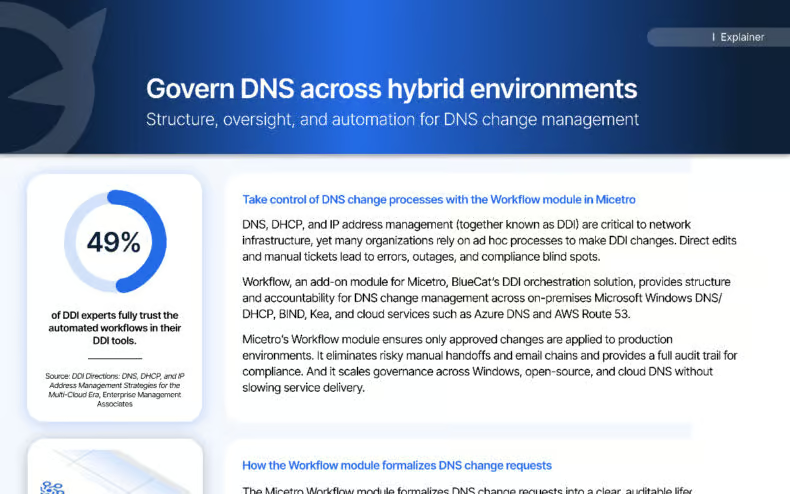
49%fully trust automation
49% fully trust automation
Just under half of DDI experts fully trust the automated workflows in their DDI tools.
Micetro’s Workflow module brings structure, oversight, and automation to DNS change management across on-premises Microsoft Windows DNS/DHCP, BIND, Kea,…
2 min·Blog
Read more →
· 06 — How shared IPAM lets autonomous teams stop colliding over IP space
How do large IT organizations stop autonomous teams from colliding over the same IP space?
They give every team one shared IPAM system tied to DNS, with enough granularity that each group can work without stepping on the others.
Once an engineer can check whether an IP exists in DNS and which host holds it, provisioning becomes far more reliable.
At HD Supply, more than 15,000 associates across 600 North American locations depend on two data centers, and several autonomous infrastructure sub-teams each reserved server IPs with their own open-source or custom tools. None were tied to DNS, so nobody could tell whether an address was already in use, and competing allocations risked disconnecting users.
HD Supply chose Micetro, which gave its IT groups the granularity to participate in IP management without stepping on each other’s toes. Engineers now look up an IP, see whether it exists in DNS and identify the host, and the Data Com team publishes one master DHCP scope to hundreds of devices.
600locations
600 locations
HD Supply’s IP space serves more than 15,000 associates working from 600 North American locations and two data centers.
With Micetro, integrate, orchestrate, and automate your current DNS, DHCP, and IPAM network infrastructure via a single web interface.
5 min·Page
View Micetro →
· 07 — Paths forward
Which path is right for governing IP and DNS changes in your network?
The right starting point depends on where control breaks down today, whether in consoles that cannot audit or delegate, in branch sites that share one permission model, in automation that skips review, or in teams that reserve addresses without a shared view. Each path below starts from one of those gaps.
PATH 01
Server-native consoles with weak auditing and coarse roles
Govern the servers you already run
Add a management layer over existing DNS and DHCP servers rather than replacing them, so changes are logged chronologically and delegated by role. Standardize sites and document changes so any team member can answer who did what and why.
Map roles to sites so each site’s architect can change only what they own, with every change tracked. Pull lease and allocation data from every branch into one view before tightening permissions.
Scripts, infrastructure-as-code or service management tools already push changes
Route automation through the same approvals
Reach every platform through one control plane so a single policy applies everywhere. Then make automated changes enter the same request, approval and audit lifecycle as manual ones.
Autonomous teams reserving IPs with their own tools
Give every team one view of the address space
Replace per-team trackers with shared IPAM tied to DNS, so anyone can see whether an address is in use and who holds it before claiming it. Mark addresses pending while requests are open.
Short answers to the questions teams ask most when they formalize how IP and DNS changes get approved.
An IPAM approval workflow is a process in which users propose DNS or IP changes instead of applying them directly. In Micetro, approvers with authority over the affected zone review, approve, schedule or reject each request, and the system records who asked, when, and what happened.
Conflicts usually start when several teams reserve addresses with separate tools that are not tied to DNS, so nobody can tell whether an IP is already in use. Competing allocations can abruptly disconnect users, and too many of them can cause outages.
It should record every change chronologically and in real time, including the request ID, the user, timestamps, comments and the outcome. Historical logging of that kind is what supports regulatory compliance.
Delegate by site rather than by device. Granular roles in Micetro let each site’s IT architect modify only their designated sites, which reduces unauthorized changes and keeps an audit trail of who did what.
Yes. When infrastructure-as-code pipelines and IT service management tools submit changes as requests, those changes go through the same approval, scheduling and audit steps as manual ones, so developers move quickly while network operations keeps oversight.
No, not once the estate grows. Built-in consoles often lack robust auditing, a common interface across servers and granular role-based access, and in some cases a junior administrator with access to a scope can delete it entirely. Micetro adds that missing layer on top of the DNS and DHCP servers you already run.
We’re using cookies on this website to improve your experience. Cookies help us learn how you interact with our website and remember you when you come back so we can tailor it to your interests.
To learn more about cookies and how we use them, read our cookie notice.
Some cookies are essential, while others help us to improve your experience by giving us insight into how you are using our website. You may adjust your preferences for non-essential cookies below.
To learn more about cookies and how we use them, read our cookie notice. You can also review our privacy policy for more details on the personal data we collect, use, hold, and disclose when you visit our website or use our products and services.
Functional cookies
Functional cookies are essential cookies that allow us to remember choices or changes you have made (such as to language settings or your choices regarding the use of cookies). These cookies cannot be turned off since they are essential for the operation of our Websites.
Analytics cookies
Analytics cookies are non-essential cookies that collect information on how visitors use our Websites. We use this information with your consent to measure the number of visitors to our Websites, determine whether specific content or communication has been viewed, and to help us improve our Websites and communication. These cookies can be turned off.
Personalisation Storage
Personalisation cookies are non-essential cookies that collect information when you fill out a form on this website. We only use this information with your consent to pre-fill other forms on the site. These cookies can be turned off.
Marketing cookies
Marketing cookies are cookies that are placed by third parties to collect information about your visits and actions on our Websites so that they or we can deliver ads to you later, such as when you are on certain third-party sites or platforms. These cookies may be used by those third parties to build a profile of your interests and show you relevant ads on other websites. These cookies also enable visitors to our Websites to share content on social networks and to enable and evaluate interactions with our communication and social media tools. These cookies can be turned off.






 Case study