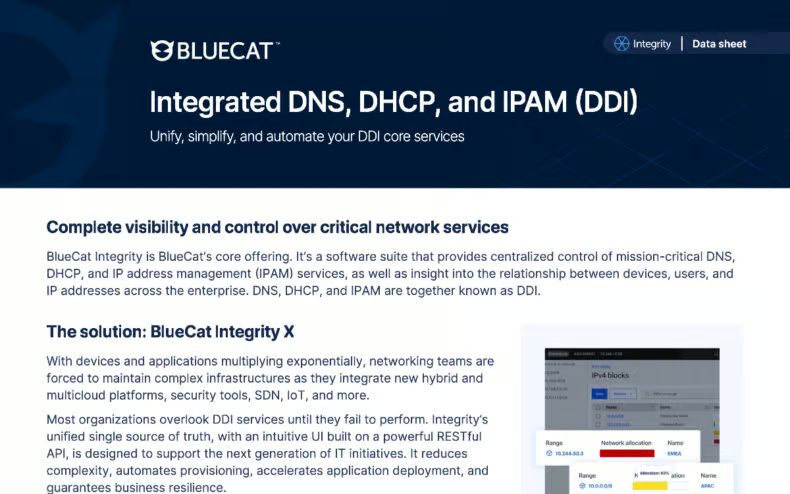
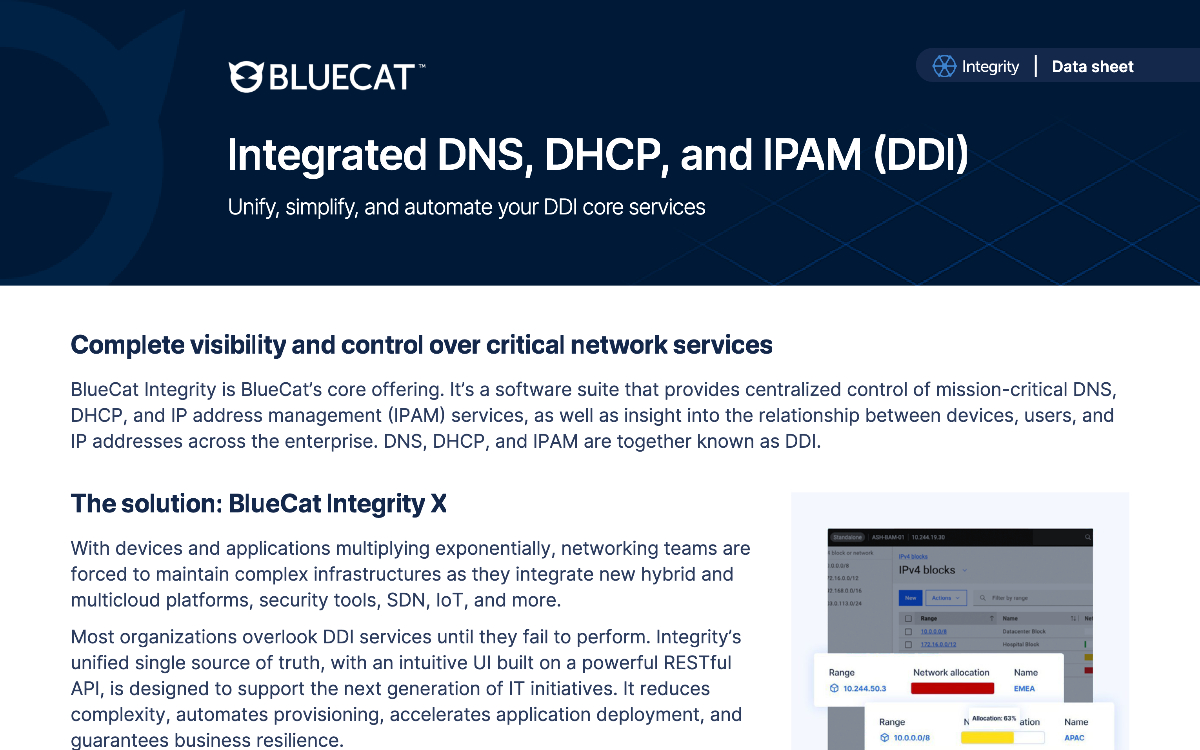
Partial or bolted-on DDI APIs only automate the easy 20 percent. But the other 80 percent, the changes that actually move the needle, still needs a ticket and a person to push it through. Integrity X’s API-first approach closes that gap: every UI action has a matching, documented REST call, exposing DNS, DHCP, and IPAM directly to CI/CD, policy-as-code, and audit reporting.
· 01 — WHY MANUAL RECORD WORK BECOMES THE BOTTLENECK
Why does manual DNS record and host management consume so much engineering time?
Because a single host addition is not one step.
Configuring the device and its role, assigning a top-level domain, adding the host or alias record, setting the IP, then validating the whole chain is five sequential actions repeated for every device, and enterprises add hundreds a day.
The volume itself is not the hard part. The hard part is that the process is sequential and validation-dependent, so it cannot be safely delegated without also handing out broad access to core systems. That is how workload relief turns into risk: one person outside the correct workflow can disrupt resolution for everyone.
The second failure mode is deployment granularity. Changes are typically batched and pushed during a low-traffic window, so an urgent single fix waits for the batch. Workflow-driven automation with selective deployment lets a specific change go out on its own, without pushing a glut of updates at once.
Get real-time DNS, DHCP, and IPAM metrics with BlueCat Integrity X. Detect issues early using native Prometheus telemetry and proactive DDI observability.
4 min·Blog
Read more →
· 02 — WHAT API-FIRST ACTUALLY MEANS
What does an API-first architecture mean in networking, and how is it different from having an API?
An API-first architecture in networking means that all functionality is exposed via APIs before the UI.
The practical test is coverage parity: if an action exists in the interface but not in the documented API, the platform is UI-first with an API attached, and automation will hit a wall.
Many DDI vendors expose only partial or outdated APIs. That limits automation and pushes network teams into brittle workarounds or dependence on professional services for anything the API does not reach. The alternative is an architecture where the interface itself runs on the same REST engine customers use.
That inversion changes the economics of automation. Every action in the Integrity X UI is a real API call, fully documented in OpenAPI (OAS3), browsable in Swagger, and aligned with modern DevOps practices. Manual work becomes a specification for automation rather than a competing path around it.
Discover API-first DDI with Integrity X by using REST v2 to automate DNS, DHCP, and IPAM for scalable, secure network operations.
5 min·Blog
Read more →
· 03 — TURNING API CALLS INTO INFRASTRUCTURE AS CODE
How can network teams implement policy-as-code for DDI configurations?
Treat DDI as an API endpoint inside existing configuration management, not as a separate console.
REST APIs are the backbone of modern infrastructure automation. A generic HTTP task module and variable registration are enough to drive DNS, DHCP, and IPAM state from version-controlled playbooks.
The practical pattern is to prototype the API call first. Validate authentication, headers, and body against a single object, then convert the call into a task that scales across inventory, registering each response for downstream use. Because REST v2 is OpenAPI-defined, the prototype step happens in Swagger before a single line of playbook is written.
Custom relationship modeling is what makes the state file honest. User-defined links in Integrity X let teams define the relationships their estate actually has, such as dual-stack IPv4-to-IPv6 pairings and NAT mappings, so the version-controlled definition reflects the network as it is rather than as the schema assumed. State that models reality is the difference between a pipeline that converges and one that fights its own source of truth.
Map your network with user-defined links in Integrity X to define and manage custom relationships, such as dual-stack and NAT environments.
5 min·Blog
Read more →
· 04 — BUSINESS CONTEXT AND COMPLIANCE VALIDATION
How do you validate compliance of DDI changes against policies?
By attaching business-aligned metadata to DDI objects and making that metadata queryable through the same API automation already uses.
Compliance validation then becomes a filtered API query rather than a manual reconciliation of IP lists against a spreadsheet.
Tags are lightweight metadata that can be applied to nearly any object in Integrity X, including networks, IP blocks, DNS zones, views, and resource records. Grouped into hierarchies that mirror business unit, department, application, region, or compliance scope, they turn raw records into contextualized assets with an owner and a stated purpose.
Integrity X v25.1 introduces tags as filterable fields in the RESTful v2 API. A query can return every network tagged for a payment-card scope, or flag newly created resources missing a required compliance label. Lifecycle tags such as Pilot, Production, or Retired do the same work for capacity planning and decommissioning.
100+nested levels
100+ nested levels
Tag groups support more than one hundred nested levels, enough to model real structures such as business unit to department to application inside IP address management.
Add business context to DNS, DHCP, and IPAM with tagging in BlueCat Integrity X. Improve visibility, automation, and governance across complex networks.
8 min·Blog
Read more →
· 05 — TCO OF MANUAL IPAM VERSUS AUTOMATED DDI
What is the total cost of ownership difference between manual IPAM and automated DDI?
The dominant cost in manual IPAM is not licensing.
It is deployment latency, engineer time absorbed by address requests, and the remediation cost of drift, all of which compound as the estate grows.
The latency line is structural. Manual provisioning serializes every request through a ticket queue and an admin, so deployment time scales with queue depth rather than task size. API-driven allocation removes the queue: provisioning, record creation, and naming execute as pipeline steps, and hub-and-spoke management means thousands of DNS and DHCP servers are administered from one point instead of many.
The drift line compounds quietly. Manual processes skip steps within months. Names and addresses fall out of sync, and correcting an out-of-sync record set costs more than creating it correctly would have. A single source of truth with automated provisioning attacks the error rate at its origin, which is why error avoidance, not headcount, is usually the largest term in the model.
What should enterprises look for in a platform for API-first DDI management?
Look for API coverage parity with the interface, documented standards-based design, first-class metadata, and workflow abstraction that lets non-specialists act safely.
Each of those criteria is the inverse of a documented failure mode: partial APIs, undocumented endpoints, context-free records, and over-privileged delegation.
Coverage parity comes first. If any UI action lacks a documented equivalent call, automation stalls at that boundary. Then check the standards: OpenAPI definitions, JSON and HAL+JSON responses, interactive exploration so endpoints can be tested before scripting, and enterprise authentication including OAuth 2.0 bearer tokens rather than a single shared credential.
Then check scale mechanics and continuity. Filtering, embedded collections, and pagination determine whether large estates can be queried precisely instead of pulled wholesale. New endpoints should be addable without breaking existing workflows, and the prior API generation should remain supported for legacy continuity so adoption is not a forced cutover.
Discover API-first DDI with Integrity X by using REST v2 to automate DNS, DHCP, and IPAM for scalable, secure network operations.
5 min·Blog
Read more →
· 07 — THE CONSOLIDATION PAYOFF
How do enterprises consolidate DNS, DHCP, and IPAM onto one automatable control plane?
By consolidating onto a single DDI platform whose interface and automation run on the same documented API.BlueCat Integrity X 25.1 is built on a fully RESTful API that is OpenAPI compliant, meaning every action in the UI is executed as a real API call.
For enterprise-scale estates, consolidation is the point: one UI, one platform, one seamless experience across IP address space, DNS namespaces, devices, and users. Integrated service health and metrics provide real-time insights through Prometheus, with built-in telemetry and visualization dashboards, so investigation no longer means correlating logs across separate tools.
The 25.1 release pairs that with governance-grade controls: DNSSEC with FIPS 140-2 Level 3 support via Hardware Security Modules, OCI virtual appliances in the Marketplace, validated unicast DHCP on Google Cloud Platform, and a WCAG 2.2 AA-compliant interface. REST v2 is the foundation for every future capability, so automation built now carries forward.
Tame network complexity with Integrity's full-stack DDI management platform and get visibility and control over your DNS, DHCP, and IPAM.
9 min·Page
View Integrity →
· 08 — Paths forward
Which API-first path fits your estate right now?
Three paths, distinguished by what is blocking you today: daily record toil, an unmet infrastructure-as-code mandate, or audit exposure. Most enterprises start with one and inherit the others.
PATH 01
Engineer time is being absorbed by host, alias, and address requests
Automate the highest-volume record workflows first
Capture the REST calls behind the routine UI actions your team already performs and turn them into reusable playbooks. Add selective deployment so urgent single changes do not wait on the next batch window. This delivers time back without altering architecture.
An infrastructure-as-code standard exists and DDI is the exception to it
Pull DDI into the existing pipeline
Prototype the API calls, move credentials into vault-encrypted strings, and drive DNS and IPAM state from version-controlled definitions alongside compute and network config. Coverage parity between UI and API is the prerequisite, so validate it before scoping the work.
Audit or compliance pressure requires provable change history and scoped ownership
Consolidate for governance and audit defensibility
Consolidate DDI onto one platform, attach business and compliance metadata to objects, and make that metadata filterable through the API so conformance reporting is a query. Integrated telemetry then shortens investigations instead of adding another console.
Common questions from enterprises building the case for API-first DDI automation.
Measure three things: provisioning latency, engineer hours reclaimed, and remediation cost avoided. Latency is the queue time between a request and a resolvable record. Hours reclaimed is routine address work moved from people to pipeline. Error avoidance is usually the largest line, because correcting an out-of-sync record set costs more than creating it correctly the first time.
Time to provision a DNS record or IP allocation, percentage of DDI changes executed through automation rather than the console, API coverage of your actual workflows, and mean time to resolution on DNS and DHCP incidents. Add a metadata completeness metric if you are under audit: the share of networks and zones carrying required ownership and compliance tags.
When every interface action is a documented API call, every change has a structured, attributable record rather than a console footnote. In Integrity X, business and compliance metadata attached to networks, zones, and records makes scope provable, and because tags are filterable fields in the v2 API, a conformance report becomes a query. Automation can also flag newly created resources missing required labels.
Significant, because DDI data is where device identity and location live. Integrity X’s native Prometheus telemetry surfaces queries per second, leases per second, and latency spikes inside the same platform that manages the records, so investigation starts where the data already is instead of in a log-correlation exercise. Corrective actions such as applying RPZ rules run from the same interface, and API-driven playbooks can isolate a suspicious domain without manual console work.
Scale and distribution dominate. Large subscriber and site counts make bulk operations, IP reconciliation, and automated conflict resolution mandatory rather than optional, and API filtering, embedded collections, and pagination determine whether you can query the estate precisely at that volume. Overlapping or cross-unit address space also needs a shared-network metadata framework so dependencies are documented rather than tribal knowledge.
Not if the platform maintains legacy continuity. In Integrity X, REST v2 fully replaces v1 functionality and is the definitive path forward for new features, while v1 remains supported for existing workflows. That lets teams migrate automation incrementally rather than treating the API transition as a cutover event.
We’re using cookies on this website to improve your experience. Cookies help us learn how you interact with our website and remember you when you come back so we can tailor it to your interests.
To learn more about cookies and how we use them, read our cookie notice.
Some cookies are essential, while others help us to improve your experience by giving us insight into how you are using our website. You may adjust your preferences for non-essential cookies below.
To learn more about cookies and how we use them, read our cookie notice. You can also review our privacy policy for more details on the personal data we collect, use, hold, and disclose when you visit our website or use our products and services.
Functional cookies
Functional cookies are essential cookies that allow us to remember choices or changes you have made (such as to language settings or your choices regarding the use of cookies). These cookies cannot be turned off since they are essential for the operation of our Websites.
Analytics cookies
Analytics cookies are non-essential cookies that collect information on how visitors use our Websites. We use this information with your consent to measure the number of visitors to our Websites, determine whether specific content or communication has been viewed, and to help us improve our Websites and communication. These cookies can be turned off.
Personalisation Storage
Personalisation cookies are non-essential cookies that collect information when you fill out a form on this website. We only use this information with your consent to pre-fill other forms on the site. These cookies can be turned off.
Marketing cookies
Marketing cookies are cookies that are placed by third parties to collect information about your visits and actions on our Websites so that they or we can deliver ads to you later, such as when you are on certain third-party sites or platforms. These cookies may be used by those third parties to build a profile of your interests and show you relevant ads on other websites. These cookies also enable visitors to our Websites to share content on social networks and to enable and evaluate interactions with our communication and social media tools. These cookies can be turned off.