Public cloud DNS alone cannot span on-premises, cloud, and edge, and as estates grow, forwarder sprawl, overlapping IP space, and provider walled gardens erode visibility and invite outages. This pillar covers why cloud DNS falls short, how to standardize naming across AWS, Azure, and GCP, DNS security trade-offs, and what a centralized forwarding approach needs. Two paths follow, chosen by where your estate lives: Micetro modernizes on-premises Microsoft DNS in place, and Horizon runs cloud DDI with observability.
· 01 — Why public cloud DNS falls short for hybrid estates
Why isn’t public cloud DNS enough for hybrid and multi-cloud environments?
Public cloud DNS services are designed to serve workloads inside a single provider's tenant and do not deliver the cross-tenant,
cross-cloud, and on-premises connectivity that hybrid enterprises need, a gap that creates availability, compliance, and security risk.
Cloud DNS is optimized for compute inside its own environment, with limited or conflicting mechanisms for zone delegation, recursion, and forwarding beyond those boundaries, and little name-server interoperability outside the cloud-delivered service. As the analysis notes, “cloud DNS is unlikely to be the only DNS service your enterprise relies on.”
Relying solely on cloud DNS leaves teams guessing at IP allocation, splits DDI into separate silos, and forces complex forwarding rules that invite misconfiguration and outages. “Enterprises need highly available network services that can deploy and scale and across heterogeneous architectures, from on-prem to cloud” which means extending on-premises DDI into the cloud.
Unsure about cloud DNS services and hybrid-cloud enterprises? Learn more with BlueCat, including why it isn't so simple for managing networks.
8 min·Blog
Read more →
· 02 — Standardizing DNS naming across the major clouds
How do you standardize DNS naming conventions across AWS, Azure, and GCP?
Standardizing DNS naming across clouds requires involving DDI teams early and enforcing consistency through centralized DDI practices and third-party tooling that span the account, VPC,
and provider boundaries the clouds themselves do not bridge, because each public cloud exhibits heterogeneous support for DNS features and readily duplicates names across boundaries.
Self-service adoption creates “islands of cloud”, many teams spin up accounts, VPCs, zones, and records without DDI expertise. “This decentralization fragments DNS management, reduces visibility and control, and increases interoperability issues across heterogeneous stacks,” producing duplicated names and one-off forwarding rules across boundaries.
Providers also differ on supported record types, DNSSEC (AWS and GCP support it; Azure does not), and hosted-zone limits, so cross-boundary resolution stays brittle. Because the clouds will not interoperate across their own walls, consistency has to be imposed from outside: “organizations should involve their DDI teams early in cloud adoption to design consistent, enterprise-grade DNS that spans on-premises and multiple clouds,” supported by third-party discovery and management tooling.
10 / 250 / 10,000hosted-zone caps
10 / 250 / 10,000 hosted-zone caps
AWS, Azure, and GCP cap hosted zones at 10, 250, and 10,000 respectively; one of many inconsistencies that force workarounds and complicate naming across a multi-cloud estate.
The public cloud presents major challenges for DNS management. Examine various capabilities and limitations of Azure, AWS, and GCP with BlueCat.
14 min·Blog
Read more →
· 03 — The DNS challenges hybrid and multicloud introduces
What new DNS challenges do hybrid and multicloud networking introduce during cloud migrations?
Hybrid and multicloud networking introduces segmented virtual networks, overlapping IP space, fragmented DNS namespaces,
and new security boundaries that make traditional ad hoc DNS stitching unmanageable and push teams toward a brittle patchwork of conditional forwarders.
Cloud networking replaces familiar Layer 2 domains and clear public/private boundaries with VPCs, peering, gateways, and private endpoints across providers. Microservices and Kubernetes multiply DNS names, while multi-cloud designs “create overlapping IP space and fragmented namespaces that outstrip typical cloud team skills.”
Manually maintained conditional forwarders and stub zones become a “wild west” that erodes visibility and security as the environment grows. DDI teams regain control by establishing a single, authoritative source of truth for DNS, DHCP, and IPAM, because “single source of truth is necessary to drive any level of automation with success.”
1,000sconditional forwarders
1,000s conditional forwarders
Hybrid cloud environments routinely accumulate thousands of conditional DNS forwarding rules, concentrating risk and operational burden on a small group of DNS experts.
Hybrid multicloud DNS should centralize DDI, governance, and cloud integration to avoid brittle forwarding and restore visibility.
6 min·Blog
Read more →
· 04 — DNS security and threat detection in hybrid DNS
What are effective strategies for DNS security and threat detection in hybrid environments?
Effective DNS security for hybrid environments combines integrity and visibility: DNSSEC provides origin authentication through a chain of trust,
while preserving enterprise visibility into plaintext DNS queries remains essential for threat detection; the reason many organizations approach DNS over HTTPS cautiously.
DNSSEC and DoH solve different problems. DNSSEC signs DNS data so resolvers can validate that responses are authentic and untampered; DoH encrypts DNS transport for privacy. They are complementary, not competing but “DNSSEC provides origin authentication via a chain-of-trust but is hard to configure and maintain.”
Encrypting DNS with DoH “hampers traditional enterprise monitoring that relies on plaintext DNS,” reducing the visibility security tools use to detect malware and route traffic, and concentrating resolution in a few public resolvers. That trade-off is why hybrid threat-detection strategies prioritize retaining query-level visibility.
We rounded up industry experts to discuss the intersection of networking, cloud, storage, and virtualization. Here is their conversation.
50 min·Blog
Read more →
· 05 — What to look for in a hybrid DNS forwarding approach
What should teams look for in a hybrid DNS forwarding approach?
Teams should look for a centralized approach that treats each data source as a namespace with ordered, prioritized forwarding,
maintains a single source of truth across on-premises and every cloud, works across all major providers, and automates DNSSEC rather than requiring manual command-line work.
“Decentralized or parallel management of DNS infrastructure can result in a situation where automation becomes harder to achieve.” The first criterion, then, is centralized, intelligent resolution: when the resolver is the first hop, it checks each namespace in the administrator’s chosen priority order and forwards only if the previous source returned no answer.
The second is cloud neutrality and low-toil security, resolution certified across AWS, Azure, Google Cloud, and private clouds so DNS is managed consistently wherever assets live, plus DNSSEC that propagates across parent and child zones automatically instead of manual key generation and trust-anchor redistribution.
· 06 — Modernizing on-prem DNS and DHCP without rip-and-replace
How do lean, Microsoft-centric teams modernize on-premises DNS and DHCP without rip-and-replace?
Lean teams modernize on-premises DNS and DHCP by orchestrating migration in place with BlueCat Micetro, which replaces manual exports and late-night cutovers with wizard-driven,
transactional workflows across Microsoft, BIND, Kea, and Cisco IOS, reducing effort while preserving a one-click rollback path.
Micetro treats every migration as a secure transaction using the same object model as its REST API, so data stays consistent and pre-flight verification catches configuration conflicts and missing dependencies before any change is applied. “Pre-flight verification eliminates change risk,” with automated halt-on-error and instant rollback removing the cutover anxiety.
It can even recover DNS zones and DHCP scopes from offline or decommissioned hardware using cached metadata and backups, so legacy Microsoft servers retire without being brought back online. Because every function is exposed via REST API, bulk migrations integrate with Ansible and Terraform for gradual, on-premises modernization.
60–80%less migration effort
60–80% less migration effort
Wizard-based migration with built-in validation reduces migration effort by an estimated 60 to 80% compared with manual export-and-script processes, with fewer post-migration incidents.
Automate cross-platform DNS and DHCP migration with Micetro to reduce risk, eliminate manual effort, and modernize infrastructure faster.
4 min·Blog
Read more →
· 07 — Unifying cloud DDI with observability as SaaS
How do teams unify cloud and multi-cloud DDI with network observability as SaaS?
Teams whose center of gravity is cloud-first and multi-cloud unify DDI with observability through BlueCat Horizon, a SaaS platform that brings DNS, DHCP, and IPAM together with network observability so addressing and resolution data can be correlated with live telemetry for faster incident response.
It is the cloud-domain choice, selected by estate, distinct from the on-premises modernization path, not layered onto it.
Horizon functions as a common control and integration layer across SaaS-based offerings, providing shared API gateways, authentication, and centralized AI analytics. EMA identifies unifying DDI and observability as a strategic shift, because it enables cross-product workflows, context-driven operations, intelligent traffic steering, and closed-loop security responses that were previously siloed.
Its architecture separates cloud-based control from local data and service residency: the control plane, AI, and orchestration run in the cloud while protocol services and high-volume telemetry can remain in the customer’s chosen cloud environments. Adding new services becomes less disruptive because integrations and data flows already exist within the platform.
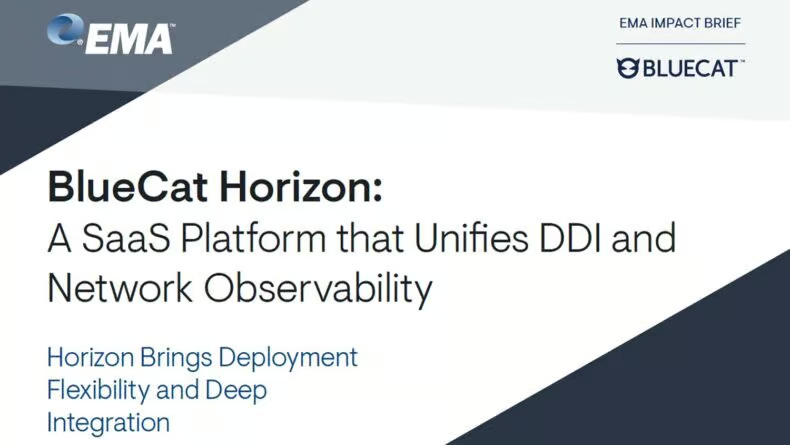
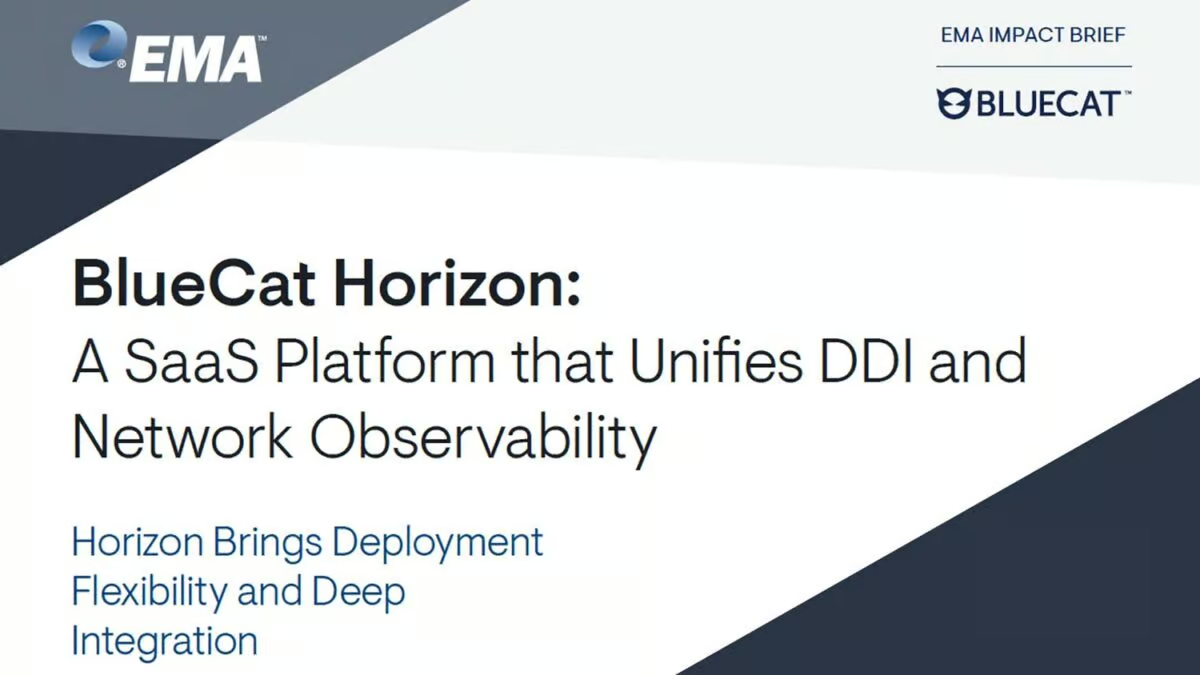
EMA evaluates BlueCat Horizon, highlighting unified DDI and observability, SaaS control architecture, and AI-driven integration benefits.
1 min·Blog
Read more →
· 08 — Paths forward
Which hybrid DNS forwarding path is right for your estate?
The right path depends on where your estate's center of gravity sits and what your immediate priority is: gaining visibility, modernizing on-premises without disruption, or running cloud-first DDI with observability. Most organizations progress iteratively, but the products divide cleanly by domain; choose the one that matches where your workloads and your risk actually live.
PATH 01
When hybrid sprawl has outpaced centralized awareness
Establish visibility and a single source of truth first
Consolidate DNS, DHCP, and IP data across on-premises and cloud into one authoritative system and enable query-level visibility before automating anything. This reduces IP conflicts and forwarder risk and creates the foundation for safe modernization.
Microsoft-centric estate, lean team, no appetite for rip-and-replace
Modernize on-premises in place with Micetro
Orchestrate cross-platform DNS and DHCP migration with wizard-driven, transactional workflows and pre-flight validation. Retire legacy Windows infrastructure gradually — even recovering scopes from offline hardware — while keeping a one-click rollback path.
Cloud-first or multi-cloud center of gravity, pursuing NetOps observability and automation
Run cloud and multi-cloud DDI with Horizon
Unify DDI and network observability on a SaaS platform so resolution data correlates with live telemetry for faster incident response. Keep control in the cloud while protocol services and telemetry stay in your chosen environments.
Common questions from teams designing hybrid and multi-cloud DNS forwarding.
Automate DNSSEC deployment so the signing scheme propagates across parent and child zones without manual key generation or trust-anchor redistribution, and validate configuration before applying changes. DNSSEC operates above the IP layer, so it behaves identically on IPv4 and IPv6 and does not change application-level resolution behavior.
No. A centralized approach integrates with cloud-native DNS where appropriate rather than replacing it, managing multi-path resolution once instead of through ad hoc per-environment rules. Cloud-native services keep handling in-tenant workloads while central DDI governs cross-environment resolution and visibility.
Large numbers of conditional forwarders concentrate tribal knowledge in a few specialists, delay service delivery, and increase outage risk while pushing teams toward shadow-IT workarounds. Prioritized, automated multi-path resolution from a single interface replaces brittle single-path rules and is far easier to maintain.
Yes. Transactional migration tools with pre-flight validation, lease preservation, and one-click rollback let you minimize or avoid downtime. Configuration conflicts and missing dependencies are caught before any change is applied, and a failed post-migration test returns the system to a known-good state.
No. Delegated administration models let cloud and DevOps teams provision within governed spaces under shared policy, so they retain agility without creating a bottleneck. A consistent DDI platform that synchronizes with cloud-assigned DNS and IP resources prevents conflicts while preserving a single source of truth.
Hybrid cloud DNS spans on-premises, private cloud, and public cloud resources, while multi-cloud means using more than one public cloud provider. An architecture can be both, which is why DNS forwarding must work across tenant, account, and VPC boundaries that each provider treats differently.
We’re using cookies on this website to improve your experience. Cookies help us learn how you interact with our website and remember you when you come back so we can tailor it to your interests.
To learn more about cookies and how we use them, read our cookie notice.
Some cookies are essential, while others help us to improve your experience by giving us insight into how you are using our website. You may adjust your preferences for non-essential cookies below.
To learn more about cookies and how we use them, read our cookie notice. You can also review our privacy policy for more details on the personal data we collect, use, hold, and disclose when you visit our website or use our products and services.
Functional cookies
Functional cookies are essential cookies that allow us to remember choices or changes you have made (such as to language settings or your choices regarding the use of cookies). These cookies cannot be turned off since they are essential for the operation of our Websites.
Analytics cookies
Analytics cookies are non-essential cookies that collect information on how visitors use our Websites. We use this information with your consent to measure the number of visitors to our Websites, determine whether specific content or communication has been viewed, and to help us improve our Websites and communication. These cookies can be turned off.
Personalisation Storage
Personalisation cookies are non-essential cookies that collect information when you fill out a form on this website. We only use this information with your consent to pre-fill other forms on the site. These cookies can be turned off.
Marketing cookies
Marketing cookies are cookies that are placed by third parties to collect information about your visits and actions on our Websites so that they or we can deliver ads to you later, such as when you are on certain third-party sites or platforms. These cookies may be used by those third parties to build a profile of your interests and show you relevant ads on other websites. These cookies also enable visitors to our Websites to share content on social networks and to enable and evaluate interactions with our communication and social media tools. These cookies can be turned off.