BlueCat Horizon explainer
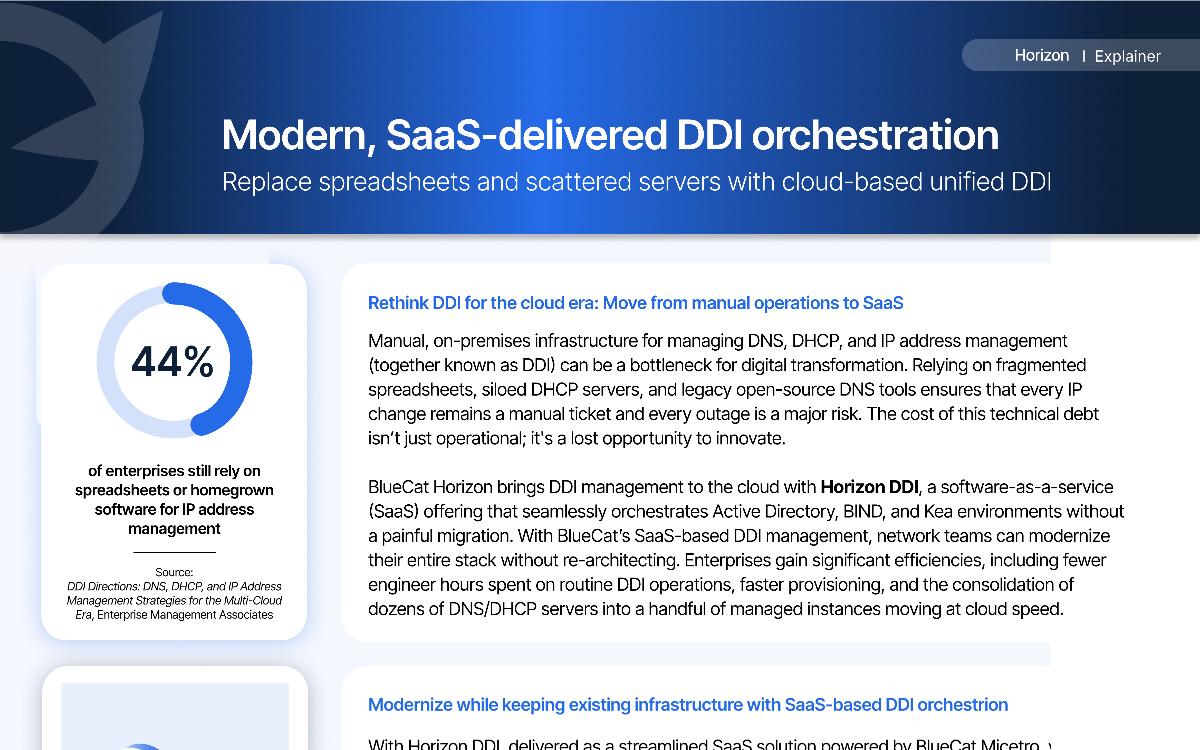
BlueCat Horizon is a SaaS-based DDI platform that unifies and automates DNS, DHCP, and IP address management across existing environments like Active…
Read moreDDI orchestration is a network automation practice that coordinates DNS, DHCP, and IP address management changes through a single automated workflow, typically via APIs and policy rules, to ensure that requests such as provisioning a host update addresses, leases, and name records together in the correct sequence. As networks grow across data centers, branches, and clouds, manual coordination of these three systems breaks down, leading to common failures such as duplicate address assignments, stale DNS records, and inconsistent naming conventions. DDI orchestration reduces repetition, enforces policy consistently, and provides audit trails, though it requires careful credential management, rollback logic, and comprehensive lifecycle automation to avoid orphaned entries and drift from out-of-band changes.

DDI orchestration places a workflow layer above the DNS, DHCP and IPAM systems. A request enters that layer, and the layer carries out each dependent change in the right order.
The exact steps vary by design, and some environments run them as event-driven updates instead of requests. Orchestration does not replace the underlying DNS, DHCP and IPAM services. It depends on their interfaces and on accurate IPAM data.
A workflow may reserve an address in IPAM and then fail while creating the DNS record, leaving an allocation with no name. Without rollback or retry logic, these orphaned entries accumulate and teams find them during audits.
Administrators who edit DNS or DHCP directly bypass the orchestration layer, so IPAM no longer matches the live servers. The result is duplicate assignments or records the workflow later overwrites or cannot find.
If naming rules differ between the orchestration layer and the cloud or ticketing tool that submits requests, requests are rejected or hosts receive names that break existing conventions. Reverse records may also fail to match forward records.
The orchestration layer often holds API credentials with write access to every zone and scope. A leaked or misused token can alter records broadly, so scoping credentials per function matters.
Teams automate provisioning but not teardown, so released hosts keep their DNS records and reservations. Stale names then point at addresses that are reassigned to other systems.