

DDI glossary

What is DDI Architecture?

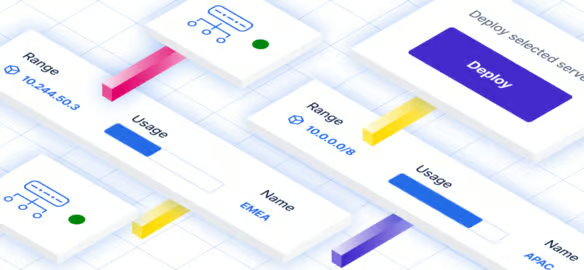
Abstract isometric UI showing network ranges, usage bars, region names (EMEA/APAC), and a purple "Deploy" button
Key takeawaysKey takeaways are generated with AI assistance. Because automated summaries can occasionally contain errors or miss important context, always refer to the full blog post for complete information.

DDI architecture integrates DNS, DHCP, and IP address management into one coordinated system that maintains a single source of truth for address and naming data across distributed servers in data centers, branches, and cloud environments. Organizations that manage these three functions separately face operational risks including stale DNS records, configuration drift, and provisioning delays, while a coordinated DDI architecture reduces manual errors, accelerates provisioning workflows, and improves security visibility through centralized policy and logging. Implementing DDI architecture requires attention to high availability for the management layer, preventing out-of-band changes that cause drift, handling overlapping address space in hybrid environments, and designing proper permissions and synchronization monitoring to ensure consistency across all DNS and DHCP servers.

  • A DDI architecture maintains a central IPAM database as the authoritative source of address data, with a management layer that automatically generates DNS zones, DHCP scopes, and configurations that are pushed to distributed servers, enabling administrators to make changes in one place rather than editing each server individually.
  • DDI architecture directly supports security and threat detection by providing centralized visibility of all assigned addresses to identify unknown devices, enabling consistent DNS policies and logging that reveal malware command traffic, and allowing DNSSEC implementation across zones when managed from a single coordinated system.
  • High availability must be designed into the management layer itself so that DNS and DHCP servers continue operating from their last known configuration if the central manager fails, because outages of these foundational services can cause application-level failures that are difficult to diagnose without proper redundancy in place.

DDI architecture at a glance

AttributeValue
CategoryNetwork management architecture
Primary useCoordinating DNS, DHCP, and IP address management from a shared source of address data
Related termsDDI, DNS, DHCP, IPAM, Dynamic DNS, Authoritative DNS server, DHCP scope

How DDI architecture works

A DDI architecture links three functions that are often run separately: name resolution, address assignment, and address tracking. The design centers on shared data and coordinated change.

At the core is an IPAM database that records address blocks, subnets, and assignments. A management layer turns that data into DNS zones, records, DHCP scopes, and options, then pushes the configuration to DNS and DHCP servers placed across data centers, branches, and cloud environments. When a DHCP server leases an address, the lease can be reported back to IPAM, and DNS records can be created or updated, for example through the dynamic update mechanism defined in RFC 2136. Administrators change data in one place instead of editing each server. Role-based access control, audit logging, and server redundancy are commonly built into the design, and APIs let automation tools and cloud platforms read and write address data.

Why DDI architecture matters in enterprise networks

Address and name data grow with every device, virtual machine, container, and cloud network. When DNS, DHCP, and IPAM are managed separately, records drift apart. Spreadsheets go stale, subnets overlap, and DNS entries point to addresses that no longer belong to the intended host. A coordinated architecture keeps one authoritative view, which reduces manual edits and the errors that come with them.

Operational impact is direct. DNS and DHCP underpin nearly every other service, so a misconfigured scope or a missing record can cause outages that look like application failures and take time to trace. Shared data also speeds provisioning, because a new subnet can be allocated, given a DHCP scope, and given matching DNS zones in one workflow. Automation through APIs extends this to cloud and infrastructure-as-code pipelines.

Security benefits follow from visibility and control. Accurate address records help identify unknown devices, and DNS is a common channel for malware command traffic, so central DNS policy and logging support threat detection. DNSSEC, defined in RFC 4033 through RFC 4035, adds signed responses but requires careful key and zone management. Without a central design, inconsistent policies and unaudited changes leave gaps that are hard to find.

DDI architecture vs DDI

DDI names the set of three functions (DNS, DHCP, and IPAM), while DDI architecture is the design that determines how those functions are deployed, connected, and kept consistent. What is DDI?

DDI architecture vs IPAM

IPAM tracks and manages address space, while DDI architecture also covers how DNS and DHCP servers consume that data and are deployed. What is IPAM?

AttributeDDI architectureIPAM
ScopeDNS, DHCP, and IPAM as one coordinated designAddress space planning, tracking, and allocation
Includes server placementYes, including distribution across sites and cloudsNo, it concerns the data rather than the servers
Includes service configurationYes, DNS zones, DHCP scopes, and optionsOnly as far as address data feeds them
Typical concernConsistency, resilience, and delegation of administrationUtilization, conflicts, and subnet planning

Common DDI architecture issues

If leases are not coordinated with DNS updates, records for departed hosts remain and new hosts inherit names that point to the wrong address. Symptoms include connections reaching the wrong device and reverse lookups returning old hostnames.

When the management layer is down, administrators cannot push changes, though servers usually keep answering from their last configuration. Teams often discover missing high availability for the manager only during an outage or a failed emergency change.

Engineers who edit a DNS or DHCP server directly bypass the central data, so the next push may overwrite the edit or the IPAM view may no longer match reality. Scope overlaps and missing records tend to appear after such pushes.

Merging sites, clouds, or acquired networks that reuse private ranges produces overlapping blocks that a single flat IPAM model cannot represent. Duplicate assignments then surface as intermittent IP conflicts and misrouted traffic.

Granting broad write access to the central system lets one mistaken zone or scope edit propagate everywhere. Failed or partial synchronization to a remote server can also go unnoticed without monitoring of deployment status.

See how unified DDI simplifies network operations

Manage DNS, DHCP and IP addresses from one platform with automation, visibility and control built in.

DDI architecture FAQ

Related terms

Article

DDI (DNS, DHCP, and IPAM)

DDI (DNS, DHCP, and IPAM) integrates DNS, DHCP, and IPAM into one management solution.

Learn more
Article

IPAM (IP address management)

IP address management (IPAM) is a method for planning, tracking, and managing IP address space on a network.

Learn more
Article

Network Source of Truth

A network source of truth is a centralized, trusted repository of network information maintaining accurate records of devices, IP addresses, subnets, and configurations.

Learn more
Article

DDI Orchestration

DDI orchestration coordinates DNS, DHCP, and IPAM operations to automate network services, streamline workflows, and maintain consistent network infrastructure.

Learn more
Article

High Availability (HA)

High Availability (HA) is a system design approach that aims to ensure a specified level of operational performance and uptime.

Learn more
Article

IP Address Lifecycle Management

IP address lifecycle management is the process of allocating, tracking, monitoring, reclaiming, and retiring IP addresses throughout their use in a network.

Learn more
Article

IP Address Conflict

An IP address conflict occurs when two or more devices on a network are assigned the same IP address, disrupting network communication.

Learn more
Article

Overlapping IP Address Space

Overlapping IP address space occurs when two or more networks use identical or intersecting IP address ranges, creating routing and connectivity challenges.

Learn more