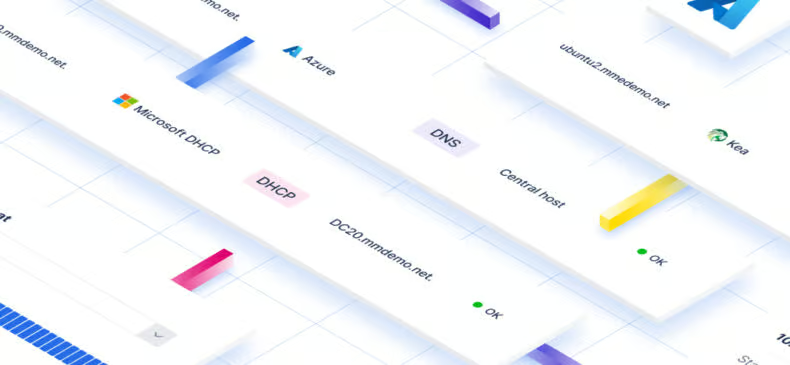
Hybrid and multi-cloud growth fragments DNS across Microsoft on-prem servers, native cloud DNS, and edge sites, creating IP conflicts, blind spots, and forwarding sprawl no single console solves alone. The durable fix is a control plane matched to your domain. Teams anchored in Microsoft on-prem and edge centralize with BlueCat Micetro as an overlay, no rip-and-replace. Teams whose center of gravity is cloud and multi-cloud orchestrate DDI from a SaaS foundation with BlueCat Horizon. Each governs its own domain and delivers one source of visibility and control there.
· 01 — Why native cloud DNS alone breaks in hybrid environments
Why isn’t native cloud DNS enough for a hybrid or multi-cloud enterprise?
Public cloud DNS services are designed to serve compute inside a single provider's tenant and lack the mechanisms to distribute or interoperate DNS data beyond those boundaries. In a hybrid or multi-cloud estate,
cloud DNS is unlikely to be the only DNS service an enterprise relies on, and treating it as one creates real availability, compliance, and security gaps.
Each cloud has different, conflicting, or missing support for zone delegation, recursion, and forwarding, and there is no name server interoperability for distributing zone data outside the cloud-delivered service. Providers historically vary on DNSSEC support, and reliance on a third party introduces outage risk for an essential network component. When that provider has an outage, the impact can be substantial.
Where cloud DNS is used without extending on-prem DDI, BlueCat sees four recurring outcomes: lost visibility into IP space that leads to conflicts and outages, separate cloud and on-prem DDI silos, complex forwarding rules that consume resources and invite misconfiguration, and suboptimal SaaS delivery that degrades user experience. Hybrid environments require centralized management of DNS, DHCP, and IP address management that cloud DNS does not provide.
Unsure about cloud DNS services and hybrid-cloud enterprises? Learn more with BlueCat, including why it isn't so simple for managing networks.
8 min·Blog
Read more →
· 02 — How can teams tell when free or bundled DNS is no longer enough?
How can teams tell when free or bundled DNS is no longer enough for enterprise networks?
Free or bundled DNS is no longer enough when ad hoc configurations, undocumented workarounds, and reliance on a few experts turn DNS into a fragile, hard-to-scale dependency.
At that point the operational risk and maintenance burden outweigh any license savings.
Relying on free DNS tends to produce non-standard configurations, custom scripts, and device-specific tweaks that only a handful of engineers fully understand. As hybrid initiatives, new applications, or acquisitions arrive, every change on that foundation requires more workarounds, raising the odds of misconfiguration, outages, and slow incident response because critical knowledge stays trapped in individuals.
The true cost of free Microsoft DNS combines administrator labor for DNS, DHCP, and IPAM changes, time spent firefighting unexpected issues, and the business impact of outages. A single disruption can cost hundreds of thousands of dollars, and at scale can lead to multi-million-dollar monthly losses. Treating those events as an unavoidable side effect obscures a measurable, recurring cost that can be modeled against modernization options.
3cost categories
3 cost categories
The true cost of “free” Microsoft DNS is the sum of administrator labor, firefighting time, and the business impact of outages — not the license price.
Wondering when to replace Microsoft DNS or other free DNS services? Learn the real costs, risks, and how to get more from Microsoft DNS without replacing…
6 min·Blog
Read more →
· 03 — Why does integrating cloud provider DNS with enterprise DNS change your architecture?
Why does integrating cloud provider DNS with enterprise DNS change your architecture?
Cloud provider DNS is a different beast than enterprise DNS.
Each provider abstracts underlying detail but implements DNS features and limits differently, which can quietly break existing enterprise DNS architectures if you assume they behave the same.
In hybrid designs the differences surface around role-based access, service tags and labels, provider-specific routing, and how DNS integrates with cloud-native load balancers and identity. These constructs change how traffic, telemetry, and incidents appear, because ephemeral IPs and identity-based policies alter how traffic looks the moment it crosses into on-prem networks — which matters for monitoring, source-IP tracking, and incident response.
Teams should adopt metadata-driven policy models based on identity, tags, and labels alongside legacy IP-based controls, and combine cloud fundamentals with hands-on labs to observe behavior. Organizationally, avoid a silo where legacy teams keep the lights on while a separate cloud group builds independently; involve DDI and firewall SMEs in cloud projects to share ownership of hybrid design.
Networking pros explore integrating enterprise and cloud DNS during the fifth Critical Conversation on Critical Infrastructure hosted in Network VIP.
67 min·Blog
Read more →
· 04 — Can encrypted and modern DNS standards hold together across a hybrid estate?
Can encrypted and modern DNS standards hold together across a hybrid estate?
Only with centralized policy.
DNSSEC and DNS over HTTPS solve different problems — DNSSEC provides origin authentication via a chain of trust, while DoH encrypts DNS transport for privacy — so they are complementary, not competing. Holding either together across a hybrid estate depends on consistent policy that spans otherwise fragmented platforms.
DNSSEC adoption has been slow primarily due to operational complexity and legacy compatibility concerns: administrators must manage signed zones, key material, and ongoing key rotation, while backward compatibility requirements bloated DNS and added more to break. DNS Flag Day was essentially a wake-up call to DNS providers to remove older, broken, non-compliant systems and support modern extensions like EDNS.
Encrypting DNS with DoH improves end-user privacy but hampers traditional enterprise monitoring that relies on plaintext DNS to detect threats, route traffic, and apply controls. It also concentrates resolution in a small number of public resolvers. Retaining visibility across a hybrid estate therefore requires a centralized layer that applies consistent controls, including DNSSEC, across what would otherwise be separate platforms.
25years
25 years
DNSSEC has existed for roughly 25 years, yet adoption stays slow because signing zones, rotating keys, and debugging broken trust chains remain operationally hard.
· 05 — What should teams look for in an approach to unify hybrid DNS management workflows?
What should teams look for in an approach to unify hybrid DNS management workflows?
Teams should look for an approach that adds a centralized management layer over existing DNS rather than replacing it — one that delivers unified visibility,
role-based delegation, workflow-based change control, and an incremental path to automation, while the DNS services teams already trust keep running underneath.
DNS rarely fails on technical merit; the strain is operational. As servers, zones, sites, and cloud services multiply, management fragments across native tools, spreadsheets, scripts, tickets, and the institutional knowledge of one or two senior admins. Adding more DNS infrastructure compounds this rather than solving it, so the right approach attacks the operating model instead of the platform.
Centralizing services, zones, records, and IP address data behind a single interface gives teams visibility into what exists and what changed, lets them delegate access by role without handing out full control, and applies consistent workflows to every change. Because the layer sits on top of existing services, there is no migration event. From that stabilized baseline, automation becomes a choice — codified incrementally through a REST API and infrastructure-as-code tooling such as Ansible and Terraform.
Simplify, automate, and gain visibility across your Microsoft DNS environment—without replacing what already works.
3 min·Blog
Read more →
· 06 — How do lean teams centralize on-prem and edge Microsoft DNS without a rip-and-replace?
How do lean teams centralize on-prem and edge Microsoft DNS without a rip-and-replace?
Lean teams centralize on-prem and edge Microsoft DNS by overlaying it with a management layer that consolidates DNS zones, records, and IP address assignments into a single interface.
BlueCat Micetro does this without replacing existing Microsoft DNS and DHCP servers, making it as easy to manage them at branch and edge sites as in the data center.
Fragmented management across on-prem servers and separate consoles makes consistency hard and lets IP conflicts and overlapping allocations accumulate — problems spreadsheets and disparate tools cannot track in real time. Micetro consolidates records and address assignments from on-premises infrastructure into one management interface, so teams see all zones, records, and allocations in one place and cut the risk of misconfiguration.
Micetro automates the workflows that eat engineering time: IP address assignments, subnet management, and DNS updates, plus automatic discovery of new zones and allocations as resources change. It enforces uniform DNS policies and provides audit logging to prevent unauthorized changes, giving lean teams centralized visibility, governance, and operational efficiency across on-prem and edge without disruptive migration.
1management interface
1 management interface
Micetro consolidates DNS zones, records, and IP address assignments from on-premises and cloud infrastructure — including Microsoft Azure and AWS — into a single management interface.
With Micetro, integrate, orchestrate, and automate your current DNS, DHCP, and IPAM network infrastructure via a single web interface.
5 min·Page
View Micetro →
· 07 — How do you orchestrate cloud and multi-cloud DDI from a single SaaS control plane?
How do you orchestrate cloud and multi-cloud DDI from a single SaaS control plane?
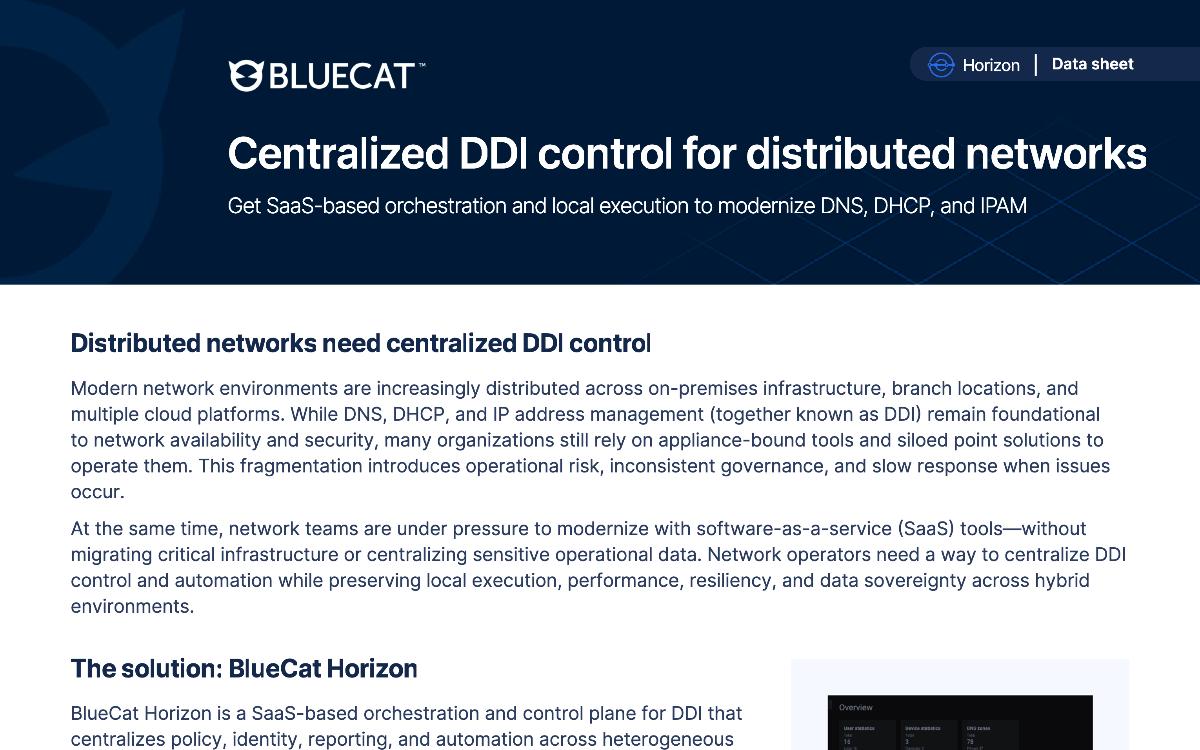
You orchestrate cloud and multi-cloud DDI by connecting your cloud DNS, DHCP, and IPAM systems to a SaaS-based control plane that centralizes policy, identity, automation, and reporting while services keep executing locally in each cloud.
BlueCat Horizon does this through lightweight, outbound-only agents, so your cloud and multi-cloud environments join one SaaS control plane without migration.
Modern estates spread DNS across multiple cloud platforms, and appliance-bound, siloed cloud DDI introduces operational risk, inconsistent governance, and slow response when issues occur. Horizon connects those cloud systems via lightweight agents and service points, applying consistent identities, policies, and automation while preserving native cloud workflows, local performance, and data sovereignty.
Bi-directional synchronization reconciles changes made centrally or locally, ensuring consistent state and auditable change across heterogeneous deployments. Built-in reporting surfaces IP utilization, DHCP lease activity, and configuration changes from selectively surfaced metadata, without full data ingestion or extra licenses. For estates whose center of gravity is cloud and multi-cloud, Horizon delivers one source of visibility and a path to AI-driven NetOps, without moving on-prem execution.
BlueCat Horizon is a SaaS-based orchestration and control plane that centralizes DDI policy, identity, reporting, and automation across heterogeneous,…
BlueCat Horizon is a SaaS-first Intelligent NetOps platform unifying DNS, DHCP, IPAM, security, and observability to automate modern network operations AI
6 min·Page
View Horizon →
· 08 — Paths forward
Which approach to unifying hybrid DNS management is right for your estate?
The right choice depends on where the immediate pressure sits, on-prem and edge Microsoft-centric operations or cloud and multi-cloud sprawl. Micetro governs the on-prem and edge Microsoft domain, Horizon governs the cloud and multi-cloud domain. The two paths below map to where your pressure sits today, and a true hybrid estate runs each in its own domain.
PATH 01
Lean team, Microsoft-centric on-prem plus branch and edge, no appetite for migration
Overlay on-prem and edge Microsoft DNS
Centralize services, zones, records, and IP address data behind one interface without replacing Microsoft DNS. Introduce role-based delegation and workflow-based change control first, then expand into automation through a REST API and infrastructure-as-code tooling when the time is right.
Growing Azure, AWS, or GCP footprint, cloud DNS silos, need visibility without moving operational data
Orchestrate cloud DDI from SaaS
Connect your existing cloud DDI through a SaaS control plane that preserves local execution in each cloud, reconciles changes with bi-directional synchronization, and surfaces built-in reporting for governance. This delivers cross-cloud visibility and a path to Intelligent NetOps without centralizing sensitive data.
True hybrid estate with real weight in both Microsoft on-prem and cloud
Run each domain on its own control plane
Use Micetro for the on-prem and edge Microsoft domain and Horizon for the cloud and multi-cloud domain, each governing its own territory. This gives you consistent policy and auditable change control within each domain without forcing on-prem into a SaaS plane or cloud into an on-prem overlay. Start with whichever domain carries the most immediate pressure and add the other when it does.
Common questions from teams unifying DNS across on-premises, cloud, and edge environments.
You unify DNS views by consolidating DNS zones, records, and IP address assignments from on-premises infrastructure and each cloud provider into a single management interface rather than working across separate consoles. Because native cloud DNS lacks name server interoperability for distributing zone data beyond its own tenant, a centralized layer that discovers and reconciles state across all environments is what actually produces one view.
The durable practice is a centralized, namespace-aware resolution layer that performs ordered, priority-based lookups and understands which namespaces reside in which environments, rather than relying on per-domain silos and fragile conditional forwarding rules. This reduces configuration sprawl, shrinks the number of touchpoints for changes, and enables consistent controls across on-premises, multiple clouds, and edge locations.
You manage dynamic DNS updates by centralizing DNS and IP address management on an automated platform that handles IP assignments, subnet management, and DNS updates, and automatically discovers new zones and allocations as resources are created or decommissioned. Automating these workflows removes the manual tracking that produces drift and misconfiguration in dynamic environments.
DNS-based deployment patterns rely on codifying record changes so traffic can shift between application versions in a controlled, repeatable way. The practical foundation is centralizing DNS behind one interface first, then codifying standard DNS operations incrementally through a REST API and infrastructure-as-code tooling such as Ansible and Terraform, so record changes become versioned, auditable automation rather than manual edits.
You consolidate multiple DNS and DHCP servers by adding a management layer that connects existing servers through lightweight agents or an overlay and centralizes zones, records, scopes, and IP data into one interface, while the underlying servers keep executing locally. This delivers unified visibility, consistent policy, and auditable change control without a rip-and-replace migration or the loss of local performance and resiliency.
No. Microsoft DNS rarely fails on technical merit; the strain is operational as environments scale. A management overlay adds centralized visibility, role-based delegation, workflow-based change control, and a path to automation through a REST API, Ansible, and Terraform while Microsoft DNS keeps running underneath — so teams centralize first and automate when ready, with no migration event.
We’re using cookies on this website to improve your experience. Cookies help us learn how you interact with our website and remember you when you come back so we can tailor it to your interests.
To learn more about cookies and how we use them, read our cookie notice.
Some cookies are essential, while others help us to improve your experience by giving us insight into how you are using our website. You may adjust your preferences for non-essential cookies below.
To learn more about cookies and how we use them, read our cookie notice. You can also review our privacy policy for more details on the personal data we collect, use, hold, and disclose when you visit our website or use our products and services.
Functional cookies
Functional cookies are essential cookies that allow us to remember choices or changes you have made (such as to language settings or your choices regarding the use of cookies). These cookies cannot be turned off since they are essential for the operation of our Websites.
Analytics cookies
Analytics cookies are non-essential cookies that collect information on how visitors use our Websites. We use this information with your consent to measure the number of visitors to our Websites, determine whether specific content or communication has been viewed, and to help us improve our Websites and communication. These cookies can be turned off.
Personalisation Storage
Personalisation cookies are non-essential cookies that collect information when you fill out a form on this website. We only use this information with your consent to pre-fill other forms on the site. These cookies can be turned off.
Marketing cookies
Marketing cookies are cookies that are placed by third parties to collect information about your visits and actions on our Websites so that they or we can deliver ads to you later, such as when you are on certain third-party sites or platforms. These cookies may be used by those third parties to build a profile of your interests and show you relevant ads on other websites. These cookies also enable visitors to our Websites to share content on social networks and to enable and evaluate interactions with our communication and social media tools. These cookies can be turned off.